![]()
Chapter 1
Market Research Basics
1.1Introduction to Market Research Process
Coherent and valuable market research follows a systemized approach. As such, like many other processes in life, it all starts with building a plan. While it is tempting to jump directly into “market research” and start collecting data, a detailed market research plan ensures that the data collected will be consistent and useful. As we will see in this chapter, market research must be planned beforehand to ensure consistency in the data that is collected, as well as to formalize the end point.
Market research without a coherent plan runs the risk of shifting midway through the process, or even having to start over. Also, a carefully planned study ensures that all stakeholders have the same vision of why the study is being done, and what it is trying to discover.
Consider the following example. Many years ago, an advertising agency I was working with was developing continuing medical education (CME) content for a big pharmaceutical company. I was tasked with surveying doctors on their interest in participating in online learning CME courses. The client pushed this project forward as he felt it was urgent, and we sent out a survey questionnaire to over a thousand doctors. As results started to trickle in, we realized that some critical data was not being collected. This happened because in the rush to get the survey out, expectations were not aligned between all the stakeholders involved in the survey. We had to stop the survey, redesign the survey questionnaire, and resend it to participants. On top of looking unprofessional, it was a loss of time, resources, and credibility.
A carefully crafted coherent plan enables the market researcher to plan from the beginning to the end, and ensures time will be used more efficiently.
On the importance of doing your own market research …
When we see the entrepreneur presenting a project with his own preliminary market research, it is a strong indication that he is proactively working to understand how his product fits in the market. He is moving beyond the technical applications of his innovation, towards its integration into the market, and it shows that he is determined to understand the issues beyond the lab. That is professionalism we favorably acknowledge.
Elizabeth Douville, Partner, AmorChem Financial Inc.
1.2Market Research Process
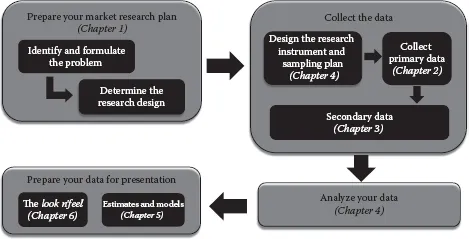
Before describing the market research process, I want to stress that there is no one unique market research process. Some researchers break down the process into 4 steps, while others use over 11 steps. Each researcher has their own approach and way of subdividing the process. I use a simplified process that consists of four steps (Figure 1.1).
Figure 1.1Market research process.
1.2.1Prepare Your Market Research Plan
Preparing your market research plan breaks down into two distinct steps: (1) Identifying and formulating the problem, and (2) determining the research design.
a.Identify and formulate the problem: The first step of the market research process is to identify and formulate the problem (or the opportunity). By formally defining the problem, the market researcher will focus his research effectively, ensuring that all participants share the same vision and objectives for the project. As such, the problem identification step will usually involve discussions with decision makers, a review of secondary data, and conversations with key opinion leaders.
The topic of research is usually defined in a few words. For example, it could be to identify emerging market opportunities for a new technology, the size and segment of the current market, or developing a customer profile.
b.Determine the research design: The next step is to determine the research design. It is the approach that you will use to collect your data, and will guide you in choosing the specific methods you will use to collect the information you need. Some key questions you will answer at this step are
Which method(s) will I use to collect data?
How will I connect with my data sample? Who will I need to connect with? How can I connect with them? Will I need to incentivize them? How?
Which data collection tools will I use (telephone, in-person, Internet)?
What is my total budget (both monetary and timewise)?
When determining your research approach, there are three types of research design you can choose. The three classifications are exploratory research, descriptive research, and causal research.
1.2.1.1Exploratory Research
Exploratory market research is akin to basic research in science. It is done to better understand a phenomenon, or when the existing knowledge that the organization possesses is too vague. It helps the organization gain some broad insight and to learn more, enabling it to gain familiarity on a topic and to conduct more precise research. Usually, exploratory research is qualitative in nature, and uses techniques such as secondary research, focus groups, and interviews.
To illustrate this, let me share an example of exploratory research I did a few years ago. A client was interested in expanding into a new geographic market, but did not know which specific technologies were used in the targeted territory. To find out, I researched the topic online (secondary research) and contacted a few key opinion leaders that have experience in the region (interviews). After this project, the client did not have a formal market appraisal, but he did have an appreciation of which technologies competed on the market, which companies were present, and some key trends that would help him decide if he wanted to explore this ...