- 208 pages
- English
- ePUB (mobile friendly)
- Available on iOS & Android
eBook - ePub
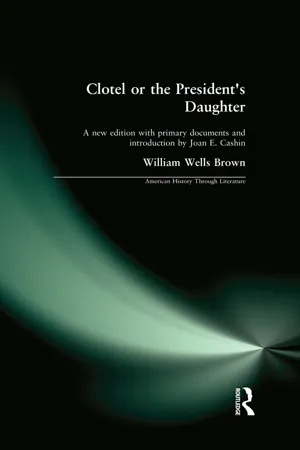
Clotel, or the President's Daughter
About this book
Originally published in 1853, Clotel is the first novel by an African American. William Wells Brown, a contemporary of Frederick Douglass, was well known for his abolitionist activities. In Clotel, the author focuses on the experiences of a slave woman: Brown treats the themes of gender, race, and slavery in distinctive ways, highlighting the mutability of identity as well as the absurdities and cruelties of slavery. The plot includes several mulatto characters, such as Clotel, who live on the margins of the black and white worlds, as well as a woman who dresses as a man to escape bondage; a white woman who is enslaved; and a famous white man who is mistaken for a mulatto. In her Introduction, scholar Joan E. Cashin highlights the most interesting features of this novel and its bold approach to gender and race relations. This volume, the latest in the American History Through Literature series, is suitable for a variety of undergraduate courses in American history, cultural history, women's studies, and slavery.
Information
GENDER, RACE, AND IDENTITY:
AN INTRODUCTION TO WILLIAM WELLS BROWN’S CLOTEL
William Wells Brown published this book, the first novel by an African-American writer, in 1853. The title character is a mulatto woman, one of two illegitimate daughters of President Thomas Jefferson. Abandoned by her father, Clotel is raised in Virginia by her slave mother. As a young woman, she becomes the lover of a white man; when he too abandons her, she is sold into slavery in the Old Southwest. Later she manages to escape, but when slave-hunters close in on her, she takes her own life rather than go back to bondage. The novel was greeted with considerable acclaim, and within a decade it went through four editions. Scholars have praised the work for its realistic depiction of the daily horrors of slavery and racism, and for its frank condemnation of the slaveholding founders of a democratic republic. Other critics have admired Brown’s further achievements as an author, for he published many books in his long life.1
But historians have yet to explore fully the fact that this novel is about women of color. This work is the first in American literature to concentrate on slave women. William Wells Brown focuses on the experiences of Currer; her mulatto daughters with Jefferson, Clotel and Althesa; and her quadroon granddaughters, Mary, Ellen, and Jane. Their destinies occupy center stage, and the complicated, mostly unhappy fates of these six women provide the foundation for the narrative. (The concentration on women distinguishes this book from Harriet Beecher Stowe’s Uncle Tom’s Cabin, with which it is often compared.) The novel resembles other mid-nineteenth-century works in that it is populated with many other characters whose lives are intertwined through implausible, melodramatic encounters. Like other books of its time, the narrative is interleaved with poems, newspaper articles, and autobiographical asides. Yet Brown never loses his focus on women of color and their distinctive suffering under slavery. He offers some bold assertions about gender, especially regarding the “nature” of black, mulatto, and quadroon women, and he also makes some extraordinary observations about race relations and identity.2
The author’s life yields a number of clues about how he came to be preoccupied with gender, race, and identity. Brown was the offspring of an interracial relationship, and he was so light-skinned that he was sometimes mistaken for Caucasian. Born in 1814 or 1815 on the Kentucky plantation of Dr. John Young, his mother was a slave named Elizabeth, and his father, George Higgins, was either Young’s half-brother or his cousin. So William was a blood relation of the man who owned him. His own father he scarcely knew, but Brown learned something about his other ancestors. His maternal grandfather, a mulatto slave named Simon Lee, had served with the Patriot army in Virginia during the Revolution. He also heard the rumor, probably from his mother, that his other grandfather was none other than Daniel Boone. (Even though the famous frontiersman lived in Kentucky for the last quarter of the eighteenth century, there is no evidence that Brown was his descendant.) Brown’s mother remained the center of his emotional life, and as a boy William could hardly bear to see her punished. As a teenager he once tried to help her escape, but they were both soon recaptured.3
His master John Young purchased a plantation in eastern Missouri in the 1810s, and William spent most of his life in bondage in the Mississippi River valley. Here he encountered all the cruelties that slavery visited upon bondsmen, wherever they lived. The blood tie with his owner made little difference in how he fared. Mrs. Young often mistreated the boy, and Dr. Young dealt him a thousand cuts. The master tried to give him another name (Sandford) after a white boy called William came to live in the household. To pay his debts, Young sold every one of the slave William’s close relatives (his mother, sister, and five brothers) to other slaveowners. He hired William out to several white men in the St. Louis area—a printer, a merchant, a professional slave-trader—and in this last position the slave worked on a boat that plied the Mississippi River trafficking in bondsmen. This experience had a deep impact on the young man.4
Here William saw slavery in one of its worst incarnations. Repeatedly he observed the destruction of families through the trade, and he vowed never to marry while he was a slave. He also glimpsed the special cruelty of slavery in the Old Southwest and years later told one of his daughters that “nothing could be worse” than bondage in Louisiana or Mississippi. He was so revolted by the drinking among the white men he met that he abstained from alcohol for the rest of his life. Perhaps most important, he acquired an unbreakable desire for freedom. On New Year’s Day, 1834, he ran away again, this time successfully, and headed north from Cincinnati across Ohio. Along the way a Quaker named Wells Brown befriended him, so the fugitive added that name to his own. For thirteen years he labored in the Lake Erie area as a steward and barber. He also assisted other runaway slaves, and after he moved to Boston in 1847 he became increasingly active as an abolitionist. His prominence in the movement forced him to make another escape, to England in 1849, to avoid capture by his former master. After making a smashing debut speech at a conference in Paris, he moved to Great Britain, where he lived for the next five years. He quickly resumed his abolitionist career, speaking, writing, and working with many prominent reformers. In London he penned Clotel and there the novel was published in 1853.5
Brown’s ideas about gender had begun to take shape long before that, when he was living on the Young plantation. He loved his mother, Elizabeth, very much, which is clear from his autobiography. He loved his sister, also named Elizabeth, almost as much. Although he grieved over losing his brothers in the slave trade, the losses of his mother and sister were the greatest sorrows of his young life. He never saw either one of them again, but through all his travails they served as his lodestar, the moral compass he steered by. He described both women as exemplary Christians who kept their faith in the midst of slavery’s brutality. William’s mother surely inspired the novel’s heartfelt portrayals of maternal devotion, whether it was Currer’s love for her offspring or Clotel’s sacrifices for her daughter. She probably serves as the model for the other women in the book who survive hardships with their integrity intact.6
The novel’s stalwart female characters are probably not drawn from Brown’s marriage to his first wife, Elizabeth Schooner. She came from an Afro-Dutch family who lived in upstate New York and northern Ohio. One of her relatives would later serve with distinction in the Union army in the Civil War, but otherwise it was an ordinary family. Elizabeth Schooner evidently grew up on a small farm in Seneca County, Ohio, and moved to Cleveland in the early 1830s. When the couple met in 1834, Brown fell passionately in love with her. (Perhaps it was just a coincidence that she shared the first name of his mother and sister.) They married that year after a brief courtship. Brown continued to love his wife during the first decade or so of their union. In fact, he later described himself as “infatuated” with her.7
The Browns had two surviving daughters, but their domestic happiness did not last. By the mid-1840s, Mrs. Brown had apparently become involved with another man. Around this time her husband also discovered that his mother-in-law and sister-in-law both had illegitimate children. According to William Wells Brown, the couple separated after Elizabeth threatened to leave him and abandon their children. She in turn declared that he was having extramarital affairs with white women, having forsaken her, his “sable wife.” We have no other commentary from Mrs. Brown about the marriage, and it is impossible to discern exactly how and when it broke down. But break down it did. William Wells Brown sent his daughters to school in Massachusetts and lived apart from his spouse until she died in Buffalo in 1851 or 1852.8
Every author is influenced by the wider world beyond personal experience, of course, and the cultural milieu of the antebellum North also affected Brown’s thinking about gender. By the late 1840s, he had resided for almost half his life in the urban North, and he imbibed most of its values to the full. He was a devout Protestant, a teetotaler, and he believed in hard work, self-denial, and self-reliance. He also absorbed the new ideas about “true womanhood” that developed among white Americans as the North underwent the first phases of industrialization and commercialization. When white men left the home to work for a salary, white women were expected to stay home and devote themselves to the children. The chief virtues of these “true women” were piety, purity, domesticity, and submissiveness. After Brown arrived in England in 1849, these assumptions were only confirmed, for the British had developed similar ideas about gender several decades before, when the Industrial Revolution began in that country. Not all free black Americans accepted these new ideas about gender or tried to emulate them; indeed, many could not because they were so poor that both spouses had to work for a wage. But by the time he wrote Clotel, Brown had embraced “true womanhood” as the model for all women. In the novel, he asserts that the black, mulatto, and quadroon female characters conform to its tenets. Women of color are no different from white women, he proclaims. They too are pious, chaste, devoted to the domestic sphere, and submissive to their partners.9
These attitudes now seem antiquated, even regressive, but in the 1850s it was a daring thing to apply them to black, mulatto, or quadroon women. In the previous two decades, so-called scientific racism made its appearance in the Western world, as writers in the United States and abroad employed pseudoscience to argue that black people were not even human beings. In reply Brown stated that women of color had the same inborn qualities as white women and shared the universal female “nature.” In the novel he portrays women of color as loyal and constant in love; willing to risk their own safety for their children; and loving their men with their whole hearts. (Brown simply chose to disregard his first marriage, which by his own account undermined the theory that there is an innate female nature.) He believed that they had the right and the capacity to be feminine by the standards of the day.10
Slavery posed an ominous threat to their purity, one of Brown’s urgent concerns in the novel. In the Old South, many white men purchased slave women for sexual partners or forced sex on women they already owned. Historians estimate that perhaps 10 percent of the four million slaves living in the South in 1860 had some white ancestry. The widespread incidence of miscegenation, or interracial sex, is also conveyed in the interviews with ex-slaves recorded by the Works Progress Administration in the 1930s. (Some of those interviews are excerpted at the conclusion of this volume.) Brown’s book emphasizes the point, especially how much black, mulatto, and quadroon women dreaded these encounters. Currer’s granddaughter Jane Morton is purchased for such a relationship and barely manages to escape it; another granddaughter, Ellen Morton, poisons herself rather than submit to one. Brown’s own daughter Josephine, born a free woman in the North, was almost certainly paraphrasing her father when she stated that one of slavery’s greatest evils was that it deprived women of the right of self-defense and left them at the mercy of any “licentious villain” who might buy them. These forced sexual relationships were one of the worst outrages that could be visited upon slave women.11
Brown is unsparing in depicting the tragic outcome of these relationships. The author had no proof that Thomas Jefferson fathered children with his slave Sally Hemings, but the story appeared in the national press during the Virginian’s first term as president and was known to many antebellum Americans. Historians do not agree on whether Jefferson sired Hemings’s mulatto children—in fact, some simply ignore the question—but other prominent white men, such as James Henry Hammond and Henry Grimké, fathered offspring with slaves. (Many white women in the Old South knew it, too, and deeply resented it. Mary Boykin Chesnut, a senator’s wife from South Carolina, cruelly remarked that white women lived “surrounded by prostitutes.”) In the novel Brown evidently chose the geographic location of Clotel’s death to underscore this point, for she is cornered near the home of George Custis, an heir of George Washington, when she decides to throw herself off a bridge. The author may have meant the reader to conclude that the legacy of these relationships would come home to haunt the republic one day.12
Yet William Wells Brown also believed strongly in romantic love when it was freely chosen by adults, and in this sense he was very much a man of his time. The Age of Romanticism promised men and women a sublime union of souls in marriage, and Brown proclaims that ideal throughout the novel. Again he chose to overlook his disappointing personal experience. (His second marriage, apparently a contented one, would take place in 1860.) He pauses early in the book to tell the reader that marriage is sacred, the foundation of civilization, and one of the most fulfilling relationships possible between human beings. He thought that men and women should seek out love, if it did not seek them out, descending upon them like a lightning bolt. His description of a white man named Carlton falling in love with a white woman—his heart pounded, he felt dizzy and short of breath—would have been familiar to many readers in the mid-nineteenth century. Despite Carlton’s reverie, the other white Southerners in the boo...
Table of contents
- Cover
- Half Title
- Title Page
- Copyright Page
- Table of Contents
- Series Foreword
- Gender, Race, and Identity: An Introduction to William Wells Brown’s Clotel
- Preface
- I The Negro Sale
- II Going to the South
- III The Negro Chase
- IV The Quadroon’s Home
- V The Slave Market
- VI The Religious Teacher
- VII The Poor Whites, South
- VIII The Separation
- IX The Man of Honour
- X The Young Christian
- XI The Parson Poet
- XII A Night in the Parson’s Kitchen
- XIII A Slave Hunting Parson
- XIV A Free Woman Reduced to Slavery
- XV To-Day a Mistress, To-Morrow a Slave
- XVI Death of the Parson
- XVII Retaliation
- XVIII The Liberator
- XIX Escape of Clotel
- XX A True Democrat
- XXI The Christian’s Death
- XXII A Ride in a Stage-Coach
- XXIII Truth Stranger than Fiction
- XXIV The Arrest
- XXV Death Is Freedom
- XXVI The Escape
- XXVII The Mystery
- XXVIII The Happy Meeting
- XXIX Conclusion
- Related Documents
Trusted by 375,005 students
Access to over 1.5 million titles for a fair monthly price.
Study more efficiently using our study tools.
Frequently asked questions
Yes, you can cancel anytime from the Subscription tab in your account settings on the Perlego website. Your subscription will stay active until the end of your current billing period. Learn how to cancel your subscription
No, books cannot be downloaded as external files, such as PDFs, for use outside of Perlego. However, you can download books within the Perlego app for offline reading on mobile or tablet. Learn how to download books offline
Perlego offers two plans: Essential and Complete
- Essential is ideal for learners and professionals who enjoy exploring a wide range of subjects. Access the Essential Library with 800,000+ trusted titles and best-sellers across business, personal growth, and the humanities. Includes unlimited reading time and Standard Read Aloud voice.
- Complete: Perfect for advanced learners and researchers needing full, unrestricted access. Unlock 1.5M+ books across hundreds of subjects, including academic and specialized titles. The Complete Plan also includes advanced features like Premium Read Aloud and Research Assistant.
We are an online textbook subscription service, where you can get access to an entire online library for less than the price of a single book per month. With over 1.5 million books across 990+ topics, we’ve got you covered! Learn about our mission
Look out for the read-aloud symbol on your next book to see if you can listen to it. The read-aloud tool reads text aloud for you, highlighting the text as it is being read. You can pause it, speed it up and slow it down. Learn more about Read Aloud
Yes! You can use the Perlego app on both iOS and Android devices to read anytime, anywhere — even offline. Perfect for commutes or when you’re on the go.
Please note we cannot support devices running on iOS 13 and Android 7 or earlier. Learn more about using the app
Please note we cannot support devices running on iOS 13 and Android 7 or earlier. Learn more about using the app
Yes, you can access Clotel, or the President's Daughter by William Wells Brown,Joan E. Cashin in PDF and/or ePUB format, as well as other popular books in Literature & Politics. We have over 1.5 million books available in our catalogue for you to explore.