eBook - ePub
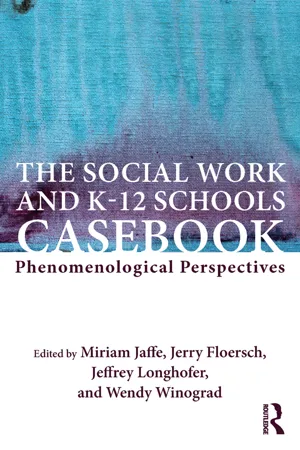
The Social Work and K-12 Schools Casebook
Phenomenological Perspectives
- 198 pages
- English
- ePUB (mobile friendly)
- Available on iOS & Android
eBook - ePub
The Social Work and K-12 Schools Casebook
Phenomenological Perspectives
About this book
This volume offers a collection of nine case studies from clinical social workers in K-12 schools, each from a phenomenological perspective, with the objective of educating Master of Social Work students and early career social work clinicians. Each chapter is framed with pre-reading prompts, reading comprehension questions, and writing assignments. This casebook provides a resource for understanding the range of practice in school social work as well as some of the challenges that school social workers face in today's complex world. Using a phenomenological perspective the contributors stay close to the lived experience of students, teachers, parents, and social workers, revealing a deeper and more nuanced understanding of the genesis and treatment of students' problems in school.
Information
1
INTRODUCTION
The Value of Case Studies in School Social Work
In recent years, the number of children and adolescents in school with psychiatric and medical diagnoses has dramatically increased. In addition, with the passage of the Americans with Disabilities Act (1990), schools are required to meet the varying needs of students with disabilities. As administrators, teachers, parents, and students themselves recognize the relationships among mental health, social skills, and academic achievement, schools are employing more and more social workers to intervene with students whose academic progress may be jeopardized by problems in the social environment (Fazel et al., 2014). In school settings, clinical social workers participate on child study teams, provide resources, counseling support, and psychotherapy. Here, we have gathered nine case studies that communicate the complexities and ambiguities of various aspects of this growing field. The case studies in this volume have been written for students and early career practitioners who are interested in the field of school social work. The author of each chapter is a seasoned expert, and thus, other experienced practitioners of school social work will find a familiar and galvanizing community at hand.
What’s in this Book?
We begin with Lynda Fabbo’s account of school social work on a child study team in “Educating Marta.” Her focus is a multiply disabled student whom Fabbo champions from kindergarten through high school—the entire course of Marta’s educational career in a public school district. Fabbo demonstrates how an astute early biopsychosocial evaluation can set a student’s trajectory toward success against all odds. She presents the nuances of school social work that are so often lost behind the scenes: how to navigate a conversation about special education with fearful parents, how to persuade resistant colleagues in an age of standardized testing, how to facilitate inclusion and accommodations mandated by an Individualized Education Plan, and how to emotionally support a student with special needs. What Fabbo does not include in this chapter are the notes and e-mails that she still receives from Marta, who writes with updates about college life. “Educating Marta” is a best-case scenario, yet throughout Fabbo’s narrative, we can feel the tensions underscoring all that might have gone wrong in launching and sustaining Marta’s academic success.
Academic performance and student behavior are often commingled priorities for school social workers. Thus, we turn next to Wendy Winograd, one of the volume’s editors, in a chapter that explores the school social worker’s role in understanding and managing social and emotional struggles. Proceeding from the assumption that behavior is an expression of inner desires, intentions, wishes, and fears, Winograd illustrates in three composite case examples how working from a psychoanalytically informed, attachment-based perspective allows a school social worker to intervene effectively when dysregulated children interfere with the classroom dynamic and with their own learning. Reluctant to label a child’s problematic behavior as pathological, she stresses the importance of collaborat-ing and working with teachers and parents in supporting a child’s normative developmental strivings. Moreover, Winograd notes the difficulties of conducting mental health services in a “host setting,” because the mission of a school does not always align with the goals of a clinical social worker.
This issue carries over into the assumption that in-house services are unnecessary in affluent school districts and private schools because students’ families likely have their basic needs met and can cover the costs of mental health services. Jessica Verdicchio, in her work with an adolescent girl, challenges the notion that more money means fewer problems. Verdicchio looks at how the school social worker as counselor navigates an environment rife with scholastic competition, mean girls armed with social media, and preoccupied parents who attempt to remedy their absence via therapeutic getaways to luxurious destinations without really taking time to know their own children. While affluent students must often keep up the facade of perfection everywhere else, the school social worker may often be the only one privy to the dynamics underlying eating disorders, cutting, and drug and alcohol addiction. With this case study Verdicchio takes the reader into the world of teens at risk of heightened levels of depression, anxiety, and suicide. She shows us how school social work is more necessary than ever before in affluent districts.
In “Healing In Loco Parentis: The Use of Schools as Therapeutic Communities,” Irma Sandoval-Arocho presents the opposite—perhaps more familiar—side of the coin, so to speak. In the urban school district where Sandoval-Arocho practiced, it was not uncommon for families to be torn apart by immigration, poverty, and institutional racism. She homes in on the story of Leo, a 9-year-old Latino immigrant whose broken family system led to his father’s suicide, to illustrate how the school in this community acted as a locus of caring. With the school social worker as central player, the school staff mobilizes to recognize Leo’s intergenerational trauma as well as the deep shame that overshadowed his grief. Sandoval-Arocho shows how a school functions as a therapeutic community, and how her role in that community required cultural competence, home visitation, and the transformation of in loco parentis from a disciplinary concept into a guardianship to keep children like Leo from suffering alone.
Eric Williams’s case study on alternative education program design further expands the boundaries of traditional school social work into the realm of administration. Using systems theory as a theoretical frame, Williams documents his innovative approach to transforming an entire school of at-risk adolescent students and the school staff into a unified family. His task required expertise in mental health, an understanding of adolescent development, knowledge of the cultural underpinnings of the community beyond the school, operationalizing a team of colleagues—and the skill to figure out how all of the moving parts could work together to promote academic achievement and social ability. He moved the school away from crisis management to create a wholly new context for student growth, drawing on the person-in-environment perspective to co-create a new culture in which students were empowered. As a result, students who needed special attention in order to thrive—who were set apart because they needed a better way to become integrated—got it not only from the school social worker and the school staff, but also from each other.
Part of what makes social workers successful in facilitating the inclusion of all people is their value to network knowledge. In “School Social Work and the Sexual and Gender Minority Student in the Twenty-First Century,” Russell Healy, an authority in LGBTQ issues, shares his experience as a school social work consultant when he is called in to oversee the case of Jay, a transgender high school student. A belief that transgender adolescents presented a “liability” because of a statistically higher suicide rate led Jay’s school administrators to urge the school social worker, Carmen, to refer Jay for services in the community. However, in consultation with Healy, who pushed for in-school counseling, Carmen was able to work with Jay in a school setting, thereby avoiding additional stigma by way of Jay’s segregation and isolation from the community. Here we see the results of Healy’s supervision of Carmen play out in transgender-affirmative case management. As Carmen learns how to help Jay, we learn the history of the LGBT student in schools, the resources to which school social workers can turn for further understanding LGBT students, why a GSA (Gay/Straight Alliance) is not for everyone, and some techniques that improve LGBT student outcomes. However, the most important takeaway from Healy’s case study is his assertion that each sexual minority student be treated as an N of 1: an individual within a specific context. And though we have come a long way, in many regions, in our awareness of gender dysphoria, we can do more to check our assumptions about LGBT students through self-reflexivity to recognize that the truest form of client engagement comes from admitting what one does not know.
These principles—self-reflexivity and humility over fragility—take on a similar shape in Alexis Kaliades’s chapter, “Rethinking Disciplinary Strategies: Reflections on White Privilege in School Social Work.” Kaliades examines how white privilege and a lack of cultural competence lead to a no-tolerance disciplinary system that reinforces oppressive power dynamics. Being a white social worker among students of color gives Kaliades the opportunity to grapple with the racism that affects the ways students respond to pressures in school. Kaliades’s structural role in that institution is revealed when her adolescent client, Tara, is repeatedly punished for the defensive behaviors that serve as a coping mechanism in her low-income neighborhood, whose inhabitants suffer from the effects of racial disparities. Tara lands regularly in Kaliades’s office, where Kaliades is expected to counsel Tara toward obedience, but through their conversations, Kaliades comes to understand how Tara’s race shapes her experience in ways that the staff—herself included—must work harder to recognize in order to implement fairer and more productive policies that actually serve to counteract staff burnout.
Ralph Cuseglio confronts burnout in a different way. When overwhelmed by an impossible caseload of individual student stressors, he turned to mindfulness meditation as a form of self-care. He then realized that the same mindfulness techniques he had been practicing could serve as the foundational coping mechanism for students; furthermore, the group therapy environment cut down on his individual caseload so that he could solve problems more efficiently. Cuseglio’s chapter on “Mindfulness Group Work in the School Setting” showcases the way he encouraged connectivity and compassion toward self and other in an age when people are more plugged into screens than to each other. Cuseglio models how to rationalize the purpose of a group, advertise a group, and manage group dynamics.
Finally, Karen Baker offers a look at the role of a school social worker in a preschool/kindergarten setting with a focus on her work with parents. While most non-therapeutic preschools do not offer social work services, Baker’s school depends on social workers to provide meaningful parenting education on the fly, in individual meetings, and in a parent group program. Proceeding from the belief that parents and teachers must be partners in a child’s development, Baker examines her work as a family coordinator, illustrating through two parent groups how a psychoanalytic perspective based on understanding the whole child in her whole environment is consistent with the basic social work principles of worth of the individual person and the importance of human relationships.
And the Assignment Questions?
While the case studies taken as a group offer an overview of school social work, each case can be read and studied individually. At the end of each chapter, therefore, we offer teaching resources to facilitate an in-depth encounter with the material in that case. The teaching resources fall into three main categories.
The pre-reading questions introduce general social work topics and help students to assess their own theoretical assumptions about those topics. As prompts for class discussion and/or quick writing exercises, the first set of questions is designed to reveal what students want to learn from reading: what they know and what they do not know. The questions ask students to define key terms and to think about how their own experiences will inform their reading before they even start. We encourage students to identify their preconceived notions and to track how their thinking changes through the act of reading a case study.
The close reading questions that appear after each chapter offer a framework to discuss, with attention to specific sets of words, the details in the case that drive the conceptual argument. Initially, the questions in this section ask for some summary as a way to test the students’ more basic understanding of the content. But the secondary close reading questions encourage students to explore the author’s motivations and scholarly perspectives.
Prompts for writing privilege the students’ voices. Students have been well trained to regurgitate the right answers, but this section puts a variety of answers into conversation with each other. These questions often pair case studies with other case studies and research articles so that students can evaluate how one set of ideas sits in relation to another set of ideas. These pairings often call for students to search the author’s references. Students are asked to generate their own ideas about what the case and its theoretical frameworks can teach them about important elements of their own practice. Most centrally, we want students to say why the case matters.
Why Narrative Case Studies?
Generalizations can tell us what school social work might look like, but generalizations are inherently reductive: they promote only stereotypes or caricatures. If you have decided to seriously explore the field of school social work, then you must closely engage with the lived experience of school social workers.
The idea that the narrative case study—a story of practice—is a significant form of knowledge production rests upon the following philosophical claim: practice takes place in open systems, and this reality means that the dominant research aim of generalization, or prediction, is often in tension with what happens in actual practice. Thus, all practice is case specific. The power of the case study is in its integrative potential for theory building and causal explanation. However, the case study can only build theory and causal explanation from context-dependent knowledge.
After all, the world of school social work is not actually made up of discrete agents—social workers and clients—who face each other making choices; in this view, reality is an aggregate of separately distinct acts. As many ecologists would argue, our existence is inevitably intertwined with our natural environments, which generalizable data often fails to capture, even with the best measures. Our aim here is for readers to enter an intersubjective world, not a subject/object world. Hence, each author featured in our text frames his/her case study as subject/object paired interactions. When school social workers choose interventions and explain them through writing, we must recognize the role of their interactive experience and interpretation.
Similarly, we must recognize that any individual social worker cannot control all of the variables in the cases that he/she depicts. Therefore, these case studies strive to capture the uncertainty of their circumstances. Andrew Sayer, in Why Things Matter to People (2011), writes that
events are not predetermined . . . yet when looking back at changes and explaining them, it is easy to imagine that what did happen was always the only things that could have happened . . . One of the temptations of social explanation is to suppress acknowledgements of the fact that at any instant, the future is open.
p. 15
The case study approach to examining school social work avoids the assumption that there is an end-point or predetermined goal in writing or reading a case study. The real value of the case study is that it does not pretend to control outcomes through these types of assumptions. Instead, the case study is, as Brandell and Varkas (2001) say, an “entree to information that might otherwise be inaccessible,” and its value “lies in its experience-near descriptions of clinical processes . . . Case studies provide examples of what already has been encountered and how difficult situations were handled” (pp. 376–377). To offer an example in a way that is “experience-near” requires in-depth self-reflexivity. The authors of this textbook display their self-reflexivity through the creation of narrative.
Why narrative? In Narrative Knowing and the Human Sciences (1988), Donald Polkinghorne defines narrative as “the fundamental scheme for linking individual human actions and events into interrelated aspects of an understandable composite” (p. 13). Narrative links events and connects ideas so that we can discover new knowledge as we create narrative and read it. As individuals, we have a great power to decide and explore what narratives mean, and then, by extension, why they matter to us. Our bodies, our identities, our memories, our cultures, our pasts are all filters for how we create and respond to narrative, and we become aware of such filters when we read and write. Even down to the element of plot, we are prone not only to interpretation through our filters, but also to being persuaded in ways that change our filters. A plot—especially if we think of the word in verb form, to plot—is something that an author chooses for a reason. The narrative theorist Ricoeur (1977) would say that the reason is to authenticate data and justify explanation. Narrative case studies do reason, authenticate, and justify by using practice as plot. Thus, narrative case studies, for our purposes, use plot to relay a sense of the school social work world, offering explanations for events that occ...
Table of contents
- Cover
- Half Title
- Title Page
- Copyright Page
- Table of Contents
- Notes on Contributors
- 1 Introduction: The Value of Case Studies in School Social Work
- 2 Educating Marta: A School Social Worker’s Role on a Child Study Team
- 3 Resuming the Forward Edge of Development: Psychoanalytically Informed School-Based Intervention
- 4 Finding Your “Selfie”: The New Crisis of the Affluent Adolescent in School
- 5 Healing In Loco Parentis: The Use of Schools as Therapeutic Communities
- 6 School Social Work Redefined: Alternative Education Program Design
- 7 School Social Work and the Sexual and Gender Minority Student in the Twenty-First Century
- 8 Rethinking Disciplinary Strategies: Reflections on White Privilege in School Social Work
- 9 Mindfulness Group Work in the School Setting
- 10 School Social Work with Parents: Developmental Guidance Groups in a Preschool Setting
- Index
Trusted by 375,005 students
Access to over 1.5 million titles for a fair monthly price.
Study more efficiently using our study tools.
Frequently asked questions
Yes, you can cancel anytime from the Subscription tab in your account settings on the Perlego website. Your subscription will stay active until the end of your current billing period. Learn how to cancel your subscription
No, books cannot be downloaded as external files, such as PDFs, for use outside of Perlego. However, you can download books within the Perlego app for offline reading on mobile or tablet. Learn how to download books offline
Perlego offers two plans: Essential and Complete
- Essential is ideal for learners and professionals who enjoy exploring a wide range of subjects. Access the Essential Library with 800,000+ trusted titles and best-sellers across business, personal growth, and the humanities. Includes unlimited reading time and Standard Read Aloud voice.
- Complete: Perfect for advanced learners and researchers needing full, unrestricted access. Unlock 1.5M+ books across hundreds of subjects, including academic and specialized titles. The Complete Plan also includes advanced features like Premium Read Aloud and Research Assistant.
We are an online textbook subscription service, where you can get access to an entire online library for less than the price of a single book per month. With over 1.5 million books across 990+ topics, we’ve got you covered! Learn about our mission
Look out for the read-aloud symbol on your next book to see if you can listen to it. The read-aloud tool reads text aloud for you, highlighting the text as it is being read. You can pause it, speed it up and slow it down. Learn more about Read Aloud
Yes! You can use the Perlego app on both iOS and Android devices to read anytime, anywhere — even offline. Perfect for commutes or when you’re on the go.
Please note we cannot support devices running on iOS 13 and Android 7 or earlier. Learn more about using the app
Please note we cannot support devices running on iOS 13 and Android 7 or earlier. Learn more about using the app
Yes, you can access The Social Work and K-12 Schools Casebook by Miriam Jaffe, Jerry Floersch, Jeffrey Longhofer, Wendy Winograd, Miriam Jaffe,Jerry Floersch,Jeffrey Longhofer,Wendy Winograd in PDF and/or ePUB format, as well as other popular books in Psychology & Mental Health in Psychology. We have over 1.5 million books available in our catalogue for you to explore.