eBook - ePub
51 Tools for Transforming Your Training
Bringing Brain-Friendly Learning to Life
- 240 pages
- English
- ePUB (mobile friendly)
- Available on iOS & Android
eBook - ePub
51 Tools for Transforming Your Training
Bringing Brain-Friendly Learning to Life
About this book
Brain-Friendly Learning is not about techniques and gimmicks. It is far more than just putting on baroque music, or playing fun games. It's a movement rather than just a method; a movement to recover the real joy of learning that combines both sizzle and substance to every part of your training. This resource provides a blueprint for a new generation of accelerated learning methods. At its heart are five key principles: ¢ Keep it real ¢ Facilitate the flow ¢ Honour uniqueness ¢ Make it rich and multi-sensory ¢ State is everything (well almost). There is a clear explanation of the theory behind Brain-Friendly Learning from the inside out; the concepts and learning models you need to underpin your approach, along with a journey through the most complex structure in the universe - your amazing brain. You'll also discover a concise guide to brain-friendly training design along with tools that you can pick and adapt to help you create new training events or make-over existing ones. This resource is packed with activities for the trainer or facilitator. Some are designed to help you understand a particular concept in more detail; others are designed to apply the concept to learning events which you are facilitating. You will have attended or facilitated (some) training sessions that engaged you, motivated you and left you with new insights and new techniques that you were just burning to try. At the time, you may not have been able to define what it was about these events that made them so special. This resource helps you to understand exactly what the mystery ingredient is and shows you how to use the whole encyclopedia of techniques that turn training into Brain-Friendly Learning.
Part One
Principles of brain-friendly learning
How to use Part One of the manual
Part One of the manual will help you understand what brain-friendly learning is all about.
The first section, ‘Brain-friendly learning from the outside in’, contains concepts and activities which demonstrate that nineteenth-century models of education and training may not be the most appropriate for the twenty-first century.
The second section, ‘Brain-friendly learning from the inside out’, takes you on a journey into the most complex structure in the universe – your amazing brain.
The remaining sections enable you to explore in detail the five principles of brain-friendly learning, which are:
- Keep it real!
- Facilitate creation not consumption
- Honour uniqueness
- Make it rich and multisensory
- State is everything (well… almost!).
Brain-friendly learning from the outside in
What is brain-friendly learning? It’s a philosophy, a movement and a wide variety of learning techniques for making learning (and the design of learning) faster, more fun and more effective.
Brain-friendly learning is based on the way in which people naturally learn, and seeks to recover the joy in learning that is missing for many people.
The nineteenth and twentieth centuries gave us many great gifts, but it also gave us the following models and paradigms:
- the factory model – assembly lines and compartmentalization
- the teacher as ‘expert’
- behaviourism and rat psychology (reward and punishment systems) – the ‘teacher’ provides the stimulus, the learner learns the appropriate responses
- paternalism and bureaucratic control
- over-reliance on cognitive, ‘left-brain’ learning processes
- competitive approaches to learning and assessment.
All of these have left their mark on the way in which learning is designed, delivered and evaluated.
Now that we’ve arrived at the twenty-first century, it’s time for a new paradigm.
Brain-friendly learning seeks to restore learners to the openness, flexibility, joy, sense of community and whole-bodied intelligence they had as children.
Brain-friendly learning environments tend to be positive, colourful, option-rich, collaborative, warm, multisensory and experiential.

Activity: Disease and cures
Look at the pictures overleaf showing what we believe are the five major ‘diseases’ of traditional training down the left-hand side, and the corresponding ‘cures’ on the right.
Make some notes in the middle column about what these pictures mean to you.
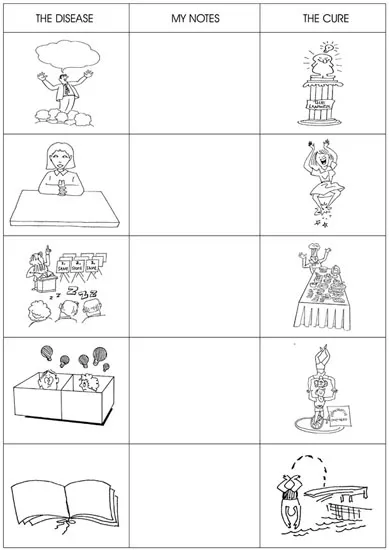
By the way, this activity also serves to demonstrate an excellent brain-friendly learning technique – that of asking learners to ‘make sense of’ relevant pictures and images, rather than just reading lots of text. How can you use this technique? What content might be ‘understood’ better by images or graphics?
Theoretical underpinnings
Brain-friendly learning has evolved from integrating a whole range of developments in our thinking and culture:
- The latest brain research. This has thrown into question many of our assumptions about learning – for example, we now understand much more about the role of the emotions in learning and memory.
- Our post-industrial culture. We now require less ability to store and memorize information – there is much more emphasis on the ability to think, collaborate, innovate and create value out of information.
- Howard Gardner’s challenging work on multiple intelligences1 – and the desirability of engaging all of these to inspire better and more lasting learning.
- The rise of emotional intelligence (EI or EQ) as a critical factor in business or personal success.
- Powerful advances in approaches to personal change and development – such as neuro-linguistic programming.
- The ‘experience economy’.2 Consumers now expect and deserve a rich, memorable and emotionally involving experience just as much when they are ‘learning’ as when they are enjoying a family holiday.
- The decline of behaviourism as the dominant psychology in learning, and the rise of more humanistic and holistic approaches.
- Research into learning styles – one size does not fit all. The work of David Kolb,3 Honey and Mumford4 and Bernice McCarthy,5 amongst others, all point to the important differences in the way people prefer to learn.
Brain-friendly learning from the inside out – your amazing brain!
- Your brain weighs about three pounds and is no bigger than a grapefruit, but it is more complex than any other known structure in the universe.
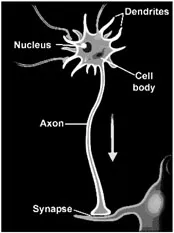
- The neuron is the primary building block of the brain: neurons carry electrical charges and make chemical connections to other neurons. Axons are long fibres that extend from the cell body and transmit messages. Dendrites are the short fibres surrounding the cell body that receive messages. Synapses are the tiny gaps between axons and dendrites that use chemical bridges to communicate.
- You have about 100 billion brain cells or neurons (give or take a few!). As it grows in the womb, a 12-week old human embryo is developing about 2000 brain cells a second!
- Compare this with an adult bee, which can do some pretty sophisticated things, such as building a honeycomb, calculating distances and communicating with other bees, and has a total of 7000 brain cells. (That’s the number of brain cells grown by a human embryo in about three seconds!)
- The total potential number of connections between cells, if written out, has been estimated at 1 followed by 10.5 million kilometres of noughts! There are more connections in the human brain than there are atoms in the universe!
- Learning has been defined as the establishment of new synapses, or the strengthening of existing ones.
- Learning and memory are based on the number of connections you have and how often you use them. Through repetition, nerve cells become connected and myelinated to recall information easily. Without occasional review or usage, the myeline begins to dissolve… Use it or lose it!
- Note the following proportions of different kinds of neuron:
- - sensory neurons (perceive stimuli) <10 per cent of total
- - motor neurons (control behavioural responses) <10 per cent of total
- - interneurons (process information, detect patterns and make meaning) >80 per cent of total.
These proportions strengthen the central principle of brain-friendly learning that training should not be about ‘giving information’ but rather about encouraging the making of meaning. After all, the original Latin meaning of education, ‘educare’, meant ‘to draw forth’. Learning must be active. It must involve making meaning, not merely memorization. - The mind-body connection is now a proven scientific fact. At a deep level you have the ability to communicate with every single cell in your body.

The big news is that intelligence is not fixed.
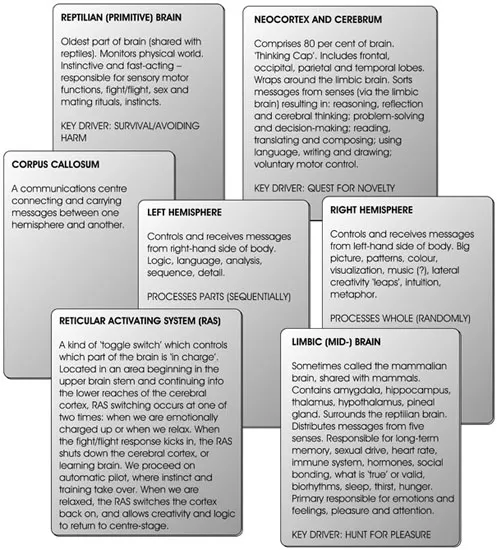
Not one brain … not two brains … but three brains!
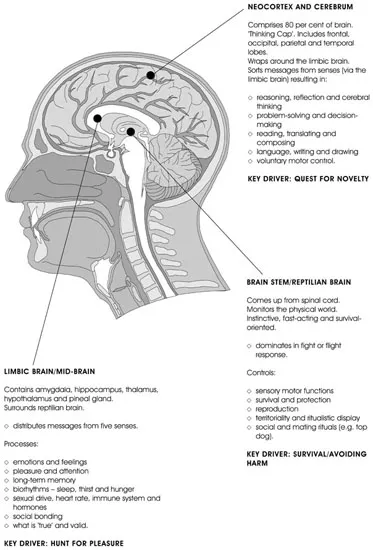
The component parts of the brain
Activity: Remembering the component parts of the brain
You’ll remember these component parts of the brain more easily if you:
- read each ‘card’ and find out what each part does
- think of a sound or noise that you would associate with each part
- think of an action that encapsulates that part of the brain.
In our brain-friendly learning workshops, we have different people ‘being’ the different parts of the brain and then the whole group ‘builds’ a brain at the front of the room – each making the sound and the action.
Now make the sound and do the action as you read the information.
Activity: So what?
Given what we know now about the human brain, what are the key implications for facilitators and d...
Table of contents
- Cover
- Half Title
- Title
- Copyright
- Contents
- Introduction
- Part One: Principles of brain-friendly learning
- Part Two: Brain-friendly design
- Part Three: Tools for brain-friendly learning
- References
- Further resources
Trusted by 375,005 students
Access to over 1.5 million titles for a fair monthly price.
Study more efficiently using our study tools.
Frequently asked questions
Yes, you can cancel anytime from the Subscription tab in your account settings on the Perlego website. Your subscription will stay active until the end of your current billing period. Learn how to cancel your subscription
No, books cannot be downloaded as external files, such as PDFs, for use outside of Perlego. However, you can download books within the Perlego app for offline reading on mobile or tablet. Learn how to download books offline
Perlego offers two plans: Essential and Complete
- Essential is ideal for learners and professionals who enjoy exploring a wide range of subjects. Access the Essential Library with 800,000+ trusted titles and best-sellers across business, personal growth, and the humanities. Includes unlimited reading time and Standard Read Aloud voice.
- Complete: Perfect for advanced learners and researchers needing full, unrestricted access. Unlock 1.5M+ books across hundreds of subjects, including academic and specialized titles. The Complete Plan also includes advanced features like Premium Read Aloud and Research Assistant.
We are an online textbook subscription service, where you can get access to an entire online library for less than the price of a single book per month. With over 1.5 million books across 990+ topics, we’ve got you covered! Learn about our mission
Look out for the read-aloud symbol on your next book to see if you can listen to it. The read-aloud tool reads text aloud for you, highlighting the text as it is being read. You can pause it, speed it up and slow it down. Learn more about Read Aloud
Yes! You can use the Perlego app on both iOS and Android devices to read anytime, anywhere — even offline. Perfect for commutes or when you’re on the go.
Please note we cannot support devices running on iOS 13 and Android 7 or earlier. Learn more about using the app
Please note we cannot support devices running on iOS 13 and Android 7 or earlier. Learn more about using the app
Yes, you can access 51 Tools for Transforming Your Training by Kimberley Hare,Larry Reynolds in PDF and/or ePUB format, as well as other popular books in Business & Business General. We have over 1.5 million books available in our catalogue for you to explore.