This is a practical, easy-to-use, patient-centred approach to e-communication that can be read from cover to cover, or dipped into as a quick reference guide. It covers potential issues both internally (patients and practice) and externally (the primary care trust and the wider community) and considers both clinical and non-clinical settings and is also a very useful teaching resource. e-Communication Skills adopts the approach that communication is the responsibility of everyone in the primary care team, and helps everyone to play their part.
This is an important book for healthcare professionals in primary care, including administrators and communications managers. It is also vital for healthcare e-organisations such as web based information services and networks, and policy makers and shapers.
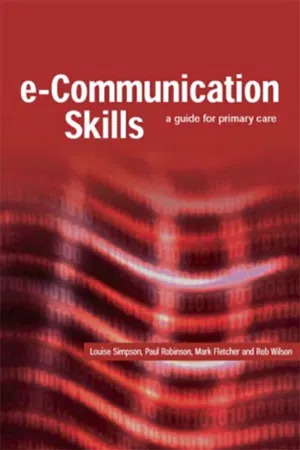
eBook - ePub
E-Communication Skills
A Guide for Primary Care
- 156 pages
- English
- ePUB (mobile friendly)
- Available on iOS & Android
eBook - ePub
E-Communication Skills
A Guide for Primary Care
About this book
Information
Part 1: Diagnosing the problem
1
About e-communication skills
What could be different?
There are always different ways to do things. The way we do things ‘round here’ might be how they have always been done, but new technologies, growing patient expectations and a changing society mean that they might not be the way we do things in the future. The banking system has changed, and, although it may not be fair to compare an essentially quantitative world with a vision for healthcare, there are lessons to be learned from this. Do I need to see the regional head of the bank to arrange a routine standing order? Do I have to arrange an appointment to see my bank statement, and pay a fee for the privilege? If I am truly responsible for my health – in the way I am responsible for my financial health – 1 need to be at the heart of the process. The consultation between the general practitioner and the patient is, for now, at the start, the middle and, often, at the end of things in healthcare, and even this represents a meaningful shift over the last 10 years, but there is further to go. The theme of trust will emerge again and again as we look at the way we do things round here – the way we communicate is through trust, the way information systems work for us needs trust, but, most of all, we need to trust patients to be at the centre of it all.
This book is about showing that communications are the responsibility of everyone in the primary care team; they are fundamental to patient care, practice administration, primary care trust management and population care. There is a range of resources and informatics available to enable primary care team members to enhance clinical and non-clinical communications, both internal (patients and practice) and external (primary care trust and the wider community).
The information age has changed the way we seek, consider and use data and knowledge, and has changed patterns of working and communicating. We can check our bank balance and do our shopping at any time on most days. The changes in healthcare are not just about access to information by people, patients, administrators, managers and clinicians, but also about the effect this has on interpersonal communications, decision-making and the wider business process.
Putting a computer on the desk in the consulting room – or taking a hand-held device to a 3 am call or assessment visit – not only allows the retrieval of important patient-centred information, but facilitates capture of the encounter experience and fundamentally affects the dynamics of the interaction. Can we ever say ‘just between ourselves’ when there is a computer in the room? Well, of course we can, but the need for mindfulness when communicating is ever more important as we consider its impact on the whole healthcare experience and the most profound need for information governance.
With domestic e-mail and internet access booming, the way patients seek advice, guidance and reassurance is changing. The quality of its content is variable, yet the world wide web still offers an opportunity for primary care. Patients’ expectations have altered – the computer is accepted as having its place in the care process – and still we must be attentive to the need for solid and sound information governance.
It has been reported that patients’ satisfaction with the National Health Service (NHS) increased by 27% in the weeks following the NHS 50th birthday celebrations in 1998. The standards of care being experienced were consistent with other episodes in the NHS story, but the unified communications campaign celebrating the unique role and place of the NHS was a single notable new factor.
The Association of Healthcare Communicators makes the following statement on its website (www.assochealth.org.uk):
The drive to strengthen communications across the NHS has never been more forceful as it sets about the task of delivering the targets set out in The NHS Plan.1 As Nigel Crisp, NHS chief executive, said in Shifting the Balance of Power:2 ‘Gone are the days when communications was a bolt-on activity. Now it is central to good management practice and crucial to building and maintaining public confidence in our health care system.’
Increasing numbers of publications, policies and contract negotiations are making the link between quality healthcare and quality communications. What does this mean for primary care?
The guiding principles here are formative, developmental and reflective.
Who is this book for?
This book has been written with a number of people in mind. First, our focus is on the primary care consultation, the encounter between clinician and patient (the term ‘patient’ is used to describe the role of the citizen in the process). From there, we consider the context in which these encounters take place, and consider the communications needs and skills requirements for the wider primary care team: the administrative support and management specialists who ail work towards that positive patient experience.
We also consider the opportunities and challenges offered by this e-world for healthcare communicators, recognising the contribution of this group in facilitating connection and well-being for the local population.
Lastly, we look through the window into the acute sector, and into the world of our local authority colleagues, and check out the real possibilities that modem informatics can offer, and try to signpost the pitfalls that might get in their way.
This book is a guide for primary care and covers the underpinning principles of communications, it also demonstrates how clinicians, managers and all members of the primary care team can exploit their informatics resources to enjoy and demonstrate excellence in communications.
How to use this book
This book has been written as an easy to use, dip in-and-out guide. It may be read from cover to cover, or you may choose to pick out one section and use that first. As well as being a guide to support individual knowledge development about both informatics and communications in primary care, it can also be used as a teaching resource, either as background reading or by using sections to prompt small group work.
References
1 Department of Health (2000) The NHS Plan. Department of Health, London. www.dh.gov.uk/assetRoot/04/05/57/83/04055783.pdf
2 Department of Health (2002) Shifting the Balance of Power: the next steps. Department of Health, London. www.dh.gov.uk/assetRoot/04/05/35/54/04073554.pdf
2
Introduction to e-communication skills
The context: communications
No one in primary care works in isolation. Communication is a foundation stone on which the clinician-patient relationship is based in primary care, and it is at the heart of the modernising NHS.
Good communication requires engagement, promotion, time and as much listening as speaking. Done well, it positively transforms both the clinician’s and the patient’s experience. Communication seems like an easy thing to do, yet it often heads any list of frustrations and complaints. So, with many millions of pounds being invested in the NHS information technology (IT) infrastructure, and accompanying service improvement, is a new communications paradigm emerging? What are the implications for those of us who work with patients? Will we need a new set of communications skills?
In 2003, the British Medical Association (BMA) published a consultation document Communication Skills Education for Doctors: a discussion paper, which stated that:
Good communication skills are recognised by the medical and other healthcare professions as central elements in demonstrating appropriate attitudes and professional development. The benefits of effective communication include good working relationships, increased patient satisfaction and improved health for patients. Undoubtedly, there are barriers to effective communication ranging from personal attitudes to the limitations placed on doctors by the organisational structures in which they work.1
The BMA rightly cites the artificial construct of the organisation as a potential barrier. But organisational boundaries will be overturned in the future. With the NHS Care Records Service, the vision of the patient-centred information record comes a step closer. The motto is ‘right information, right time, regardless of location’. Appropriate access to information, 24 hours a day, is the aim. A central data ‘spine’ will enable information-sharing across agencies, organisational structures, teams and professions.
With so much being spent on IT support for the care process, pausing for a moment to reflect on how to build on existing communications skills seems timely. The computer is as common as the stethoscope on the clinical desktop, but the new models found in ‘Connecting for Health’ (formerly the National Programme for IT (NPfIT), a means of driving forwards the implementation of modem information systems and technology across the NHS)2 will change the experience of using electronic health records for good. And if one of the barriers to good communications is conflicting advice, how can we manage in a world of information overload?
Combining the drive to computerise with recognition of the importance of quality communications is the starting point for this book. Quality communications – clinical, organisational and external – are the responsibility of everyone in the general practice team, and this book looks at what informatics resources are available to help to improve them and, therefore, the quality of patient care in the modernising NHS.
The context: informatics
‘Connecting for Health’ is changing the way healthcare computing is designed, built and operated. Five clusters structure management and implementation, and new communities and alliances are emerging as a result. The technical infrastructure is getting a mighty boost and the IT architectures that have dominated the NHS for over a decade are being replaced with a new technical model, the result of the largest procurement of IT systems ever undertaken. The NHS Care Records Service is just that – the NHS now buys a service, not systems.
The document, Delivering 21st Century IT for the NHS,3 was published in June 2002 and its aims were to connect the delivery of The NHS Plan4 with the capabilities of modem technologies, to:
- support the patient and the delivery of services designed around the patient, quickly, conveniently and seamlessly
- support staff in the delivery of integrated care, through effective electronic communications, better learning and knowledge management, cut the time to find essential information (notes, test results) and make specialised expertise more accessible
- improve the management and delivery of services by providing good quality data to support national service frameworks, clinical audit, governance and management information.
The key principle is that care services are designed around the needs of patients and service users, they are not based on NHS institutions.
The core of the strategy is to take greater control over specificatio...
Table of contents
- Cover
- Title Page
- Copyright Page
- Dedications Page
- Table of Contents
- Frontispiece
- Foreword
- About the authors
- About the contributors
- Acknowledgements
- Part 1: Diagnosing the problem
- Part 2: e-Communications in the clinical setting
- Part 3: Practical matters
- Part 4: Resource pack
- Index
Trusted by 375,005 students
Access to over 1.5 million titles for a fair monthly price.
Study more efficiently using our study tools.
Frequently asked questions
Yes, you can cancel anytime from the Subscription tab in your account settings on the Perlego website. Your subscription will stay active until the end of your current billing period. Learn how to cancel your subscription
No, books cannot be downloaded as external files, such as PDFs, for use outside of Perlego. However, you can download books within the Perlego app for offline reading on mobile or tablet. Learn how to download books offline
Perlego offers two plans: Essential and Complete
- Essential is ideal for learners and professionals who enjoy exploring a wide range of subjects. Access the Essential Library with 800,000+ trusted titles and best-sellers across business, personal growth, and the humanities. Includes unlimited reading time and Standard Read Aloud voice.
- Complete: Perfect for advanced learners and researchers needing full, unrestricted access. Unlock 1.5M+ books across hundreds of subjects, including academic and specialized titles. The Complete Plan also includes advanced features like Premium Read Aloud and Research Assistant.
We are an online textbook subscription service, where you can get access to an entire online library for less than the price of a single book per month. With over 1.5 million books across 990+ topics, we’ve got you covered! Learn about our mission
Look out for the read-aloud symbol on your next book to see if you can listen to it. The read-aloud tool reads text aloud for you, highlighting the text as it is being read. You can pause it, speed it up and slow it down. Learn more about Read Aloud
Yes! You can use the Perlego app on both iOS and Android devices to read anytime, anywhere — even offline. Perfect for commutes or when you’re on the go.
Please note we cannot support devices running on iOS 13 and Android 7 or earlier. Learn more about using the app
Please note we cannot support devices running on iOS 13 and Android 7 or earlier. Learn more about using the app
Yes, you can access E-Communication Skills by Simpson Louise,Robinson Paul,Fletcher Mark,Wilson Rob in PDF and/or ePUB format, as well as other popular books in Medicine & Health Care Delivery. We have over 1.5 million books available in our catalogue for you to explore.