Developing Young Children's Mathematical Learning Outdoors provides detailed guidance and practical advice on planning mathematical experiences for young children outdoors. By examining the key features of a mathematically rich outdoor environment, it illustrates how this can motivate children in leading their own learning and mathematical thinking.
Drawing upon the author's wealth of experience, the book provides support for students and early years' practitioners in developing a deeper understanding of how to plan quality experiences, which combine pedagogy with effective practice. Covering all aspects of mathematics, it identifies meaningful contexts and shows how adults can use open-ended questions and prompts to promote children's mathematical play outside.
With rich case studies and reflective questions included throughout, as well as suggestions for useful resources to put the ideas in the book into practice, it is essential reading for all those that want to develop curious and creative mathematical thinkers in the early years.
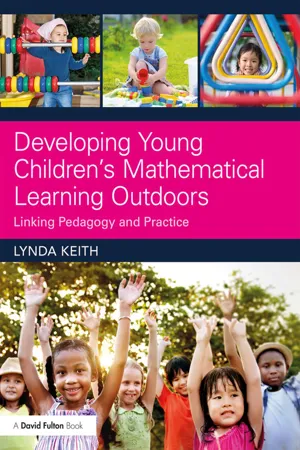
eBook - ePub
Developing Young Children’s Mathematical Learning Outdoors
Linking Pedagogy and Practice
- 144 pages
- English
- ePUB (mobile friendly)
- Available on iOS & Android
eBook - ePub
About this book
Information
1
What types of young mathematical learners do we want?
I think that we need more bricks. Hundreds and hundreds to go up to the sky.
—Nursery child recreating the Three Little Pigs’ house outdoors
There is an increasing focus on the potential for more outdoor play experiences for children at a time when many may have limited access and possibly more restricted learning indoors. With greater awareness of the importance of young children’s health and well-being, the outdoor environment has had recent increased focus on its potential for children’s overall development (Bilton, 2010). The Characteristics of Effective Learning in the Early Years Foundation Stage (EYFS) Statutory Framework in England (2012), Building the Ambition: National Practice Guidance on Early Learning and Childcare, Children and Young People (Scotland) Act 2014 (Scottish Government, 2014), the revised Foundation Stage in Wales (2008) and Northern Ireland Curriculum (CCEA, 2006) clearly identify the importance of young children’s learning on the need for play-based learning, exploration, building resilience, being active and engaged in the learning process, making decisions, making connections, thinking skills and creativity. All of these skills and dispositions are central to developing young children as mathematical thinkers and learners.
In addition, there has been wide-ranging exemplification within national guidance documentation and linked website pages to support practitioners in their practice. Getting It Right for Play: The Power of Play – An Evidence Base (2012) commissioned by Play Scotland discusses how children’s play patterns in the outdoors have changed over time as many play spaces for children have become restricted. This document sets out the power of play in the outdoors for children’s overall development. At a national level, Play Scotland is supporting play for all children and young people as part of the wider Scottish Government’s Play Strategy. Similarly, the national charity Learning through Landscapes in England, Wales and Northern Ireland (Grounds for Learning) in Scotland supports schools and settings to enrich childhood by improving outdoor spaces. Its paper on core values for high quality outdoor experiences for young children identifies ten key features further explored in White et al. (2011). Each of these vision and value statements could also be clearly linked to the mathematical potential in the outdoors.
There also still remains a widespread culture of fear of maths at the adult level, and this has provided even more focus on the need to develop growth mindsets in young children. We know that they will learn best when they are happy, secure and can learn through play where there are no mistakes. How many of us may still have a fear of our own learning in maths – scared to try, unsure of what to do and quite a negative attitude which can remain with us for a long time? Boaler (2015) reminds us that we can’t know what mathematics our children will need in the future but that the best preparation is to develop their mathematical ideas and help them to think in a flexible way, promoting problem solving and creativity.
The perception that it is OK to be ‘no good at maths’ and the many negative attitudes to maths in society are being increasingly challenged. The All Party Parliamentary Group for Maths and Numeracy (2016) identifies the difficulties for many parents to engage in mathematical experiences in the home due to embedded attitudes. The groups’ paper on Maths and Numeracy in the Early Years concurs with the need to ‘raise the profile of maths and encourage the development of mathematical thinking in young children.’ It highlights the need to incorporate play into maths and the development of more concrete experiences for young children, especially in developing counting skills and a deeper understanding by practitioners in this key skill of number sense. In Scotland, one of the key areas for change comes from the Making Maths Count Group (2016) and focuses on transforming public attitudes to maths and in creating greater enthusiasm for maths as a vital life skill.
Based on our own experiences, it is also true that we can often focus on quite a narrow view of maths in our observations of children’s play and can jump in too quickly with a question that we consider to be appropriate, e.g. ‘How many is that?’ when the child is not even considering the abstract nature of counting or whether it has a purpose in the nature of their play situation. We tend to see the maths curriculum as separate aspects, i.e. counting, shape, pattern, measure and information handling, but to the young child it is all learning. So in planning to meet their needs, we have to understand the links and connections in early mathematics, which will in turn help children to develop key skills and the confidence to apply their new-found knowledge and skills in different contexts. Central to developing our young learners is their motivation as mathematical thinkers, talkers and recorders – all of which will be necessary as the foundation of later learning in mathematics. Pound (2008) reminds us of the importance of these key aspects which will be further explored in Chapter 3. There is also a sense of maths being a boring subject and not in the least creative. On the contrary, Devlin (2000) argues that maths is full of creativity and about life. In thinking of maths only in terms of a worksheet or task to be completed, we risk gaining a full understanding of what children already know about the world and lose the possibilities to make ‘the invisible visible’ (Devlin, 2000) through quality interactions and appreciating this part of childhood as a time in its own right.
I spent a wonderful session with some 4-and-a-half-year-olds who had just started school, talking about what they knew about numbers, where they could find numbers and what numbers were for. Each child brought something different to these questions as they talked about their ages ‘I’m 4 and will be bigger when I’m 5, but my brother is bigger still and he’s 8’; numbers on buses ‘I go on the number 45 ’; and ‘I like big numbers. They’ve lots of zeros’ . It brought me back to my firm belief that children have rich previous experiences upon which to build, but the most effective memories that children create are those that are truly embedded in their play with experiences in number, shape, measure and sorting and embedded in their own contexts to give real meaning. I am also more conscious of using the term ‘experiences’ rather than ‘activities’. Influenced by Moyles (2013) and Building the Ambition (Scottish Government, 2014), experiences have a more qualitative feel for child-led learning, with deeper thinking involved than activity which may still be rich in learning but has the possibility of being highly planned with a very definite outcome in mind.
I have asked staff and students about the types of young mathematical learner we want to develop on many occasions, and their very varied responses are listed in Table 1.1.
In then asking about how young children learn best and develop a sound mathematical awareness, the following comments have been made, as shown in Table 1.2.
Table 1.1 What types of young mathematical learners do we want?
| • Confident, engaged, focused |
| • Eager, motivated, enthusiastic |
| • Curious, investigative, inquisitive |
| • 'Have-a-go' attitude, resilient, tries different ways to solve a problem, risk taker |
| • Likes and seeks out challenges |
| • Open to suggestions |
| • Imaginative, creative |
| • Communicative, wants to talk about their learning |
| • Thinks things through, plans, predicts |
| • Sees real purposes for sorting, counting, measuring in contexts that make sense |
| • At times independent, but also cooperative and collaborative |
Table 1.2 How do young children learn best and develop a sound mathematical awareness?
| • By being actively engaged in their learning |
| • In rich play experiences |
| • Using open-ended resources which help them think differently |
| • Making choices and decisions about what they need |
| • With problems and challenges that are meaningful and playful to them |
| • Communicating in different ways ' sometimes talking and reflecting; representing their ideas through mark making; sometimes revisiting their ideas |
| • By watching others and sharing ideas |
| • Getting a feel for numbers in their own way |
| • Starting with child-led ideas which are followed through by responsive adults |
The outdoor environment should complement the mathematical learning occurring indoors, have equal value and offer mathematical opportunities which can’t be:
- achieved indoors, e.g. due to restriction in size and scope of materials. This would include the use of construction with large crates and pallets, experiences that will take up an extended space, water and sand investigations which extend beyond one indoor water tray to enable exploration of longer tubing and linking builders’ trays or connecting to a hose pipe. Learning mathematically outdoors will also enhance the experiences of real seasonal change and the understanding of time, which can be more limited in scope through pictures indoors. If early mathematical awareness requires children to make links, where can it be done more effectively than in this context?
- achieved in the same way, e.g. selection of loose parts for creative investigations, sorting with different resources in different ways, measuring for different purpose...
Table of contents
- Cover
- Title
- Copyright
- Contents
- List of illustrations
- Acknowledgements
- Introduction
- 1 What types of young mathematical learners do we want?
- 2 What are the key features of a mathematically enriched outdoor environment?
- 3 What knowledge, skills and understanding are children developing through their play outdoors?
- 4 How can we support young children in their learning?
- 5 What resources can support and enhance mathematical learning outdoors?
- 6 How can we plan for effective learning and quality experiences?
- 7 Drawing conclusions and taking it forward: implications for your own professional development
- Index
Trusted by 375,005 students
Access to over 1.5 million titles for a fair monthly price.
Study more efficiently using our study tools.
Frequently asked questions
Yes, you can cancel anytime from the Subscription tab in your account settings on the Perlego website. Your subscription will stay active until the end of your current billing period. Learn how to cancel your subscription
No, books cannot be downloaded as external files, such as PDFs, for use outside of Perlego. However, you can download books within the Perlego app for offline reading on mobile or tablet. Learn how to download books offline
Perlego offers two plans: Essential and Complete
- Essential is ideal for learners and professionals who enjoy exploring a wide range of subjects. Access the Essential Library with 800,000+ trusted titles and best-sellers across business, personal growth, and the humanities. Includes unlimited reading time and Standard Read Aloud voice.
- Complete: Perfect for advanced learners and researchers needing full, unrestricted access. Unlock 1.5M+ books across hundreds of subjects, including academic and specialized titles. The Complete Plan also includes advanced features like Premium Read Aloud and Research Assistant.
We are an online textbook subscription service, where you can get access to an entire online library for less than the price of a single book per month. With over 1.5 million books across 990+ topics, we’ve got you covered! Learn about our mission
Look out for the read-aloud symbol on your next book to see if you can listen to it. The read-aloud tool reads text aloud for you, highlighting the text as it is being read. You can pause it, speed it up and slow it down. Learn more about Read Aloud
Yes! You can use the Perlego app on both iOS and Android devices to read anytime, anywhere — even offline. Perfect for commutes or when you’re on the go.
Please note we cannot support devices running on iOS 13 and Android 7 or earlier. Learn more about using the app
Please note we cannot support devices running on iOS 13 and Android 7 or earlier. Learn more about using the app
Yes, you can access Developing Young Children’s Mathematical Learning Outdoors by Lynda Keith in PDF and/or ePUB format, as well as other popular books in Education & Early Childhood Education. We have over 1.5 million books available in our catalogue for you to explore.