eBook - ePub
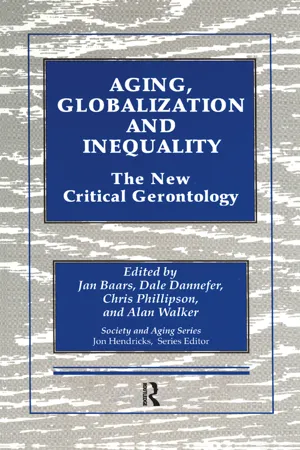
Aging, Globalization and Inequality
The New Critical Gerontology
- 304 pages
- English
- ePUB (mobile friendly)
- Available on iOS & Android
eBook - ePub
Aging, Globalization and Inequality
The New Critical Gerontology
About this book
This book is a major reassessment of work in the field of critical gerontology, providing a comprehensive survey of issues by a team of contributors drawn from Europe and North America. The book focuses on the variety of ways in which age and ageing are socially constructed, and the extent to which growing old is being transformed through processes associated with globalisation. The collection offers a range of alternative views and visions about the nature of social ageing, making a major contribution to theory-building within the discipline of gerontology. The different sections of the book give an overview of the key issues and concerns underlying the development of critical gerontology. These include: first, the impact of globalisation and of multinational organizations and agencies on the lives of older people; second, the factors contributing to the "social construction" of later life; and third, issues associated with diversity and inequality in old age, arising through the effects of cumulative advantage and disadvantage over the life course. These different themes are analysed using a variety of theoretical perspectives drawn from sociology, social policy, political science, and social anthropology. "Aging, Globalization and Inequality" brings together key contributors to critical perspectives on aging and is unique in the range of themes and concerns covered in a single volume. The study moves forward an important area of debate in studies of aging, and thus provides the basis for a new type of critical gerontology relevant to the twenty-first century.
Information
CHAPTER 1
Introduction: Critical Perspectives in Social Gerontology
This book is the product of our shared conviction that mainstream social gerontology has paid insufficient attention to the degree to which age and aging are socially constituted (Baars, 1991) and to the ways in which both age and aging are currently being transformed as a result of the set of social forces surrounding processes of globalization. The neglect of critical analysis has weakened attempts to understand the social processes involved in shaping age and the life course and, consequently, the creation of alternative conceptions and visions about the future of old age. This failure must itself be linked to general inadequacies of theory building within gerontology, a deficiency shared across both European and North American studies of aging (Bengtson & Schaie, 1999; Biggs, Lowenstein, & Hendricks, 2003; Birren & Bengtson, 1988; Lynott & Lynott, 1996).
Despite its explosive development over the last half-century, social gerontology has been characterized by an imbalance between the accumulation of data and the development of theory (Bengtson, Rice, & Johnson, 1999; Hendricks & Achenbaum, 1999; Riley & Riley, 1994). Researchers interested in aging have relentlessly collected mountains of data, often driven by narrowly defined, problem-based questions and with little attention to basic assumptions or larger theoretical issues. An absence of theoretical development is surely not surprising for a fairly young enterprise that seeks to capture a complex empirical reality; especially one that draws from many disciplines, and that is preoccupied with urgent practical problems (Hagestad & Dannefer, 2001). Yet the lack of attention to theory has meant that research questions have often been informed by an uncritical reliance on images and assumptions about aging drawn from popular culture or from traditions and paradigms of theory that are considered outdated within the broader discourses of behavioral and social theory. When such assumptions are used to guide the formulation of research questions and research designs, the result can be what has been termed “dust-bowl empiricism” (Birren, 1988), unintended reductionisms or other fallacies that misspecify the level of analysis and, therefore, missed opportunities to pursue the most revealing aspects of the subject matter in question (Hendricks, 1999).
Yet without question, several major gerontological paradigms of the late 20th century have contributed fundamental insights to inform theoretical development. These include, for example, the principles underlying cohort analysis and the interplay of demographic and economic forces, which in turn reflect the importance of history and social structure. These paradigms have included age stratification (Riley, Johnson, & Foner, 1972), life-course theory (Elder, 1974), life-span development (Baltes, 1987), and the first paradigmatic source of critical gerontology, political economy (Estes, 1979; Minkler & Estes, 1999; Phillipson, 1982; Walker, 1980, 1981).
Although these important traditions of thought have contributed organizing principles that have become classic in their influence upon both theoretical and methodological questions, with the exception of political economy approaches they do not claim to provide specific theoretical guidance. Instead, they provide some bedrock elements that must be included in any adequate theory, such as the importance of cohort flow and cohort succession, the tension between agency and structure, and the complexities involved in the articulation of individual and social change.
Moreover, almost all of these approaches have been appropriately criticized for their lack of attention to the actual experience of aging. By definition, such approaches give little attention to interpretive phenomena, such as the rich and complex fields of experience, consciousness, and action (Gubrium, 1993). As human phenomena, both age and aging are, by definition, experiences that are laden with meaning, and it is now understood that the dynamics surrounding the interpretation of events can have powerful effects on health and physiology (Ryff & Marshall, 1999). Yet many research traditions focused at the individual level are also problematic. First, some popular conventional approaches, such as exchange theory (Bernheim, Schleifer, & Summers, 1985; see Bengtson, Parrott, & Burgess, 1997), rational choice theory (Cromwell, Olson, & Avary, 1991), or socioemotional selectivity theory (e.g., Carstensen, Fung, & Charles, 2003), deal with meaning only in within narrowly formulated terms.
Second is research in the psychodynamic and psychoanalytic traditions. Much of this work deals more directly with experience and meaning, psychodynamic and psychoanalytic traditions. Much of this work deals with experience and meaning, but with a universalizing impulse that forces data into prefigured categories and patterns. Such approaches include Tornstam’s (1996) exploration of gerotrans-cendence as a form of personal integration and Levinson’s (1994) theories of adult development. Such approaches do justice neither to the complexities of data on the one side nor to the range of outcomes found under diverse social conditions on the other (Dannefer, 1984; Morss, 1995).
In response to such approaches, a third set of analyses have sought to make the diversity of experience and the contingency and uncertainty of meaning— phenomena that are closely allied with the theme of social change—into integral parts of theory. These include narrative approaches (Gubrium, 1993), work in the “risk society” tradition (Beck, 1992; O’Rand, 2000) and the related “postmodern” or “poststructural” accounts (Gilleard & Higgs, 2000; Gubrium & Holstein, 2002). These approaches seek to draw on humanistic and critical elements in social theory that have rightly been viewed as missing from the mainstream contemporary discourse in social gerontology (Cole, 1993).
Thus, in contrast to the traditional lament of a dearth of theory, social gerontology is now courted by numerous theoretical suitors. Despite the valuable and often provocative insights generated by each of these perspectives, our shared conviction is that none of these approaches, taken alone, provides an adequate paradigm or conceptual basis for theorizing aging.
This is the case, even though some of these approaches have effectively identified the limitations of others. For example, the discovery of cohort analysis (Riley et al., 1972; Ryder, 1965; Schaie, 1965) and cross-cultural studies of physiological, psychological, and social aspects of development and aging (e.g., Fry, 1999; Rogoff, 2003) revealed that individuals who live under different conditions develop and “age differently” (e.g., Maddox, 1987; Rowe & Kahn 1998). More than that, however, “age stratification” (Riley & Riley, 1994) and related traditions made clear that age is a feature not just of individuals, but of social organization. Age is used politically and bureaucratically as a principle of social organization and social control. Age is also a feature of culture, carrying the force of meaning and power back into the minds and bodies of citizens. When such forces are recognized, it becomes clear that age-related outcomes are, thus, not mere consequences of organismic aging, but of complex interrelations that combine social structural, cultural, and interactional processes.
In this situation, it becomes clear that it is indeed a premature closure of inquiry to accept the widely popular assumption that chronological age reflects natural, organismic changes that can therefore be the basis for the search for a general theory of human aging (Baars, 1997, 2000). This is a form of naturalization and, as with most instances of naturalization, it is also ideological because it hides from view the role of political power in structuring age-related outcomes. As a familiar example, consider the reasoning used by those working in the tradition of disengagement theory (Cumming & Henry, 1961). It is a curious logic that discovers that individuals post-65 are socially disengaged and decides that this is indicative of human nature, while ignoring the fact that their study population lived under a social regime in which age-graded retirement was a social institution. Such analyses always, and necessarily, eclipse the role of institutional power, assuming that it is nothing but an accommodation to the natural inclinations of the body. Because it deflects attention away from the importance of social and political forces, naturalization can serve as a form of legitimation of a social order. Indeed, it can be a particularly strong form of legitimation since it renders social forces and their explanatory potentials completely invisible. One notable feature of such models is the absence of attention to the importance of power in social relationships, or power differentials between individual and society. In this model, individuals are assumed to be largely predetermined and fixed in their nature, characteristics, and developmental possibilities; the roles of power, private interest, and ideology are eclipsed or sidelined (Dannefer, 1984, 1999).
While the importance of social forces in the constitution of aging can be glimpsed through cohort and cross-cultural studies, these approaches by themselves do not provide an analysis of the actual face-to-face processes through which both individual selves and cultural meanings are constituted and sustained. Such mechanisms have been described by work in the interactionist (Kuypers & Bengtson, 1984) and constructivist (Gubrium & Holstein, 2002; Gubrium & Wallace, 1990) traditions of sociology. In addition, the related meaning-focused analyses of other scholars from several disciplines (e.g., Cole, 1993; Kenyon, Birren, & Schroots, 1991; Marshall & Tindale, 1978; Moody, 1996). Some of this work demonstrated the potentials of analyzing micro-interaction and self-processes, and in so doing offered an implicit and occasionally explicit critique of quantitatively based approaches. Some would claim that such perspectives are, paradoxically, the most rigorous in their methodology and in their approach to empirical data, even though they are typically nonquantitative. The first task of science, Herbert Blumer proposed, is “to respect the nature of its subject matter” (1969, p. 44).
Such approaches thus stand as powerful critics of both the psychologistic and the conventional quantitatively oriented social science. Yet these approaches themselves are characterized by at least two important problems. The highly descriptive microfocus, welcome as it is, entails a risk of microfication (Hagestad & Dannefer, 2001). This has two sources. First, work in the constructivist and humanistic traditions typically substitutes microsocial or narrative analysis for macroanalysis, rather than seeking to conjoin the micro and macro. This practice ignores the degree to which microprocesses are shaped by macrolevel forces that are beyond the control and often beyond the sphere of knowledge of the experienced realities of everyday life. Second, related to the first, is the neglect of the centrally important reality of power. Key to understanding both individual aging and the development of age, as a property of social systems is a recognition of the centrality of power. Power is at work in determining, for example, which ideologies of age become accepted within popular or scientific discourse and which individuals have the best odds to “age successfully.”
An adequate understanding of human aging requires the contributions of all the various approaches described above, despite their limitations. It requires a recognition of the importance of cohort analysis, cross-cultural and historical analysis, and it requires serious attention to processes of meaning construction and self-constitution at the microlevel of face-to-face interaction.
We share the conviction that it also requires more. It requires a recognition of how social forces operate at the macrolevel to shape the microlevel of everyday experience; of how legitimating ideologies are enacted at that microlevel to reproduce the larger institutional patterns or are occasionally resisted in ways that challenge and transform the larger institutional patterns. Such analyses make explicit the need to attend to connections between micro and macro and to the reality that power is always at play in those interrelationships and in the ongoing processes that occur at both micro- and macrolevels. These assertions represent some of the key insights of critical theory, the second paradigmatic source of critical gerontology. They are built upon contributions of other theoretical efforts in social gerontology, but go significantly beyond them.
DEVELOPING CRITICAL GERONTOLOGY
These key principles of critical gerontology are informed and enriched by foundational work in the related fields of the sociology of aging (e.g., Riley et al., 1972), the demography (Ryder, 1965; Uhlenberg, 1978), anthropology (Fry, 1999; Keith, 1982; Sokolovsky, 1990), and political economy of aging (Minkler & Estes, 1984; Phillipson & Walker, 1986). Taken together, these bodies of work have made unmistakable the fundamental importance of the social in understanding human aging. As result of this work, an opening was created for analyses that begin to comprehend aging in terms that include power, ideology, and stratification, and the expanding global reach of such forces. This book is devoted to a detailed assessment of work in this tradition. Its development can be traced to symposia exploring aspects of critical gerontology, organized at conferences in Europe and the United States in the late 1990s. The editors have brought together a range of papers first presented at these events, as well as commissioning new contributions to provide a detailed overview of current work in the broad area of critical gerontology.
This book is divided into three sections, each of which deals with key issues and concerns behind the development of critical gerontology. Each section reflects a number of forces driving debates within the discipline. First, from the mid-1990s onwards, social and political science started to analyze the impact of globalization, notably in terms of the changing role of the nation-state, the accelerated movement of people across the globe, and the rise of transnational organizations and agencies (Urry, 2000). In general terms, debates about globalization have focused on issues such as the ecological crisis, the power of multinational corporations, problems of debt repayment, and related concerns. All of these affect the lives of older people to a substantial degree. Yet as a group they have been treated as marginal to critiques of globalization and related forms of structural change. But the pa...
Table of contents
- Cover
- Title Page
- Copyright Page
- Table of Contents
- Dedication
- Acknowledgments
- Introduction
- 1. Introduction: Critical Perspectives in Social Gerontology
- Section 1: Dimensions of Critical Gerontology
- Section 2: Critical Dimensions of Medicalization: Aging and Health as Cultural Products
- Section 3: Age and Inequality: Local, National, and Global Dynamics
- Contributors
- Index
Trusted by 375,005 students
Access to over 1.5 million titles for a fair monthly price.
Study more efficiently using our study tools.
Frequently asked questions
Yes, you can cancel anytime from the Subscription tab in your account settings on the Perlego website. Your subscription will stay active until the end of your current billing period. Learn how to cancel your subscription
No, books cannot be downloaded as external files, such as PDFs, for use outside of Perlego. However, you can download books within the Perlego app for offline reading on mobile or tablet. Learn how to download books offline
Perlego offers two plans: Essential and Complete
- Essential is ideal for learners and professionals who enjoy exploring a wide range of subjects. Access the Essential Library with 800,000+ trusted titles and best-sellers across business, personal growth, and the humanities. Includes unlimited reading time and Standard Read Aloud voice.
- Complete: Perfect for advanced learners and researchers needing full, unrestricted access. Unlock 1.5M+ books across hundreds of subjects, including academic and specialized titles. The Complete Plan also includes advanced features like Premium Read Aloud and Research Assistant.
We are an online textbook subscription service, where you can get access to an entire online library for less than the price of a single book per month. With over 1.5 million books across 990+ topics, we’ve got you covered! Learn about our mission
Look out for the read-aloud symbol on your next book to see if you can listen to it. The read-aloud tool reads text aloud for you, highlighting the text as it is being read. You can pause it, speed it up and slow it down. Learn more about Read Aloud
Yes! You can use the Perlego app on both iOS and Android devices to read anytime, anywhere — even offline. Perfect for commutes or when you’re on the go.
Please note we cannot support devices running on iOS 13 and Android 7 or earlier. Learn more about using the app
Please note we cannot support devices running on iOS 13 and Android 7 or earlier. Learn more about using the app
Yes, you can access Aging, Globalization and Inequality by Jan Baars, Dale Dannefer, Chris Phillipson, Alan Walker, Jan Baars,Dale Dannefer,Chris Phillipson,Alan Walker in PDF and/or ePUB format, as well as other popular books in Social Sciences & Globalisation. We have over 1.5 million books available in our catalogue for you to explore.