![]()
CHAPTER 1
Introduction
Food Packaging Materials
Ali Abas Wani, Preeti Singh, and Horst-Christian Langowski
CONTENTS
1.1 Introduction
1.2 Packaging Materials for Food Applications
1.3 Properties of Packaging Materials
1.3.1 Barrier Properties
1.3.2 Physical and Mechanical Properties
1.3.3 Migration Aspects of Packaging Materials
References
1.1 INTRODUCTION
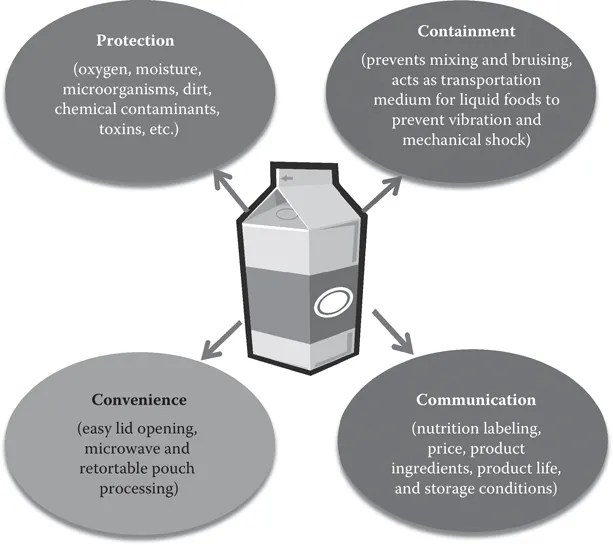
Food packaging is not only indispensable in the distribution chain but is designed to prevent the spoilage of food products throughout the supply chain. Diversity in food composition and product structure in fresh and processed food products demands unique packaging solutions for each product category. However, the primary function of packaging remains similar in order to preserve the freshness as well as to prevent spoilage and pathogenicity and to extend the shelf life. Before we proceed to the packaging material properties, it would be appropriate to review basic functions of food packaging—that is, protection, containment, communication, and convenience (Figure 1.1) (Wani et al., 2014).
Figure 1.1 Major functions of food packaging.
Protection: Each package is intended to protect the food from physical, chemical, and biological changes. Therefore, the product type determines the package requirements in order to prevent the food from any physical changes such as shrinkage arising from moisture loss due to dehydration, loss of texture due to moisture gain (e.g. potato chips), and/or a tissue injury during transportation or handling (such as damage to fresh produce). Proper packaging also reduces chemical changes such as light- or oxygen-induced oxidation and flavor loss, and it prevents postprocessing microbial contamination of foods. Therefore, the package’s primary function is to protect the food from undesirable changes emanating from interaction with environment and to maintain the quality and safety of fresh or processed foods.
Containment: The function of containment of food products in specific packages is to facilitate transportation and distribution throughout the supply chain. Packaging prevents huge product losses from several environmental factors, such as damage due to friction of loose materials, contamination from air-suspended particles, and so on. Containment also prevents the mixing of some foods while giving shape to others. Mixing of different solid foods is possible during transportation due to shock and vibration, while it is practically impossible to move liquid products without packaging.
Convenience: Packaging brings convenience to foods through innovative containment solutions with features such as easy-to-open containers, aseptic packaging, microwavable packaging, product visibility, oven safe trays, boil-in-bags, resealability, and so on. This has enabled the consumer to prepare food in the shortest possible time and has increased the global demand for fresh, processed, and fast foods.
Communication: The purpose of package labeling is to inform the consumer about a product’s contents, brand, shelf life, storage conditions, and price. Consumers are keen to know about product quality, proper handling instructions, and nutritional composition. Package labeling provides product information (nutrients, weight, brand labels, certification, ingredient labeling, barcodes, etc.) in order to satisfy legal requirements and to promote product branding, storage, cooking instructions, price, and shelf life.
1.2 PACKAGING MATERIALS FOR FOOD APPLICATIONS
Approved packaging materials for food use are mainly glass, metal, paper, plastic, and biobased materials. The material properties determine the end use of a packaging material, and the shelf life is product specific (Robertson 2006). Plastic, metal, glass, and paper are commonly used as packaging materials to preserve the freshness and quality of different food products. However, bio-based packaging is a focus of current research in order to avoid the environmental impact of polymeric packaging materials. Several books have highlighted specific packaging materials in detail. Following is a brief overview of packaging materials for food use.
Glass: This inert packaging material provides an absolute barrier to gases and moisture, making it suitable for flavor retention and freshness of food products such as beer and wine. Glass can withstand high thermal-processing conditions, provides good insulation, and can be formed into different shapes—either transparent or opaque. Aluminum oxide coatings improve its barrier properties, especially from chemical attack (Marsh & Bugusu 2007). Recycling glass to preserve our fragile environment from pollution is an additional advantage. Heavy weight and fragility when exposed to internal pressure, impact, and thermal shock are some of the disadvantages for extensive use of glass as a packaging material.
Paper: Paper is modified with additives (lacquers, waxes, resins, etc.) or coextruded with other polymers to improve its barrier properties. Paper and paper boards are used in different forms (corrugated boxes, cartons, bags, sacks, and wrapping paper) for several packaging levels in food and allied products. Different forms of paper include:
- Kraft paper: Natural brown, unbleached, bleached white, and heavy duty, this paper is used to fabricate bags and wrappings. It is the strongest paper and is used for packaging flour, sugar, and dried fruits and vegetables.
- Sulfite paper: This paper is glazed to improve its appearance, wet strength, and oil resistance. Sulfite paper is relatively lighter and weaker than kraft paper but has high print quality. It is often used with plastic or foil laminates to prepare packaging materials for biscuits and confectionery.
- Greaseproof paper: Offering resistance to oil but allowing moisture migration, greaseproof paper is commonly used to pack cookies, butter, oily foods, candies, and so forth.
- Glassine: This greaseproof paper has a high degree of smoothness and a glossy finish. It is commonly used for packaging biscuits, fats, fast foods, and so on.
- Parchment paper: Made from acid-modified cellulose to improve its air and moisture barrier properties, parchment paper is used for butter, lard, and fat packaging.
- Paperboard: Paperboard is available in several forms (white board, solid board, chip board, fiber board, and paper laminates) and is mainly used in secondary packaging to improve the handling and distribution of food products.
Metal: The commonly used metals for food packaging are tin, steel, aluminum, and chromium. They offer excellent barrier properties, physical protection, printability, consumer acceptance, and recyclability. Tinplate is produced from low carbon steel that is coated on both sides with a thin layer of tin and then further lacquered with epoxy phenolic, oleoresins components, or vinyl resins to provide an in...