Cable and Wireless Networks: Theory and Practice presents a comprehensive approach to networking, cable and wireless communications, and networking security. It describes the most important state-of-the-art fundamentals and system details in the field, as well as many key aspects concerning the development and understanding of current and emergent services.
In this book, the author gathers in a single volume current and emergent cable and wireless network services and technologies. Unlike other books, which cover each one of these topics independently without establishing their natural relationships, this book allows students to quickly learn and improve their mastering of the covered topics with a deeper understanding of their interconnection. It also collects in a single source the latest developments in the area, typically only within reach of an active researcher.
Each chapter illustrates the theory of cable and wireless communications with relevant examples, hands-on exercises, and review questions suitable for readers with a BSc degree or an MSc degree in computer science or electrical engineering. This approach makes the book well suited for higher education students in courses such as networking, telecommunications, mobile communications, and network security. This is an excellent reference book for academic, institutional, and industrial professionals with technical responsibilities in planning, design and development of networks, telecommunications and security systems, and mobile communications, as well as for Cisco CCNA and CCNP exam preparation.
1Introduction to Data Communications and Networking
LEARNING OBJECTIVES
• Describe the fundamentals of communications.
• Identify the key components of networks and communication systems.
• Describe different types of networks and communication systems.
• Identify the differences between a local area network (LAN), a metropolitan area network (MAN), and a wide area network (WAN).
• Identify the different types of media and traffic.
• Define the convergence and the collaborative age of the network applications.
1.1 FUNDAMENTALS OF COMMUNICATIONS
Communication systems are used to enable the exchange of data between two or more entities (humans or machines). As can be seen from Figure 1.1, data consists of a representation of information source, whose transformation is performed by a source encoder. An example of a source encoder is a thermometer, which converts temperatures (information source) into voltages (data). A telephone can also be viewed as a source encoder, which converts the analog voice (information source) into a voltage (data), before being transmitted along the telephone network (transmission medium). In case the information source is analog and the transmission medium is digital, a CODEC (COder and DECoder) is employed to perform digitization. A VOCODER (VOice CODER) is a codec specific for voice, whose functionality consists of converting analog voice into digital at the transmitter side, and the reciprocal at the receiver side.
The emitter of data consists of an entity responsible for the insertion of data into the communication system and for the conversion of data into signals. Note that signals are transmitted, rather than data. Signals consist of an adaptation* of data, such that their transmission is facilitated in accordance with the used transmission medium. Similarly, the receiver is responsible for converting the received signals into data.
The received signals correspond to the transmitted signals subject to attenuation and distortion, and added with noise and interferences. These channel impairments originate that the received signal differs from that transmitted. In the case of analog signals, the resulting signal levels do not exactly translate the original information source. In the case of digital signals, the channel impairments originate corrupted bits. In both cases, the referred channel impairments originate a degradation of the signal-to-noise plus interference ratio (SNIR).† A common performance indicator of digital communication systems is the bit error rate (BER). This corresponds to the number of corrupted bits divided by the total number of transmitted bits over a certain time period.
FIGURE 1.1 Generic block diagram of a communication system.
A common definition associated with information is knowledge. It consists of a person’s ability to have access to the right information, at the right time. The conversion between information and knowledge can be automatically performed using information systems, whereas information can be captured by sensors and distributed using communication systems.
1.1.1 ANALOG AND DIGITAL SIGNALS
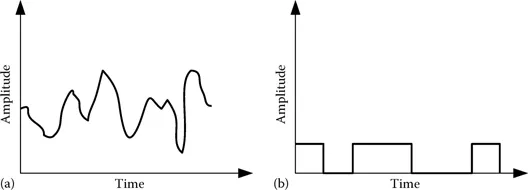
Analog signals present a continuous amplitude variation over time. An example of an analog signal is voice. Contrarily, digital signals present amplitude discontinuities (e.g., voltages or light pulses). An example of digital data includes the bits* generated in a workstation. The text is another example of digital data. Figure 1.2 depicts examples of analog and digital signals.
Digital signals present several advantages (relating to analog) such as the following:
• Error control is possible in digital signals: corrupted bits can be detected and/or corrected.
• Because they present only two discrete values, the consequences of channel impairments can be more easily detected and avoided (as compared to analog signals).
• Digital signals can be regenerated, almost eliminating the effects of channel impairments. Contrarily, the amplification process of analog signals results in the amplification of signals, noise, and interferences, keeping the SNR relationship unchanged.†
• The digital components are normally less expensive than the analog ones.
• Digital signals facilitate cryptography and multiplexing.
• Digital signals can be used to transport different sources of information (voice, data, multimedia, etc.) in a transparent manner.
FIGURE 1.2 Example of (a) analog and (b) digital signals.
However, digital signals present an important disadvantage:
• For the same information source, the bandwidth required to accommodate a digital signal is typically higher than the analog counterpart.* This results in a higher level of attenuation and distortion.
1.1.2 MODULATOR AND DEMODULATOR
As can be seen from Figure 1.3, when the source (e.g., a computer) generates a digital stream of data and the transmission medium is analog, a MODEM (MOdulator and DEModulator) is employed to perform the required conversion. The modulator converts digital data into analog signals, whereas the demodulator (at the receiver) converts analog signals into digital data. An example of an analog transmission medium is radio transmission, whose signals consist of electromagnetic waves (present a continuous variation in time).
A modem (e.g., asynchronous digital subscriber line [ADSL] or cable modem) is responsible for modulating a carrier wave with bits, using a certain modulation scheme.† The reverse of this operation is performed at the receiver side. Moreover, a modem allows sending a signal modulated around a certain carrier frequency, which can be another reason for using such a device.
In case the data is digital and the transmission medium is also digital, a modem is normally not employed, as the conversion between digital and analog does not need to be performed. In this case, a line encoder/decoder (sometimes also referred to as a digital modem, nevertheless not accurately) is employed. This device adapts the original digital data to the digital transmission medium,‡ adapting parameters such as levels and pulse duration. Note that, using such a digital encoder, the signals are transmitted in the baseband.§
The output of a line encoder consists of a digital signal, as it comprises discrete voltages that encode the source logic states. Consequently, it can be stated that the line encoder is employed when the transmission medium is digital. On the other hand, the output of a modulator consists of an analog signal, as it modulates a carrier that is an analog signal.
In the case of high data rate, the required bandwidth necessary to accommodate such a signal is also high.¶ In this scenario, the medium may originate a high level of attenuation or distortion at limit frequency components of the signal. In such a case, it can be a good choice to use a modem that allows the modulation of the signal around a certain carrier frequency. The carrier frequency can be carefully selected such that the channel impairments in the frequencies around it (corresponding to the signal bandwidth) do not seriously degrade the SNR.
The reader should refer to Chapter 6 for a detailed description of the modulation schemes used in modems, as well as for the description of digital encoding techniques.
FIGURE 1.3 Generic communication system incorporating a modem.
1.1.3 TRANSMISSION MEDIUMS
Transmission mediums can be classified as cable or wireless. The examples of cable transmission mediums include twisted pair cables, coaxial cables, multimode or single mode optical fiber cables, and so on.
In the past, LANs were made of coaxial cables. These cables were also used as a transmission medium for medium- and long-range analog communications. Although coaxial cables were replaced by twisted pair cables in LANs, the massification of cable television enabled their reuse.
As a result of telephone cables, twisted pairs are still the dominant transmission medium in houses and offices. These cables are often reused for data. With the improvement in isolators and copper quality, as well as with the development of shielding, the twisted pair has become widely used for providing high-speed data communications, in addition to the initial use for analog telephony.
Currently, multimode optical fibers have been increasingly installed at homes, allowing reaching throughputs of the order ...
Table of contents
Cover
Half Title
Title Page
Copyright Page
Table of Contents
Summary
Laboratorial Introductory Notes
Author
Chapter 1 Introduction to Data Communications and Networking
Chapter 2 Network Protocol Architectures
Chapter 3 Channel Impairments
Chapter 4 Cable Transmission Mediums
Chapter 5 Wireless Transmission Mediums
Chapter 6 Source Coding and Transmission Techniques
Chapter 7 Advanced Transmission Techniques to Support Current and Emergent Multimedia Services
Chapter 8 Services and Applications
Chapter 9 Transport Layer
Chapter 10 Internet Layer
Chapter 11 Internet Layer
Chapter 12 Data Link Layer
Chapter 13 Structured Cabling System
Chapter 14 Transport Networks and Protocols
Chapter 15 Cellular Communications and Wireless Standards
Chapter 16 Network Security
Appendix I
Appendix II
Appendix III
Appendix IV
Appendix V
Appendix VI
References
Index
Trusted by 375,005 students
Access to over 1.5 million titles for a fair monthly price.
Study more efficiently using our study tools.
Frequently asked questions
Yes, you can cancel anytime from the Subscription tab in your account settings on the Perlego website. Your subscription will stay active until the end of your current billing period. Learn how to cancel your subscription
No, books cannot be downloaded as external files, such as PDFs, for use outside of Perlego. However, you can download books within the Perlego app for offline reading on mobile or tablet. Learn how to download books offline
Perlego offers two plans: Essential and Complete
Essential is ideal for learners and professionals who enjoy exploring a wide range of subjects. Access the Essential Library with 800,000+ trusted titles and best-sellers across business, personal growth, and the humanities. Includes unlimited reading time and Standard Read Aloud voice.
Complete: Perfect for advanced learners and researchers needing full, unrestricted access. Unlock 1.5M+ books across hundreds of subjects, including academic and specialized titles. The Complete Plan also includes advanced features like Premium Read Aloud and Research Assistant.
Both plans are available with monthly, semester, or annual billing cycles.
We are an online textbook subscription service, where you can get access to an entire online library for less than the price of a single book per month. With over 1.5 million books across 990+ topics, we’ve got you covered! Learn about our mission
Look out for the read-aloud symbol on your next book to see if you can listen to it. The read-aloud tool reads text aloud for you, highlighting the text as it is being read. You can pause it, speed it up and slow it down. Learn more about Read Aloud
Yes! You can use the Perlego app on both iOS and Android devices to read anytime, anywhere — even offline. Perfect for commutes or when you’re on the go. Please note we cannot support devices running on iOS 13 and Android 7 or earlier. Learn more about using the app
Yes, you can access Cable and Wireless Networks by Mário Marques da Silva in PDF and/or ePUB format, as well as other popular books in Technology & Engineering & Computer Networking. We have over 1.5 million books available in our catalogue for you to explore.