Introduction to Laser Science and Engineering provides a modern resource for a first course in lasers for both students and professionals. Starting from simple descriptions, this text builds upon them to give a detailed modern physical understanding of the concepts behind light, optical beams and lasers. The coverage starts with the nature of light and the principles of photon absorption and transmission, leading to the amplified and stimulated emission principals governing lasers. The specifics of lasers and their application, safe use and future prospects are then covered, with a wealth of illustrations to provide readers with a visual sense of optical and laser principles.
- 267 pages
- English
- ePUB (mobile friendly)
- Available on iOS & Android
eBook - ePub
Introduction to Laser Science and Engineering
About this book
Information
1
What Is Light?
This book is entitled Introduction to Laser Physics and Engineering, so one would suspect that like all the other introductory laser books out there we would start with talking about what lasers are and jump right into the concept of stimulated emission. Looking through most texts on the subject to date, more than most mention stimulated and spontaneous emission on the very first page. We’ve mentioned it here so that it puts this book at least on par for that course. That said, it is the author’s viewpoint that jumping right into the discussion of stimulated emission and spontaneous emission without taking a few steps back and getting our understanding of the more basic concepts involving lasers straight in our minds we might actually miss how truly profound lasers are and how much we can learn from them. In fact, many texts on the subject start with semi-classical physical nomenclature that is neither illuminating nor completely accurate which can become confusing for the entry-level laser scientist or engineer. Hopefully, this book will offer a slightly different approach that will in the end (pun intended) shed more light on the topic, be enlightening (another intended pun), and enable us to obtain a laser tight focus (that one just happened, honestly) on such an intricate, detailed, complicated, and highly exciting subject.
LASER is actually an acronym just like NASA, radar, lidar, and ASAP. We all know that NASA is the National Aeronautics and Space Administration, radar is a U.S. Navy acronym for Radio Detection (or Direction) and Ranging, and ASAP means As Soon As Possible. Lidar is a bit more obfuscated in that it is an attempt at creating a word like “radar” but for lasers and/or light. Lidar is often described as Light Detection and Ranging, while sometimes it is Laser Imaging, Detection, and Ranging. The first one is the most widely used because not all lidar systems perform imaging.
LASER actually stands for Light Amplification by the Stimulated Emission of Radiation. So, if we wanted to be absolutely nitpicky and exactly correct with our acronym instead of “laser,” it would be “labtseor” but the latter doesn’t quite roll off the tongue as well as the former. Hence, laser. Also, note that “laser” has become such a common acronym that it has become grammatically acceptable to write it in lowercase just like “radar.”
Looking at the acronym itself is the simplest method to determine where to start in our study of the laser. The very first word in the acronym is “light.” So, right off the bat we can ask ourselves one simple question and if we can’t answer it succinctly then we have some work to do before we can go any further. So, let’s ask that question (and hopefully answer it) ASAP.
What is light?
1.1 The Classical Description of Light
1.1.1 500 to 0 B.C.E.
For centuries the nature of light has been debated, discussed, and experimented with. There is no singular truly “classical description” of light because there are several. In the 5th century B.C.E., the pre-Socratic Greek philosopher Empedocles (see Figure 1.1) of Acragas (a city in Sicily) developed what became known as the cosmogenic theory of the universe where he proposed that the universe was made from four classical elements: fire, air, water, and earth. He believed that the goddess Aphrodite had made the human eye from these elements and that she lit the fire within the eye, which in turn, shone outward illuminating objects and therefore leading to sight. Empedocles was clever enough to realize if this were true then humans would be able to see at night, so, he postulated that there was somehow an interaction of “rays” from the eyes and “rays” from the sun or other sources.
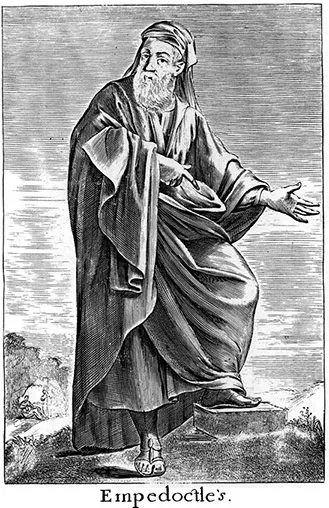
FIGURE 1.1
Empedocles of Acragas theorized that light was given to man by the goddess Aphrodite, who had made the human eye from these elements and that she lit the fire within the eye, which, in turn, shone outward illuminating objects and therefore leading to sight.
Empedocles of Acragas theorized that light was given to man by the goddess Aphrodite, who had made the human eye from these elements and that she lit the fire within the eye, which, in turn, shone outward illuminating objects and therefore leading to sight.
The ancient Hindu text Vishnu Purana that was written along the same time frame, give or take a couple 100 years based on the particular estimate or history book, describes the “seven rays of the sun.” As far back as ancient civilization, light was being referred to in forms of rays.
The Greek philosopher Democritus of Abdera (see Figure 1.2), around 400 B.C.E., argued that objects generated “simulacra” of themselves or images that were cast-off of them and into space. When these simulacra were impressed upon the surrou...
Table of contents
- Cover
- Half Title
- Title Page
- Copyright Page
- Table of Contents
- List of Figures
- List of Tables
- Preface
- Introduction
- Author
- 1. What Is Light?
- 2. What Is Amplification?
- 3. What Is the Stimulated Emission of Radiation?
- 4. What Are Lasers?
- 5. What Are Some Types of Lasers?
- 6. How Do We Describe Lasers?
- 7. How Do We Use Lasers Safely?
- 8. What Are Some Laser Applications?
- Suggested Reading for Laser Scientists and Engineers
- Index
Trusted by 375,005 students
Access to over 1.5 million titles for a fair monthly price.
Study more efficiently using our study tools.
Frequently asked questions
Yes, you can cancel anytime from the Subscription tab in your account settings on the Perlego website. Your subscription will stay active until the end of your current billing period. Learn how to cancel your subscription
No, books cannot be downloaded as external files, such as PDFs, for use outside of Perlego. However, you can download books within the Perlego app for offline reading on mobile or tablet. Learn how to download books offline
We are an online textbook subscription service, where you can get access to an entire online library for less than the price of a single book per month. With over 1.5 million books across 990+ topics, we’ve got you covered! Learn about our mission
Look out for the read-aloud symbol on your next book to see if you can listen to it. The read-aloud tool reads text aloud for you, highlighting the text as it is being read. You can pause it, speed it up and slow it down. Learn more about Read Aloud
Yes! You can use the Perlego app on both iOS and Android devices to read anytime, anywhere — even offline. Perfect for commutes or when you’re on the go.
Please note we cannot support devices running on iOS 13 and Android 7 or earlier. Learn more about using the app
Please note we cannot support devices running on iOS 13 and Android 7 or earlier. Learn more about using the app
Yes, you can access Introduction to Laser Science and Engineering by Travis S. Taylor in PDF and/or ePUB format, as well as other popular books in Technology & Engineering & Optics & Light. We have over 1.5 million books available in our catalogue for you to explore.