- 252 pages
- English
- ePUB (mobile friendly)
- Available on iOS & Android
eBook - ePub
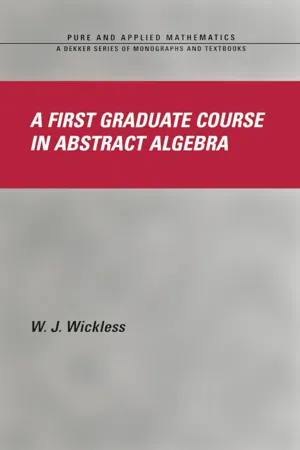
A First Graduate Course in Abstract Algebra
About this book
Since abstract algebra is so important to the study of advanced mathematics, it is critical that students have a firm grasp of its principles and underlying theories before moving on to further study. To accomplish this, they require a concise, accessible, user-friendly textbook that is both challenging and stimulating. A First Graduate Course in Abstract Algebra is just such a textbook.
Divided into two sections, this book covers both the standard topics (groups, modules, rings, and vector spaces) associated with abstract algebra and more advanced topics such as Galois fields, noncommutative rings, group extensions, and Abelian groups. The author includes review material where needed instead of in a single chapter, giving convenient access with minimal page turning. He also provides ample examples, exercises, and problem sets to reinforce the material. This book illustrates the theory of finitely generated modules over principal ideal domains, discusses tensor products, and demonstrates the development of determinants. It also covers Sylow theory and Jordan canonical form.
A First Graduate Course in Abstract Algebra is ideal for a two-semester course, providing enough examples, problems, and exercises for a deep understanding. Each of the final three chapters is logically independent and can be covered in any order, perfect for a customized syllabus.
Information
Chapter 1
Groups (mostly finite)
1.1 Definitions, examples, elementary properties
Remark 1.1.1
We assume the reader is familiar with the standard notions and notations of set theory. A particular thing we wish to point out is that in listing the elements of a set, say S = {x1, ...,xn}, unless said otherwise,we make no assumption that the listed elements are distinct. When wewrite A ⊆ B, we allow the possibility that the sets A and B could be equal.To indicate that A is properly contained in B, we use the notation A ⊂ B. Recall that the Cartesian product A × B = {(a,b) : a ∈ A, b ∈ B}. A function f : A → B is a subset f ⊆ A × B such that (a, b) and (a, b′) in f implies b = b′. As usual, if (a,b) ∈ f we write b = f(a). The set A is called the domain and B the codomain of the function f. The functionf : A → B is called monic if, whenever a, a′ are distinct elements of A, it follows that f(a) ≠ /(a′). The function f is epic if f(A) = B, that iseach b ∈ B is f(a) for some a ∈ A. We call f a bijection if it is bothmonic and epic. Other popular terminology for these last three properties of functions are injective, surjective and bijective. Finally, a binary operation on a set A is a function o : A × A → A. We denote the image o[(a, a′)] by a o a′.
We begin at the beginning, defining our first object of study.
Definition 1.1.1
The pair (G, o) is a group if the following axioms hold:
- G is a set and o is a binary operation on G.
- There is an element e ∈ G such that eºx = xºe = x for all x ∈ G.
- For all x,y,z ∈ G, x º (y º z) = (x º y) º z. (The operation º is associative.)
- For all x ∈ G, there exists an element y ∈ G such that xºy = yºx = e.
Axiom 3 allows us to write the product of any three elements x,y,z ∈ G as x º y º z, without parentheses. Using induction (which we’ll discuss later), one can show that the product of any finite number of elements can be computed by inserting parentheses in any manner. For example x º y º z º w ºu could be computed as x º [y º (z º w)] º u. This result is eminently believable and the proof is fairly cumbersome, so we won’t present it.
The element e in Axiom 2 is called the identity of G; the element y in Axiom 4 is called the inverse of x, we write y = x−1. If (G, º) satisfies the additional axiom that x º y = y º x for all x, y ∈ G, we call (G, º) an abelian (or commutative) group. For ease of notation, we denote x º y by xy, that is we represent the binary operation in an abstract group by multiplication. Of course, if the binary operation º should naturally be written as addition we do so, and, adopting additive notation, denote the identity element by 0, the inverse of x by −x.
Exercise 1.1.1
Prove that the element e in Axiom 2 is unique and that, for each x ∈ G the element y in Axiom 4 is also unique. This justifies the terminology “the identity” and “the inverse of x”.
Exercise 1.1.2
Prove that a group G satisfies the right and left cancellation laws: For a,b,c ∈ G, ba = ca ⇒ b = c and ab = oc ⇒ b = c.
(Throughout, we will use ⇒ for logical implication and ⇔ for logical equivalence.)
Exercise 1.1.3
Show that in a group (x1x2...xn)−1 =
The notion of a group has been used in ma...
Table of contents
- Cover Page
- Half Title Page
- Title Page
- Copyright Page
- Preface
- Contents
- Chapter 1 Groups (mostly finite)
- Chapter 2 Rings (mostly domains)
- Chapter 3 Modules
- Chapter 4 Vector Spaces
- Chapter 5 Fields and Galois theory
- Chapter 6 Topics in noncommutative rings
- Chapter 7 Group extensions
- Chapter 8 Topics in abelian groups
- References
- Index
Trusted by 375,005 students
Access to over 1.5 million titles for a fair monthly price.
Study more efficiently using our study tools.
Frequently asked questions
Yes, you can cancel anytime from the Subscription tab in your account settings on the Perlego website. Your subscription will stay active until the end of your current billing period. Learn how to cancel your subscription
No, books cannot be downloaded as external files, such as PDFs, for use outside of Perlego. However, you can download books within the Perlego app for offline reading on mobile or tablet. Learn how to download books offline
Perlego offers two plans: Essential and Complete
- Essential is ideal for learners and professionals who enjoy exploring a wide range of subjects. Access the Essential Library with 800,000+ trusted titles and best-sellers across business, personal growth, and the humanities. Includes unlimited reading time and Standard Read Aloud voice.
- Complete: Perfect for advanced learners and researchers needing full, unrestricted access. Unlock 1.5M+ books across hundreds of subjects, including academic and specialized titles. The Complete Plan also includes advanced features like Premium Read Aloud and Research Assistant.
We are an online textbook subscription service, where you can get access to an entire online library for less than the price of a single book per month. With over 1.5 million books across 990+ topics, we’ve got you covered! Learn about our mission
Look out for the read-aloud symbol on your next book to see if you can listen to it. The read-aloud tool reads text aloud for you, highlighting the text as it is being read. You can pause it, speed it up and slow it down. Learn more about Read Aloud
Yes! You can use the Perlego app on both iOS and Android devices to read anytime, anywhere — even offline. Perfect for commutes or when you’re on the go.
Please note we cannot support devices running on iOS 13 and Android 7 or earlier. Learn more about using the app
Please note we cannot support devices running on iOS 13 and Android 7 or earlier. Learn more about using the app
Yes, you can access A First Graduate Course in Abstract Algebra by W.J. Wickless in PDF and/or ePUB format, as well as other popular books in Mathematics & Algebra. We have over 1.5 million books available in our catalogue for you to explore.