eBook - ePub
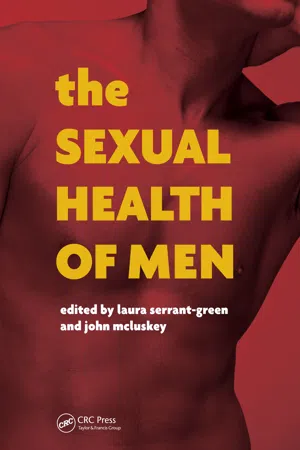
The Sexual Health of Men
Dealing with Conflict and Change, Pt. 1
- 146 pages
- English
- ePUB (mobile friendly)
- Available on iOS & Android
eBook - ePub
About this book
This challenging critique explores the current constraints and opportunities for addressing and promoting the sexual health of men. It redresses the balance between society's traditional views and expectations of men's sexual health, compared to the sexual health of women. The wide-ranging approach critically considers all aspects of sexual health, including historic developments, social considerations, personal issues and political climates. Authoritative and evidence-based, "The Sexual Health of Men" brings together experts from the fields of sexual health research, education and practice. It is highly recommended for health and social care professionals, including nurses, doctors, social workers, health advisers and sexual health service providers. Health researchers, and policy makers and shapers will find the research of great interest, as will all those concerned about the sexual health and well-being in men.
Information
CHAPTER 1
Introduction
This book will explore the challenges, constraints and opportunities for addressing and promoting the sexual health of men in Britain. It begins by considering many issues, including some of the ways in which sexual health has been defined in society, and discusses how the sexual health of men compared with that of women has received little attention from health researchers, policy makers and health service providers. It continues through the ensuing chapters to explore, highlight and critique some of the consequences of this for sexual health policy, service provision and healthcare practice. Ultimately the aims of the book are:
- To critically examine men’s sexual health within personal, social and political contexts
- To provide a platform for reviewing the importance of integrating psychosocial and physical aspects into men’s sexual healthcare provision
- To bring together expert evidence from the fields of sexual health research, education and practice
The book is aimed at health and social care professionals, e.g. nurses, social workers, health advisers, medics, sexual health service providers and others concerned about the sexual health and well-being of men. The authors hope that the book will provide a useful resource and add to the information available that focuses on the sexual health of men.
Sexual Health and British Society
The past few decades have seen increasing interest in sexual health as an area of concern for healthcare professionals and service providers in Britain. This has occurred against a backdrop of wider changes in healthcare policy, where the focus is primarily on prevention of ill health and promotion of healthy lifestyles.1,2 Since the emergence of HIV and AIDS in the twentieth century, issues such as sexual health and the need to provide for what were previously viewed as private issues between individuals have entered the public sphere.3-5 Sexual health is in general no longer simply a matter of a physical act with consequences for an individual, but is recognised by the Government, health and social care providers as an area of health need requiring planning, assessing and services to support it.6,7
However, the apparent recognition of a need to address sexual health issues at an individual and strategic level is juxtaposed by the silences that have developed around sexual health as a subject in itself and the way it has been addressed within a healthcare context. Discussions of sexual health as an area of need in health policy and the healthcare strategies used to promote it have been built around a very narrow view of what constitutes sexual health. This view had at its core an implicit assumption that the nature of sexual health was primarily concerned with physiological functioning.8 In this context a tradition of sexual-health work has developed in healthcare practice where it is more likely to be associated with reproductive function, the investigation and treatment of sexually transmitted infections and the prevention of unplanned pregnancy.9-11 As a result there exists in Britain a historical legacy of relatively little discussion amongst professionals, policy makers and service providers about any possible variation in people’s understanding of sexual health and the consequences of this for diverse populations. This has occurred despite the fact that as far back as 1975 the World Health Organization (WHO) urged healthcare professionals to widen their views on sexual health away from pure epidemiology and sexual intercourse towards a more positive and holistic approach. They called for:
The integration of the somatic, emotional, intellectual and social aspects of sexual being in ways that are positively enriching and that enhance personality, communication and love.12
In contrast to the situation in healthcare practice, the social sciences, particularly areas such as gender and cultural studies, have produced a vast array of literature investigating and discussing a wide variety of issues relating to sexual health, including sexuality, self-identity and social stigma. Of the studies investigating sexual health from a healthcare perspective, few have incorporated a person-centred approach. Up until the 1980s at least most continued with the push to ‘measure’ sexual health in terms of infection and pregnancy. In this environment little consideration was given to the wider components of sexual health and the possibility of variation in the associated sexual decision-making of different groups in society.13 As a consequence, with the exception of HIV/AIDS, which will be commented on later, discussing ‘sexual health’ is to a great extent actually synonymous with ‘sexual ill health’ and disease, with epidemiological studies forming the main and often only source of research data.
The majority of the research conducted under this restricted interpretation of sexual health centred on medical treatments for specific diseases such as sexually transmitted infections (STIs), or took the form of large surveys conducted by public health departments. The contribution of person-centred or sociological approaches from healthcare professionals to this challenging area of health were conspicuous by their absence. The reasons for the lack of information or investigation into the nature and consequences of sexual health from a healthcare perspective are complex. Some of the possible influencing factors relate to wider social attitudes to sexual health as an issue in itself, while others are specifically associated with the response of healthcare providers to sexual health as an area of healthcare.
Research into sexual health is impeded by a variety of issues related to the nature of sex and sexual expression in society.8 Sexual health has throughout history been inextricably associated with social taboo, privacy and blame. Long before the onset of HIV/AIDS, sexual practices had been colonised by concerns about immorality and fears about the consequences of moral decline in the political, public and private sphere.14,15 The Victorian purity movement for example, with its well-rehearsed warnings against sex outside marriage, masturbation and homosexuality has been well documented.15-18 Social action and sanctioning at the time served to perpetuate feelings of guilt and sin around any sexual expression outside the sanitised arena of marriage and procreation. As a result of this and many other examples, sexual health has regularly been subjected to degrees of silence over the years which have been difficult to overcome. This has contributed to the current situation where health researchers seeking to expand the pool of knowledge about the nature of human sexual experience and decision making have been hindered by the fact that the subject itself is still perceived as being ‘not nice’, too sensitive for objective research or unlikely to provide truthful responses.19
In the 1980s the emergence of AIDS and HIV as life-threatening conditions had a far-reaching impact on the need to discuss sexual activity and risk taking.20 As a result of the devastating effects of HIV/AIDS experienced worldwide, sexual health issues were openly discussed beyond the parameters of epidemiology. Efforts were made to explore the causes, consequences and effects of sexual illness on an individual and at societal level.21 Healthcare practice and research equally responded to the challenges arising from HIV/AIDS, recognising the consequences for patient care, infection control and professional health and safety amongst other issues.8 However, while the emergence and worldwide recognition of the seriousness of HIV/AIDS was both effective and invaluable in bringing into the public arena the importance of research and discussion into sexual health, the success of the efforts made in HIV/AIDS reveal other silences.
The political climate in the face of the widespread hysteria around HIV in the early 1980s played a central role in the disease and to some extent sexual ill health, becoming established in the minds of the public as being far removed from the experiences of the white, male, heterosexual norm.22 As a result gay men, black people, prostitutes and groups marginalised as ‘other’ were identified as the primary cause of HIV infection and harbourers of the disease.13,23,24 Despite the progressive move towards wider consideration of sexual health called for by WHO in the 1970s, the effect of political attempts to manage the fear surrounding HIV/AIDS, by controlling sexual practices in the social and private spheres, resulted in a re-focussing on ‘illness’ as a consequence of poor sexual practices. The possibility of any other causative or influencing contextual factors on sexual health were lost in the impetus by politicians and media sources to create and recreate the divisions between ‘us’ and ‘them’ through the HIV tragedy, ‘good’ sex and health being again associated with morality and reunited with stoic versions of romantic love and duty.25-27 Once historical parameters of good versus bad were erected around sexual behaviour and reinforced by the scientific ‘proof’ provided by HIV research, lifestyles which did not conform to the ideal were labelled ‘unhealthy’. The practical effect of this labelling on individuals belonging to these marginalised groups is evidenced later in this book through chapters exploring the sexual health of black and minority ethnic men. This has also been highlighted in the literature in relation to the effects on other socially excluded or marginalised communities in the UK and worldwide.22,28,29 However, with the emphasis of sexual-health work once again placed on prevention of the negative consequences of illness rather than promotion of health in any positive sense, what began as a public relations or harm-reduction exercise at parliamentary level also helped to confine the exploration of sexual health in its broadest sense.
The widespread and firm as...
Table of contents
- Cover
- Half Title
- Title Page
- Copyright Page
- Contents
- Foreword
- About the editors
- About the contributors
- Dedication Page
- 1 Introduction
- 2 Recasting masculinity: mapping out challenges and opportunities for public health
- 3 Men and sexual health
- 4 Physical sexual ill health
- 5 Psychosexual aspects of men’s
- 6 Sexual behaviour
- 7 Sexual health promotion for black and minority ethnic men
- 8 Providing sexual health services for men
- Index
Trusted by 375,005 students
Access to over 1.5 million titles for a fair monthly price.
Study more efficiently using our study tools.
Frequently asked questions
Yes, you can cancel anytime from the Subscription tab in your account settings on the Perlego website. Your subscription will stay active until the end of your current billing period. Learn how to cancel your subscription
No, books cannot be downloaded as external files, such as PDFs, for use outside of Perlego. However, you can download books within the Perlego app for offline reading on mobile or tablet. Learn how to download books offline
Perlego offers two plans: Essential and Complete
- Essential is ideal for learners and professionals who enjoy exploring a wide range of subjects. Access the Essential Library with 800,000+ trusted titles and best-sellers across business, personal growth, and the humanities. Includes unlimited reading time and Standard Read Aloud voice.
- Complete: Perfect for advanced learners and researchers needing full, unrestricted access. Unlock 1.5M+ books across hundreds of subjects, including academic and specialized titles. The Complete Plan also includes advanced features like Premium Read Aloud and Research Assistant.
We are an online textbook subscription service, where you can get access to an entire online library for less than the price of a single book per month. With over 1.5 million books across 990+ topics, we’ve got you covered! Learn about our mission
Look out for the read-aloud symbol on your next book to see if you can listen to it. The read-aloud tool reads text aloud for you, highlighting the text as it is being read. You can pause it, speed it up and slow it down. Learn more about Read Aloud
Yes! You can use the Perlego app on both iOS and Android devices to read anytime, anywhere — even offline. Perfect for commutes or when you’re on the go.
Please note we cannot support devices running on iOS 13 and Android 7 or earlier. Learn more about using the app
Please note we cannot support devices running on iOS 13 and Android 7 or earlier. Learn more about using the app
Yes, you can access The Sexual Health of Men by Laura Serrant-Green,John Mcluskey in PDF and/or ePUB format, as well as other popular books in Medicine & Health Care Delivery. We have over 1.5 million books available in our catalogue for you to explore.