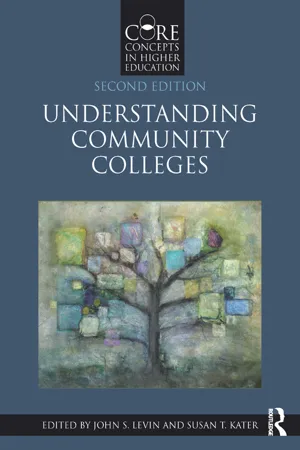
Understanding Community Colleges provides a critical examination of contemporary issues and practices and policy of community colleges. This contributed volume brings together highly respected scholars as well as new scholars for a comprehensive analysis of the community college landscape, including management and governance, finance, student demographics and development, teaching and learning, policy, faculty, and workforce development. At the end of each chapter, the "Questions for Discussion" section helps to bridge the gap between research and practice. Written for students enrolled in higher education and community college graduate programs, as well as social sciences scholars, this provocative new edition covers the latest developments in the field, including trends in enrollment, developmental education, student services, funding, and shared governance.
eBook - ePub
Understanding Community Colleges
- 292 pages
- English
- ePUB (mobile friendly)
- Available on iOS & Android
eBook - ePub
Understanding Community Colleges
About this book
Information
1
THE HISTORICAL ORIGINS OF THE COMPREHENSIVE COMMUNITY COLLEGE MISSION, 1901–1965
THE MISSION PROBLEM
Understanding historical context is essential for demystifying the community college mission and the discourses surrounding it. Terms such as “community college mission” or “junior college philosophy” have been under-theorized by scholars. Community college mission discussions often lack precision. In mission debates variant categories and levels of analysis tend to elide differences of meaning or intent, depending on the theoretical stance, rhetorical strategy, or the professional or social interests of the observer or practitioner (Levin, 1998; Meier, 2008).
There is a history of ambiguity, even confusion, regarding the mission and purposes of the colleges (Breneman & Nelson, 1981; Cross, 1985; Levin, 2000). John Frye remarks that the first junior colleges were “accompanied by no clear mission, set of criteria, nor theoretical framework” (Frye, 1992, p. 1). Employing content analysis of the publications of fifty-six colleges for the year 1920–21, an early junior college scholar identified at least twenty-one distinct educational and social purposes for the colleges (Koos, 1925). Later scholars worried that the colleges lacked a “plausible categorical imperative” (Cohen, 1977, p. 74).
The Carnegie Commission on Higher Education notes that the “most striking structural development in higher education has been the phenomenal growth of the community college.” The Commission adds, “The roles of the community college are so diverse as to be bewildering” (Ogilvie & Raines, 1971, p. v). Multiple roles and shifting institutional identity are reflected in organizational rituals of public community colleges devoted to “reforming,” “renewing,” “revitalizing,” “reassessing,” and “revisiting” the mission (Tillery & Deegan, 1985). Burton Clark views uncertainty about the junior-community college mission as a consequence of open access and weak institutional connection to the organizational field of higher education: “[T]he building of a communicable and socially acceptable identity is the problem resulting from the character of the unselective junior college” (Clark, 1960, p. 171, emphasis in original).
The “academic revolution” of the twentieth century defined a mission for the research university focused on the troika of research, teaching, and public service (Jencks & Riesman, 1968). There has never been a similar degree of consensus among practitioners, policymakers, or university scholars in respect to the community college mission (Breneman & Nelson, 1981). A barrier to theoretical consensus is that some scholars evaluate these community-based, open-access organizations by the standards of selective universities (Frye, 1994).
Another challenge to theorizing the mission is the wide diversity of institutions, communities, and state-level governance systems that exist across the community college organizational field. National mission discourses often overlook community contexts that shape the enacted missions of individual colleges. Arizona Eastern College is a small historically Mormon led college in Safford, Arizona. It defines and enacts the mission for its relatively homogeneous community and students differently compared to La Guardia Community College in Queens with its 50,000 students from over 160 countries speaking more than 110 native languages (Meier, 2008; Mellow & Heelan, 2008). Reconciling the missions of such different institutions requires both historical understanding and theoretical suppleness. Finally, the volatility of the American social and economic context dictates that community colleges tack and wend continually in response to the frequent and sometimes-conflicting gales directed at them from the state, business, labor markets, and local communities (Levin, 2001; Cohen & Brawer, 2008).
A common conception among scholars is that the colleges are “non-specialized by design, their mandate is to offer a comprehensive curriculum and to serve a wide range of community needs” (Owen, 1995, p. 145). The rub is what this means in either theory or practice. Openness, access, and responsiveness amount to a stance, perspective, or attitude rather than constituting either a theory or a purposeful program that differentiates a college from, say, a shopping mall or a theme park. The perennial focus on “inputs” by practitioners begs the question of measurable institutional outcomes.
The idea of comprehensiveness tied to open access emerged in part from California junior college developments during the depression and World War II (Brossman & Roberts, 1973; Witt et al., 1994). The comprehensive mission gained national currency by the 1960s. The conventional definition of the community college mission incorporates those educational functions that comprise “five traditional community college programs” (Cross, 1985, p. 36). These include: 1) collegiate and transfer education; 2) vocational education; 3) developmental or compensatory education; 4) general education; and 5) community education and service. Some practitioners include guidance and student development in the list of functions (Collins & Collins, 1971). By the 1990s, a “new function” was added to the mix—community economic and workforce development (Dougherty & Bakia, 1999).
One group of scholar-practitioners contends that flux, change, and “multi-variance” are defining characteristics of the colleges and their mission (Blocker, Plummer, & Richardson, 1965). Mutability is a frequently observed characteristic of the mission: “[Community colleges] change frequently, seeking new programs and clients” (Cohen & Brawer, 2008, p. 41). Mission opportunism may lead to muddled institutional identity: “[The] definition of the two year college in not much clearer today than it was before 1940” (Frye, 1991, p. 12).
It not unusual for community colleges to ignore their publicly expressed missions in response to perceived community needs or demands, external policy signals from the state or federal governments, an enticing revenue stream, or social and economic change. In the restless pursuit of new opportunities, the colleges ignore the history and traditions of higher education: “Unlike four-year colleges and universities, community colleges are nontraditional or untraditional: they do not even adhere to their own traditions. They make and remake themselves” (Levin, 1998, p. 2).
Some observers perceive frenetic activity and weak traditions as symptoms of an inadequately realized “institutionalization project” (DiMaggio, 1988). Others explain mission drift and organizational ambiguity as a consequence of a) pioneering on the frontiers of community economic development and social responsibility (Vaughan, 1991); b) self-aggrandizing behaviors of relatively autonomous professional elites (Dougherty, 1994); c) cutting-edge entrepreneurial enterprise and technological innovation (O’Banion, 1997); d) tracking and diverting student ambitions (Brint & Karabel, 1989); and e) cultural dynamics and adaptive behaviors that maintain and reproduce community college identity (Levin, 1998).
CONCEPTUAL FRAMEWORK
Historical and organizational analyses are necessary for assessing the relative merits of competing perspectives on the mission and the community college qua institution. This chapter is the result of two nearly two decades of investigation into community college history. It conceptualizes the community college mission as a historically contingent social and educational process that is structured by the needs of local communities, student demands, and regional and national imperatives for economic and workforce development (Gleazer, 1994; Ratcliff, 1994). Multiple missions and influences dictate organizational behavior that is often at variance with traditional higher education. Community college leaders equate non-traditional practice with institutional virtue. Loath to seek a lesser place within the higher education hierarchy, community college leaders assert a community college identity that is “neither the penthouse for the high school nor the first two floors of the senior institution” (Gleazer, 1958, p. 486).
The historical junior-community college mission is more intelligible when analyzed across four theoretical domains: the philosophical, functional, empirical, and formative missions. The philosophical mission is expressed or implied in vision and values statements. It communicates the social and educational purposes of the community college in a democratic society. Historically these philosophical values include student-centeredness, community service, lifelong learning, equity, opportunity, social justice, open access, education for citizenship, and even spirituality.
The functional or operational mission is generally articulated in formal college mission and purposes statements. It is reflected in the curriculum and “core” programs that characterize the comprehensive community college. The classic functions are transfer general education, career and technical education, developmental education, student development, and community and cultural programming (Bogue, 1950).
The summative or empirical mission is enacted at the level of the academic schedule and daily organizational commitments and activities of the colleges. It constitutes concrete, replicated organizational behavior. It encompasses the educational, fiscal, and political decisions that shape educational practices and outcomes. This is the nexus at which institutional structures connect to the purposeful professional activity of faculty and the educational and social engagement of students and community. This substantive mission is reflected in measurable organizational outcomes.
The formative or social mission is conceptualized as the long-term effects of more than one thousand public colleges on local communities, higher education, and American society in general. This is the domain in which practitioners, stakeholders, policymakers, critics, and scholars contend over the efficacy of the community college in American society and as an institution of higher education. Perceived gaps between the philosophical mission and the formative mission are a matter of ideological and theoretical contest to validate or invalidate the community college as an educational institution.
Almost by definition, formal community college mission statements are influenced by the expectations of external constituencies: “[M]issions exist at the interface between an institution and its environment” (Richardson & Doucette, 1984, p. 12). The publicly stated mission of an organization is one matter, but the enacted or empirical mission may be quite another as the organization is shaped by and responds to its social and economic environment. Organizational theory provides insights regarding the environmental context of mission enactment.
Resource dependency theory (Pfeffer & Salancik, 1978) frames organizations as open-systems influenced decisively by the environment. They are “quasi-markets” that struggle for limited organizational autonomy. Threats and opportunities are defined by influences emanating from broader organizational fields: “The key to organizational survival is the ability to acquire and maintain resources” (Pfeffer & Salancik, 1978, p. 2). Transactions within and between organizational fields in pursuit of marginal dollars and increments of political capital tend to structure organizational behavior.
Institutional theory explains organizational activity and outcomes as nested within networked organizational fields. Organizational forms with similar social, political, or economic purposes take on the characteristics of institutions by emulating each other. Institutional environments comprise historical and cultural as well as technical and economic dimensions: “[O]rganizations compete not just for resources and customers, but for political power and institutional legitimacy, for social as well as economic fitness” (DiMaggio & Powell, 1983, p. 150). Insights from organization theory provide nuances and context for explaining the historical development of the community college mission.
HISTORIOGRAPHY OF THE PUBLIC COMMUNITY COLLEGE
Junior-community college historical research is a relatively underdeveloped field. Practitioners take little interest in their history; individual colleges devote little time and few resources to the preservation of institutional memory. Academic researchers who examine the history of the colleges often evidence ideological assumptions that bias their perceptions of the community mission and outcomes (Pedersen, 2000).
John Frye argues that community college historical writing is mostly “descriptive and promotional,” and when it “touches on theory or general models . . . it tends to vagueness and imprecision” (1992, p. 6).
[It] is very rare for any writer on the junior college to show a serious historical interest in the origins of the movement. Typically a few generalizations are made as to formative figures, usually prominent personalities in higher education, who played a role in initiating the movement. This outline information is passed from author to author in those few introductory or survey studies of the junior college. (Frye, 1992, p. 5)
A relative paucity of accurate historical information leads researchers on the colleges to make assumptions about the mission and history of these institutions that will not stand the test of rigorous theoretical interrogation. The following discussion addresses the contributions and limitations of the most important historical works in the field.
America’s Community Colleges: The First Century (Witt, Wattenbarger, Gollattscheck, & Suppiger, 1994), published by the American Association of Community Colleges (AACC), attempts to survey the entire history of community colleges. The authors celebrate rather than critically analyze the movement. The book is ebullient about community college growth without paying much attention to the quality of its outcomes. As community college boosters, they ignore critical research on the colleges. Their work provides a useful state-level chronology of the historical development of community college systems. An important contribution is an extended analysis of junior college developments during World War II. The authors also make a significant point that has not been theorized by community college scholars: community colleges constitute the “only sector of higher education to be called a movement” (Witt et al., 1994, p. xviii).
Brick (1964) provides a shrewd history of the American Association of Junior Colleges (AAJC) to 1960. Brick describes the AAJC as “forum and focus” of the movement. He is one of the first community college historians to employ primary material and careful document analysis to explain community college history from a national perspective. This is an important synthesis of AAJC history to 1960.
Utilizing secondary sources Tillery and Deegan (1985) develop a brief, schematic history of the community college mission from the founding of the first ...
Table of contents
- Cover
- Half Title
- Title Page
- Copyright Page
- Table of Contents
- List of Illustrations
- Series Editor Introduction
- Preface
- Acknowledgments
- Chapter 1 The Historical Origins of the Comprehensive Community College Mission, 1901–1965
- Chapter 2 Student Diversity in Community Colleges: Examining Trends and Understanding the Equity Challenge
- Chapter 3 Student Development Versus Consumerism: Student Services on Campus
- Chapter 4 Hispanic Community College Students: A Profile of Theory and Research
- Chapter 5 International Student Enrollment in U.S. Community Colleges: Joint Endeavors by Individuals and Institutions
- Chapter 6 Adult Student Development: The Socio-Agentic Approach and its Relationship to the Community College Context
- Chapter 7 Teaching Academically Underprepared Students in Community Colleges
- Chapter 8 Career and Technical Education: Old Debates and Persistent Challenges
- Chapter 9 Faculty and the Connection to the Institution
- Chapter 10 Leading in the Middle
- Chapter 11 Redefining Shared Responsibility: Governance in the 21st Century Community College
- Chapter 12 State Fiscal Support for Community Colleges
- Chapter 13 The Future is Probabl[e]y: The Same but Different
- Notes on Contributors
- Index
Trusted by 375,005 students
Access to over 1.5 million titles for a fair monthly price.
Study more efficiently using our study tools.
Frequently asked questions
Yes, you can cancel anytime from the Subscription tab in your account settings on the Perlego website. Your subscription will stay active until the end of your current billing period. Learn how to cancel your subscription
No, books cannot be downloaded as external files, such as PDFs, for use outside of Perlego. However, you can download books within the Perlego app for offline reading on mobile or tablet. Learn how to download books offline
We are an online textbook subscription service, where you can get access to an entire online library for less than the price of a single book per month. With over 1.5 million books across 990+ topics, we’ve got you covered! Learn about our mission
Look out for the read-aloud symbol on your next book to see if you can listen to it. The read-aloud tool reads text aloud for you, highlighting the text as it is being read. You can pause it, speed it up and slow it down. Learn more about Read Aloud
Yes! You can use the Perlego app on both iOS and Android devices to read anytime, anywhere — even offline. Perfect for commutes or when you’re on the go.
Please note we cannot support devices running on iOS 13 and Android 7 or earlier. Learn more about using the app
Please note we cannot support devices running on iOS 13 and Android 7 or earlier. Learn more about using the app
Yes, you can access Understanding Community Colleges by John S. Levin, Susan T. Kater, John S. Levin,Susan T. Kater in PDF and/or ePUB format, as well as other popular books in Education & Education General. We have over 1.5 million books available in our catalogue for you to explore.