eBook - ePub
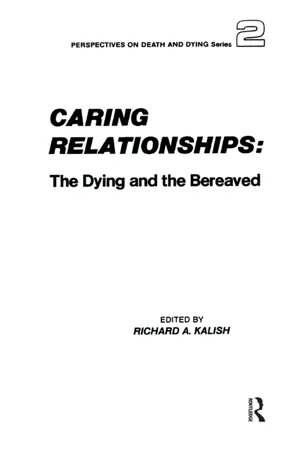
Caring Relationships
The Dying and the Bereaved
- 160 pages
- English
- ePUB (mobile friendly)
- Available on iOS & Android
eBook - ePub
About this book
Just as everyone must die, almost everyone will deal with death among close friends or loved ones. This collection explores the often difficult issues of human relationships with the dying, as well as the many stresses and burdens faced by the survivors.
Information
CHAPTER
1
1
INTRODUCTION
Toward Standards of Care for the Terminally Ill
THAT A NEED EXISTS
Who among us is satisfied with the level of care provided to the terminally ill person in the United States? It cannot be very many, judging from what this writer has had the opportunity to see and hear. We seem to be engaged in an endless round of persuading each other that the prevailing level of terminal care ranges from the inadequate to the intolerable. Often the clinical or research report documents what the patient has already learned from personal experience: that the dying person is isolated physically (Markson, 1970) and emotionally (Kübler-Ross, 1969), subject to a biased communication network (Glaser & Strauss, 1965) in a social context that gives low priority to the individual’s personality and inner experiences (Weisman and Kastenbaum, 1968), and in a physical environment that may be deficient or even hazardous (Reynolds and Kalish, 1974). It would be easy to extend the list of critical reports, difficult to compile a counterbalancing set of findings that “all is well.”
Increasingly, we see the dying person as victim—not of death per se, but of an imposed style of life that assaults and erodes values cherished by the individual. Evidence for this conclusion is convincing, so far as this writer is concerned. Although other types of data would be helpful to round out our knowledge, there is no reason to suspend action while waiting for the next study to be completed. Let us take it as sufficiently demonstrated that care of the terminally ill should be improved.
This leads, on a more positive note, to the likelihood that care of the terminally ill can be improved. Suggestions have already come from many sources. Furthermore, scattered efforts to support the dying person—and his or her family—have already met with success. Granted that we have much to learn about techniques for helping the dying person with the entire spectrum of problems he confronts—yet the more systematic use of our best available knowledge would be of immediate benefit. Again, there is no compelling reason to wait for innovations and refinements. People in anguish today could be relieved by what is already known, but seldom applied. In Weisman’s apt phrase, “safe conduct” through the perils of the terminal phase of life might be provided, even within the limitations of present knowledge and technique, to many who suffer pain, indignity, and despair (Weisman, 1972).
Here is where the question of standards arises. It appears to us that standards for care of the terminally ill do not exist in any explict form in most settings where people, in fact, do pass through their last months, weeks, and hours. The absence of explicit standards seems to be accompanied by absence of staff dialogue—and likely by absence of systematic reflection—on what the goals of terminal care should be. Which comes first: the lack of standards, or the constellation of attitudes indicative of avoidance and neglect? However this question might be answered, in practice too often we see a situation in which the quality of terminal care is not evaluated as such. The health provider who is inclined to shrink from the demands of high level terminal care is protected in this reflex by the absence of standards that demand fulfillment.
We do not wish to exaggerate the power of standards. The existence of standards is not identical with their fulfillment. But it would seem that the formulation and adoption of appropriate standards for care of the terminally ill is a process worthy of our immediate attention. The very process of developing standards should itself generate new interest and insights. But outcome is even more important than process here. We believe that every terminal care setting should be guided by standards that are well articulated and taken seriously.
What should be the nature of these standards? Where will they come from? How can they be introduced effectively? Questions such as these will be touched upon. At present the author is working with a number of others to develop one possible set of standards. Perhaps similar efforts are being made by other individuals and groups—if so, let’s share.
It seems fitting to note the cogent discussion of “Talk or Terminal Care?” offered recently by Edward F. Dobihal, Jr. (1974), president of New Haven’s Hospice, Inc. Dobihal is deeply involved in the development of a facility modeled after Cicely Saunder’s justly renown St. Christopher’s Hospice in London, England. He defines terminal care as “the antithesis of the attitude conveyed when we say, ‘There is nothing more we can do.’” His answer to the question raised in his title is that we need both more talk and more action—with the emphasis, understandably, on the latter. Constructive talk that leads to standards could also lead directly to action for improved care. Let’s make a start!
WHAT STANDARDS EXIST TODAY?
The need to develop and implement standards of care for the terminally ill—and their families—is becoming increasingly evident. What follows here is a partial sharing of observations made by an international ad hoc task force as it set to work to address this problem.
The absence of explicit and recognized standards of care was noted by the group. It was decided to begin by making explicit those criteria which actually seem to be applied in many settings even though they are not officially stated in the handbook of rules and procedures. The following, then represents what a “good” death is in the typical medical facility of today, judging by the existing implicit standards.
1. The good or successful death is quite, uneventful. Nobody is disturbed. The death slips by with as little notice as possible.
2. Not too many people are around. In other words, there is no “scene.” Staff does not have to adjust to the presence of family and other visitors who have their own needs and who are in various kinds of “states.”
3. Leave-taking behavior is at a minimum.
4. The physician does not have to involve himself intimately in terminal care, especially as the end approaches.
5. The staff makes few technical errors throughout the entire terminal care process, and few mistakes in “etiquette.”
6. Strong emphasis is given to the body, little to the personality or spirit of the terminally ill person in all that is done for or to him.
7. The person dies at the right time, i.e., after the full range of medical interventions has been tried, but before a lingering period has set in.
8. The staff is able to conclude that “We did everything we could for this patient.”
9. Patient expresses gratitude for the excellent care received.
10. After patient’s death, family expresses gratitude for the excellent care received.
11. Parts or components of the deceased are made available to the hospital for clinical, research or administrative purposes (i.e., via autopsy permission or organ gifts).
12. A memorial (financial) gift is made to the hospital in the name of the deceased.
13. The cost of the total terminal care process is determined to have been low or moderate: money was not wasted on a person whose life could not be “saved.”
In the judgment of the task force, a “good death” by today’s implicit standards would be one that embodies all or most of the preceding characteristics. These standards were considered to be unacceptable.
A FEW GUIDING PRINCIPLES
We need standards of care for the terminally ill. The standards implied by what is actually said and done in many situations today are unacceptable.
These points were sketched in previously. Now it is time to consider a few of the guiding principles that might be developed. We will limit attention to three propositions that have grown organically through discussions of an international task force concerned with standards of care. These are not “official” statements, but are communicated here so that others can join in the process of fashioning a more articulate, committed, and constructive approach.
The problem: Almost everything that is done (or not done) for the terminally ill person is justified as being in his best interests. This rationalization does not stand up to scrutiny. Many practices and decisions are oriented toward needs of the care-givers, administrators, and vested authorities. The needs of family members sometimes find expression under the flag of what is good for the patient, but often even this outlet is denied those whose lives are interwoven with the terminally ill individual. In such a climate, communication is far from adequate, and the needs of each person in the situation frequently are brought into mutual opposition.
The suggested guiding principle: Patients, family, staff, and community all have legitimate needs and interests. These should be clearly identified and expressed. Specific standards of care should be established in each realm.
Technically, perhaps, “standards of care” should refer only to the patient. But a caring orientation in the broad sense of the term is needed by everybody else as well. Legitimatizing the needs and interests of all people concerned with terminal care might be expected to make communications more honest and straightforward. In the long run, the patient will receive better care because his/ her needs are not confused with the needs of others. It will be unnecessary to pretend that everybody else is concerned only for the patient. Where there are actual points of conflict among needs of patient, family, staff and community, these are more likely to be resolved.
The problem: Delivery of health services has become increasingly impersonal and bureaucratic. The terminally ill person often is “processed” in accordance with several systems external to himself (e.g., provisions of insurance plans, hospital regulations, professional habits). The details of his physical care may or may not be first-rate. But it is seldom that the personality and distincitive needs of the terminally ill person himself are offered the opportunity for expression in this process.
The suggested guiding principle: The terminally ill person’s own framework of values, preferences, and life-outlook must be taken into account in planning and conducting treatment.
This is a standard which, in effect, maintains that treatment should not be standard. By recognizing individuality and encouraging its expression we will have a consistency of general approach coupled with a rich variety of person oriented care plans. The terminally ill person him/herself would not be seen as an intrusion. Instead, there would be the expectation on all parts that the treatment plan would truly center on the unique individual. We would not expect the individual automatically to adjust to “the system.”
An ambitious principle, this. It has many implications for the details of care and for the equilibrium of the care-givers. Even those who might agree with this principle as principle might find themselves resisting it in practice. Yet it is doubtful that specific standards of care can be effectively formulated and implemented unless there is a commitment to the individuality of the terminally ill person.
The problem: A rural area. A big city. People who have lived for generations within a close-knit ethnic enclave. People who function as part of a larger, more open society. An institution that is essentially medical in character. An institution that essentially represents the embodiment of a religious faith, with health care services only one part of the whole. These are a few of the ways in which peoples, places, and environments can be seen to differ from each other. Isn’t it unrealistic to expect diverse situations to accept identical standards of care for the terminally ill when their standards for life in general may differ appreciably?
The suggested guiding principle: Detailed standards of care should be developed in each setting to represent most adequately the fundamental values and needs, or the most compelling “vision”, of the group.
In other words, it is neither necessary nor desirable to hand down a detailed set of standards from some source on high to every situation where people are prepared to care for the terminally ill. There will be important guiding principles in common. Many of the specific standards and means of implementation may also be similar. But there must be opportunity for the distinctive character of peoples and places to enter into the development of standards of care, just as the distinctive character of each individual merits its recognition.
Consider hospices, for example. The hospice is only one of many possible settings in which care is provided for the terminally ill. But even within this type of setting, is it necessary that each hospice pursue the identical standards and aims? Or would our society be more enriched—and the options for terminally ill individuals and their families increased—if each hospice clearly outlined objectives growing out of the specific realities and values that distinguish their existence?
Guiding principles are not standards. And standards are not the same as accomplishments. But if we can find enough core agreement at this general level, perhaps we are ready to move on to the challenges of a systematic approach to terminal care that respects differences and cherishes individuality.
BIBLIOGRAPHY
Dobihal, E. F. Talk of terminal care?Conn. Med., 1974, 38, 364–367.
Glaser, B. G., & Strauss, A. L. Awareness of dying, Chicago: Aldine Pub. Co., 1965.
Kübler-Ross, E. On death and dying. NY: Macmillan, 1969.
Markson, E. The geriatric house of death: Hiding the dying elder in a mental hospital. Int. J. Aging & Hum. Develop., 1970, 1, 37–50.
Reynolds, D. K., & Kalish, R. A. The social ecology of dying: Observations of wards for the terminally ill. Hosp. & Comm. Psychiat., 1974, 25, 147–152.
Weisman, A. D. On dying and denying. NY: Behavioral Publications, 1972. Weisman, A. D., & Kastenbaum, R. The Psychological autopsy: A study of the terminal phase of life. NY: Behavioral Publications, 1968.
PART 1
Relationships with the Dying
Many people have noted that “we begin to die the moment we begin to live” and that “to live is to die.” I certainly agree with these statements philosophically, but I have some problems with them when I put on my psychologist’s hat. Primarily, I see them as ways to avoid the very real impact of dying for those persons whose death has become foreseeable and predictable, as well as for their family members and friends. By saying that “we are all dying”, we attempt to take the sting out of death. What we do instead is to deny that death...
Table of contents
- Cover
- Title Page
- Copyright Page
- Table of Contents
- Preface
- 1. Introduction: Toward Standards of Care for the Terminally Ill
- PART ONE Relationships With the Dying
- PART TWO Survivors of Death
- PART THREE The Relationships of Health Professionals
Trusted by 375,005 students
Access to over 1.5 million titles for a fair monthly price.
Study more efficiently using our study tools.
Frequently asked questions
Yes, you can cancel anytime from the Subscription tab in your account settings on the Perlego website. Your subscription will stay active until the end of your current billing period. Learn how to cancel your subscription
No, books cannot be downloaded as external files, such as PDFs, for use outside of Perlego. However, you can download books within the Perlego app for offline reading on mobile or tablet. Learn how to download books offline
Perlego offers two plans: Essential and Complete
- Essential is ideal for learners and professionals who enjoy exploring a wide range of subjects. Access the Essential Library with 800,000+ trusted titles and best-sellers across business, personal growth, and the humanities. Includes unlimited reading time and Standard Read Aloud voice.
- Complete: Perfect for advanced learners and researchers needing full, unrestricted access. Unlock 1.5M+ books across hundreds of subjects, including academic and specialized titles. The Complete Plan also includes advanced features like Premium Read Aloud and Research Assistant.
We are an online textbook subscription service, where you can get access to an entire online library for less than the price of a single book per month. With over 1.5 million books across 990+ topics, we’ve got you covered! Learn about our mission
Look out for the read-aloud symbol on your next book to see if you can listen to it. The read-aloud tool reads text aloud for you, highlighting the text as it is being read. You can pause it, speed it up and slow it down. Learn more about Read Aloud
Yes! You can use the Perlego app on both iOS and Android devices to read anytime, anywhere — even offline. Perfect for commutes or when you’re on the go.
Please note we cannot support devices running on iOS 13 and Android 7 or earlier. Learn more about using the app
Please note we cannot support devices running on iOS 13 and Android 7 or earlier. Learn more about using the app
Yes, you can access Caring Relationships by Richard A Kalish, Richard Kalish,Richard A Kalish in PDF and/or ePUB format, as well as other popular books in Psychology & Public Health, Administration & Care. We have over 1.5 million books available in our catalogue for you to explore.