Complex Adaptive Leadership
Embracing Paradox and Uncertainty
- 256 pages
- English
- ePUB (mobile friendly)
- Available on iOS & Android
About this book
Complex Adaptive Leadership argues leadership should not be something only exercised by nominated leaders. It is a complex dynamic process involving all those engaged in a particular enterprise. The theoretical background to this lies in complexity science and chaos theory - spoken and written about in the context of leadership for the last 20 years, but still little understood. We all seem intuitively to know leadership 'isn't what it used to be' but we still cling to old assumptions which look anachronistic in changing and challenging times. Organisations and their contexts are increasingly paradoxical and uncertain. A broader approach to leadership is needed. Nick Obolensky has practised leadership in the public, private and voluntary sectors. He has also researched it, and taught it over many years in leading business schools. In this exciting book he brings together his knowledge of theory, his own experience, and the results of 15 years of research involving 1, 500 executives in 40 countries around the world. The main conclusion from that research is that the more complex things become, the less traditional directive leadership is needed. Those operating in the real world, nonetheless, need ways of coping. The book is focused on helping practitioners struggling to interpret and react to increasingly complex events. Arranged in four parts, it provides a number of exercises, tools and models that will help the reader to understand: - why the context for leadership has changed, and why complexities in organisations have emerged - what complexity is and what lessons can be drawn from this emergent area of scientific study - how Complex Adaptive Leadership can be exercised in a very practical way at two levels: organisationally and individually, and how to get more for less - the actions that can be taken when Complex Adaptive Leadership is applied. The book will particularly appeal to practitioners wishing to add to their knowledge of leadership theory.
Frequently asked questions
- Essential is ideal for learners and professionals who enjoy exploring a wide range of subjects. Access the Essential Library with 800,000+ trusted titles and best-sellers across business, personal growth, and the humanities. Includes unlimited reading time and Standard Read Aloud voice.
- Complete: Perfect for advanced learners and researchers needing full, unrestricted access. Unlock 1.4M+ books across hundreds of subjects, including academic and specialized titles. The Complete Plan also includes advanced features like Premium Read Aloud and Research Assistant.
Please note we cannot support devices running on iOS 13 and Android 7 or earlier. Learn more about using the app.
Information
PART I The Context
CHAPTER 1 A Journey of Discovery
A REFLECTIVE EXERCISE TO OPEN UP YOUR MIND AND GET A VIEW OF LEADERSHIP GENERALLY
- Has your own attitude to leaders changed in your life, and if so how?
- If we take as a starting point the attitude to those in authority/leaders as held by your grandparents, and then look at those attitudes held by your parents, and then by you, and then by the younger generation, is there a changing trend? If so, what is it?
- Why do you think that this has occurred?
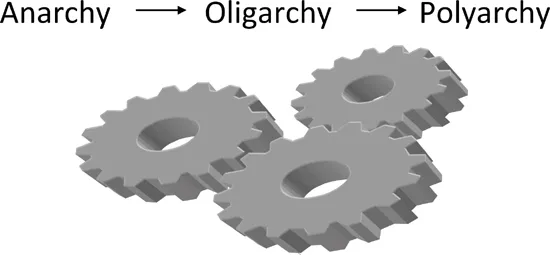
- The context within which leadership exists, both globally and locally is the starting point. Leadership in any form cannot produce results without a context within which to exist. And the context within which we live today is in many ways unique to the history of our species. The changes in technology and knock-on social changes are the most dramatic ever seen. Yet our leadership assumptions are still relatively stuck. This is looked at in more detail in Chapter 2.
- After understanding the wider context, one needs to understand the limitations of oligarchy as it exists today. These limitations are due both to the fast changing times and also result from the organisational contextual factors. We all intuitively have a healthy suspicion of the heroic charismatic leaders in a way we never seemed to have before.5 Whether we like it or not, oligarchy and its sister hierarchy exist all around us and will continue to do so for some time, despite the stresses and strains. However, structures are becoming more fluid and traditional boundaries are becoming more dynamic. Knowledge and wisdom are becoming wider spread, and this means leadership needs to be more dynamic and honest. This is looked at in more detail in Chapters 3 and 4.
- And finally, one needs to understand the dynamics of anarchy – not the philosophical nihilistic revolutionary ‘off-with-all-their-heads’ anarchy, but the anarchy of chaos and complexity. It is only recently in the area of science and mathematics that nondeterministic approaches are making their usefulness known. The development of chaos mathematics and quantum mechanics seems to go against traditional deterministic scientific theories hundreds of years old, and yet they have reaped great results. For example we would not have solid state electronics, lasers, semi-conductors, remote controls or DVDs without such advances in these relatively new ‘non-deterministic’ sciences. So perhaps it is no surprise that in the field of leadership the need for a more non-deterministic ‘complex’ approach is emerging. Complex Adaptive Leadership combines both deterministic and non-deterministic approaches to a powerful effect. This is looked at in more detail in Chapters 5, 6 and 7.
- Tao literally means ‘the way’. So at the very basic level this book proposes a new ‘way’ of leadership. However, there are some very deep precepts in Taoism which, if you ‘get’, will enable you better to understand and put into practice the powerful approaches in this book. The precepts will enable you to embrace paradox and uncertainty. This book is not just about the way of leadership generally, but a particular way which enables polyarchy to flow enabled by a type of leadership which is very dynamic, and enables Lau Tzu’s words above to become a reality.
- At the second level, this new approach to leadership expresses the dynamics of opposites and paradoxes. So far we have uncovered some paradoxes. For example we said polyarchy is about anarchy and oligarchy (two opposites at once). Perhaps the most important precept of Taoism to ‘get’ is the concept of ‘both/and’ rather than ‘either/or’.9 Within polyarchy leaders need to know how to follow those they lead as well as lead those who follow. The key symbol of Tao is the Yin/Yang symbol (the ‘T’ai C’hi Tu’). Yin means the dark side of mountain, and Yang means the light side. The Yin/Yang symbolises a basic precept of Taoism that opposites exist to complement and support each other. Opposites are a complementary dynamic rather than two antagonistic and static positions facing each other. Each has an element of each other’s opposite within themselves – the smaller circle. The Yin/Yang symbolises ‘Both/And’ rather than ‘Either/Or’. It is about going beyond opposites and realising that opposites combine to create something powerful. For example Yin is aligned to the female, and Yang to the male –...
Table of contents
- Cover Page
- Title Page
- Copyright Page
- Contents
- dedcation
- List of Figures
- Acknowledgements
- Preface: What’s This All About?
- PART 1 The Context
- PART 2 Chaos and Complexity
- PART 3 The Leadership Angle
- PART 4 Looking Forward and Other Interests
- Appendix A The Insights of Tao and Buffalo Maps
- Appendix B Polyarchy and Leadership Models1
- Appendix C Polyarchy and the Relevance to Modern Political Leadership
- Appendix D Leadership Development
- Bibliography
- Index