![]() O
O![]()
OPTICAL COUPLING IN WAVEGUIDES
Kazuhito Furuya
The power transfer, that is, the optical or mode coupling is caused by any coupling mechanism between two waves. If such couplings, are not there the multimode fibers would be used as single-mode transmission media by using only one mode to transmit a narrow pulse without any broadening. However, in practice, mode couplings are unavoidable. On the other hand, functional optical devices, such as directional-couplers, switches, etc., use the coupling as their operational principle. The basics of the coupling are described here.
Let us consider optical Waves 1 and 2 of angular frequency ω propagating in the +z direction. Waves 1 and 2 may be waves propagating either along two parallel waveguides 1 and 2 or as two Modes 1 and 2 in a single waveguide. Their amplitudes are a1(z) and a2(z), while and are their powers. When there is no coupling, amplitudes are given as
where β1 and β2 are propagation constants of waves. When there is coupling, the equation can be written as
| (1) |
where C12 is the coupling coefficient representing the amplitude transfer from Wave 2 to Wave 1 while C21 is that from Wave 1 to Wave 2. Assuming lossless waveguide, that is, (d/dz) (P1 + P2) = 0, condition C12 = –C21* is derived from Eq. (1). In the following sections, weak coupling thoery, periodic coupling, random coupling, and microbending loss in fibers are described.
WEAK COUPLING THEORY
Assuming that (weak coupling) and constant C12, substituting a1(z) = Aexp(-iβz) and a2(z) = B exp(–iβz) into Eq. (1) we obtain solutions for β, a1(z), and a2(z) as follows:
where βa = (β1 + β2)/2 (average propagation constant), (beat propagation constant) and βd = (β1 – β2)/2.
Substituting a1(0) = 1 and a2(0) = 0 as the initial condition, we obtain
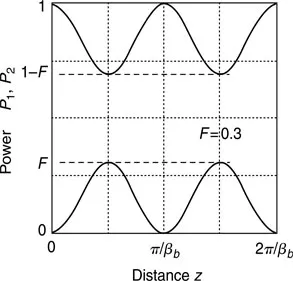
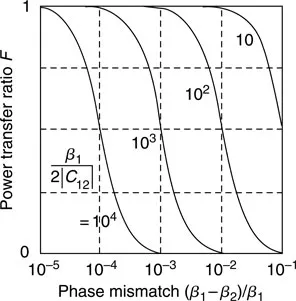
Factor F is the maximum ratio of the power transfered from one wave to the other, to the total power carried by the waves. The maximum transfer takes place at the distance of the coupling length π/2βb multiplied by an integer. Between the two waves, fractional power is transferred back and forth as shown in Figure 1. When two propagation constants coincide, β1 = β2, F is unity (100% power transfer). A relation between F and the mismatch in the propagation constant is shown in Figure 2. This is useful in designing directional coupler type devices.
PERIODIC COUPLING
When β1 ≠ β2 and the coupling coefficients are periodic functions with the period as
100% power transfer takes place. These satisfy the lossless condition C12 = –C21*. This is shown by substituting the previous and the following equation
RANDOM COUPLING
In multimode waveguides, for example, multimode fibers, even if single mode is excited, after the propagation, the power distributes over multiple modes by the mode coupling. The cause of the coupling is imperfect homogeneity of the waveguide structure along the axial direction [1,2], for example, as a result of bending of the fiber axis. Such a coupling mechanism varies at random along the axial direction.
Figure 1 Powers in Waves 1 and 2 versus propagation distance
Figure 2 Power transfer ratio versus mismatch in propagation constant
Let us consider that only Wave 1 carries the power at z = 0, β1 ≠ β2 and, therefore, the power of Wave 2 is always much smaller than that of Wave 1. Neglecting the second term in the right-hand side of the first equation in Eq. (1) we get
Substituting this into the second equation in Eq. (1)
Since C21(z’) is a statistical function of z’, any deterministic analysis is unavailable.
However, we can obtain P2(z) as follows:
where R(u) is the autocorrelation function of the function C21(z’), that is,
R(u) is symmetric with respect to the origin and decreasing function with . A characteristic length, such as l in R(u) = exp(–(u/l2) for example, is called as the correlation length. Here we assume z ≫ l in the derivation of the earlier formula. S(β) is the Fourier transform of R(u) and is equal to the power spectrum (Wiener–Khinchin’s theorem). Finally, the power of Wave 2 is proportional to the distance, and the power spectral density at β1 – β2 is the statistic function of th...