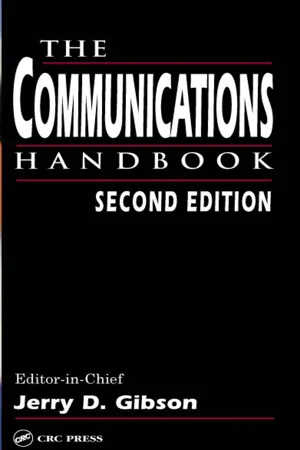
The Communications Handbook
eBook - PDF

The Communications Handbook

  1. 1,616 pages
  2. English
  3. PDF
  4. Available on iOS & Android
eBook - PDF

The Communications Handbook

About this book

For more than six years, The Communications Handbook stood as the definitive, one-stop reference for the entire field. With new chapters and extensive revisions that reflect recent technological advances, the second edition is now poised to take its place on the desks of engineers, researchers, and students around the world.

From fundamental theory to state-of-the-art applications, The Communications Handbook covers more areas of specialty with greater depth that any other handbook available.

  • Telephony
  • Communication networks
  • Optical communications
  • Satellite communications
  • Wireless communications
  • Source compression
  • Data recording

Expertly written, skillfully presented, and masterfully compiled, The Communications Handbook provides a perfect balance of essential information, background material, technical details, and international telecommunications standards. Whether you design, implement, buy, or sell communications systems, components, or services, you'll find this to be the one resource you can turn to for fast, reliable, answers.

Frequently asked questions

Yes, you can cancel anytime from the Subscription tab in your account settings on the Perlego website. Your subscription will stay active until the end of your current billing period. Learn how to cancel your subscription.
No, books cannot be downloaded as external files, such as PDFs, for use outside of Perlego. However, you can download books within the Perlego app for offline reading on mobile or tablet. Learn more here.
Perlego offers two plans: Essential and Complete
  • Essential is ideal for learners and professionals who enjoy exploring a wide range of subjects. Access the Essential Library with 800,000+ trusted titles and best-sellers across business, personal growth, and the humanities. Includes unlimited reading time and Standard Read Aloud voice.
  • Complete: Perfect for advanced learners and researchers needing full, unrestricted access. Unlock 1.4M+ books across hundreds of subjects, including academic and specialized titles. The Complete Plan also includes advanced features like Premium Read Aloud and Research Assistant.
Both plans are available with monthly, semester, or annual billing cycles.
We are an online textbook subscription service, where you can get access to an entire online library for less than the price of a single book per month. With over 1 million books across 1000+ topics, we’ve got you covered! Learn more here.
Look out for the read-aloud symbol on your next book to see if you can listen to it. The read-aloud tool reads text aloud for you, highlighting the text as it is being read. You can pause it, speed it up and slow it down. Learn more here.
Yes! You can use the Perlego app on both iOS or Android devices to read anytime, anywhere — even offline. Perfect for commutes or when you’re on the go.
Please note we cannot support devices running on iOS 13 and Android 7 or earlier. Learn more about using the app.
Yes, you can access The Communications Handbook by Jerry D. Gibson in PDF and/or ePUB format, as well as other popular books in Tecnología e ingeniería & Ingeniería eléctrica y telecomunicaciones. We have over one million books available in our catalogue for you to explore.

Table of contents

  1. Front Cover
  2. Preface
  3. Editor-in-Chief
  4. Contents
  5. 1. Complex Envelope Representations for Modulated Signals*
  6. 2. Sampling
  7. 3. Pulse Code Modulation*
  8. 4. Probabilities and Random Variables
  9. 5. Random Processes, Autocorrelation, and Spectral Densities
  10. 6. Queuing*
  11. 7. Multiplexing
  12. 8. Pseudonoise Sequences
  13. 9. D/A and A/D Converters
  14. 10. Signal Space
  15. 11. Channel Models
  16. 12. Optimum Receivers
  17. 13. Forward Error Correction Coding
  18. 14. Automatic Repeat Request
  19. 15. Spread Spectrum Communications
  20. 16. Diversity
  21. 17. Information Theory
  22. 18. Digital Communication System Performance
  23. 19. Synchronization
  24. 20. Digital Modulation Techniques
  25. 21. Plain Old Telephone Service (POTS)
  26. 22. FDM Hierarchy
  27. 23. Analog Telephone Channels and the Subscriber Loop
  28. 24. Baseband Signalling and Pulse Shaping
  29. 25. Channel Equalization
  30. 26. Pulse-Code Modulation Codec-Filters
  31. 27. Digital Hierarchy
  32. 28. Line Coding
  33. 29. Telecommunications Network Synchronization
  34. 30. Echo Cancellation
  35. 31. The Open Systems Interconnections (OSI) Seven-Layer Model
  36. 32. Ethernet Networks
  37. 33. Fiber Distributed Data Interface and Its Use for Time-Critical Applications*
  38. 34. Broadband Local Area Networks
  39. 35. Multiple Access Methods for Communications Networks
  40. 36. Routing and Flow Control
  41. 37. Transport Layer
  42. 38. Gigabit Networks*
  43. 39. Local Area Networks
  44. 40. Asynchronous Time Division Switching
  45. 41. Internetworking
  46. 42. Architectural Framework for Asynchronous Transfer Mode Networks: Broadband Network Services
  47. 43. Service Control and Management in Next Generation Networks: Challenges and Opportunities
  48. 44. Fiber Optic Communications Systems
  49. 45. Optical Fibers and Lightwave Propagation
  50. 46. Optical Sources for Telecommunication
  51. 47. Optical Transmitters
  52. 48. Optical Receivers
  53. 49. Fiber Optic Connectors and Splices
  54. 50. Passive Optical Components
  55. 51. Semiconductor Optical Amplifiers
  56. 52. Optical Amplifiers
  57. 53. Coherent Systems
  58. 54. Fiber Optic Applications
  59. 55. Wavelength-Division Multiplexed Systems and Applications
  60. 56. Geostationary Communications Satellites and Applications*
  61. 57. Satellite Systems
  62. 58. The Earth Station
  63. 59. Satellite Transmission Impairments
  64. 60. Satellite Link Design
  65. 61. The Calculation of System Temperature for a Microwave Receiver
  66. 62. Onboard Switching and Processing
  67. 63. Path Diversity
  68. 64. Mobile Satellite Systems
  69. 65. Satellite Antennas
  70. 66. Tracking and Data Relay Satellite System
  71. 67. Wireless Personal Communications: A Perspective
  72. 68. Modulation Methods
  73. 69. Access Methods
  74. 70. Rayleigh Fading Channels*
  75. 71. Space-Time Processing
  76. 72. Location Strategies for Personal Communications Services
  77. 73. Cell Design Principles
  78. 74. Microcellular Radio Communications
  79. 75. Microcellular Reuse Patterns
  80. 76. Fixed and Dynamic Channel Assignment
  81. 77. Radiolocation Techniques
  82. 78. Power Control
  83. 79. Enhancements in Second Generation Systems
  84. 80. The Pan-European Cellular System
  85. 81. Speech and Channel Coding for North American TDMA Cellular Systems
  86. 82. The British Cordless Telephone Standard: CT-2
  87. 83. Half-Rate Standards
  88. 84. Wireless Video Communications
  89. 85. Wireless LANs
  90. 86. Wireless Data
  91. 87. Wireless ATM: Interworking Aspects
  92. 88. Wireless ATM: QoS and Mobility Management
  93. 89. An Overview of cdma2000, WCDMA, and EDGE
  94. 90. Multiple-Input Multiple-Output (MIMO) Wireless Systems*
  95. 91. Near-Instantaneously Adaptive Wireless Transceivers of the Near Future*
  96. 92. Ad-Hoc Routing Techniques for Wireless LANs
  97. 93. Lossless Compression
  98. 94. Facsimile
  99. 95. Speech
  100. 96. Video
  101. 97. High Quality Audio Coding
  102. 98. Cable
  103. 99. Video Servers
  104. 100. Videoconferencing
  105. 101. Magnetic Storage
  106. 102. Magneto-Optical Disk Data Storage
  107. Index
  108. Back Cover