eBook - ePub
Computer Application in Fire Protection Engineering
- 166 pages
- English
- ePUB (mobile friendly)
- Available on iOS & Android
eBook - ePub
Computer Application in Fire Protection Engineering
About this book
A collection of papers that address such issues as model limits and reliability, emerging expert systems and integrated gas and solid phase combustion simulation models.
Information
CHAPTER 1
Critical Review of Fire-Dedicated Thermal and Structural Computer Programs
P. J. E. Sullivan, M.J. Terro, and W.A. Morris
This chapter presents a survey of available numerical methods used in the thermal and structural analysis of buildings in fire. The problem of structural response of buildings to fire is normally broken down into two distinct parts. First, a thermal analysis is performed which considers heat transfer to and heat flow within the building elements. This is followed by a determination of the mechanical response of the heated elements and their interaction with the rest of the building. In the work described in this chapter no less than seven different thermal analysis programs and fourteen structural analysis models have been identified [1]. All of these programs are in common use and can be employed to provide data as supporting evidence for regulatory compliance. Little work has been previously presented by way of general validation for these methods. More commonly, programs are validated against specific and limited test data. In achieving a good correlation between theory and practice it has been observed that it is necessary to make a number of assumptions, often in an arbitrary and empirical manner. This often means that the accuracy of output is determined by a pre-knowledge of the result. Such methods have to be used with caution and understanding. The work described in this chapter discusses the theoretical background to the programs together with their strengths and weaknesses. Some comparative bench mark testing was also carried out.
Traditional structural design methods include large safety factors, thus reducing the risk in fire. Currently, building codes of practice implement the concept of limit state of failure in design, which although more economical to implement, does not operate under the same levels of safety factors. The use of limit state methods should, therefore, be investigated to cover the design of buildings under expected hazardous conditions such as fire. The current process of design for fire is based on testing and prescriptive techniques with pseudo engineering methods for interpolation and extrapolation. Other areas of engineering do not use such out-of-date methods of design. Instead, rational procedures have been adopted based on probabilistic and deterministic calculations [2].
The current Building Regulations permit structural fire calculations and states that:
The building shall be so constructed that, in the event of fire, its stability will be maintained for a reasonable period
The key word in this clause is “building,” yet, current methods of testing only consider single elements. The stability of buildings during a fire can only be practically assessed using numerical methods.
The Approved Document B2/3/4 “Fire Spread” of the Department of the Environment [3], in support of the Building Regulations, recognizes that a satisfactory performance of a complete building structure is difficult to determine with the current state of fire engineering analysis. In view of this difficulty, it is suggested in the document that an acceptable solution can be achieved by considering results from tests on single elements providing good design practice with respect to other loads at ambient temperatures is followed. The problem of analyzing complete building structures under fire can be effectively addressed using numerical engineering methods.
Numerical methods have been applied to structural analysis since the 1960s, but computer programs dedicated to the analysis of buildings exposed to fire did not appear until a decade later. Most of the currently available programs have grown out of a number of research projects within universities or research establishments. Consequently, the programs tend to be badly structured, because the aim of the researcher is to further the science rather than to produce commercial software. A badly structured program is also inevitable as the researcher tries out various options, and then discards many of them as the work proceeds, but the discarded options often remain in the source code. A corollary of the badly structured program is poor documentation. In contrast, the large commercial software packages are well supported and documented, but the numerical models available tend to lag behind those used for research purposes. In general, the developers of the commercial software packages have not produced efficient fire temperature material models.
Commercial software packages required in the past large mainframe computers and could not be operated within the PC environment. However, with the rapid increase in computer power and technology this limitation is being overcome and many designers and product developers look toward computer modeling as an economic supplementary method to furnace testing, as a means of performance verification. The ever increasing costs of furnace tests is contrasted to the falling costs of computer software and hardware. The time scale associated with the setting up and executing of fire tests can also be significantly greater than the time required to run a computer analysis of the same problem. Additionally, numerical analysis offers greater flexibility in the choice of geometries, sizes, materials and boundary conditions.
The development of analytical techniques in structural fire engineering have been very slow, but the general level of awareness in the area of numerical modeling is growing and it is only a matter of time before these methods will be widely used by the industry.
The object of the work described in this chapter is to provide a critical review of, and recommendations on, no less than twenty one existing computer programs and their theoretical background.
Nearly fifty research workers in the field were contacted world-wide as follows:
1. Personal contact followed in some cases by meetings.
2. A detailed questionnaire was sent requesting specific information on the theoretical background of the methods adopted in modeling the effect of fire on the structure.
3. Benchmark tests were sent to authors and users of programs to solve specific thermal/structural problems.
Nineteen organizations responded positively to the contacts, and the result was that seven thermal analysis programs and fourteen different structural analysis programs have been included in this study. All of these programs are in common use and their authors claim that they can be employed to provide data as supporting evidence for regulatory compliance.
The descriptions provided in this work are based on the information received from the authors who were sent drafts for approval. In some other cases, very limited information was released by the authors, presumably because of commercial confidentiality. It was, therefore, not possible to include a description of such programs.
The numerical modeling of the effect of fire on the structural behavior of buildings has been the subject of considerable research in recent years. The majority of this research work has been concentrated in universities and other research institutions. Professional software companies, such as LUSAS, ADINA and ABAQUS, have recently started to have some interest in this field.
A survey of currently available fire-dedicated thermal and structural analysis programs is presented in this chapter. The information in this survey is based on available literature and private communication with the authors of the programs described and of necessity is dependent on the details provided.
This survey was only concerned with fire-dedicated computer models where it was possible to contact the authors of the programs during the time devoted to complete this work. Bench mark exercises were conducted with the assistance of the authors of programs covered in this survey. A summary of the conducted survey on thermal and structural programs is presented in Figures 1 and 2, respectively.
THERMAL ANALYSIS PROGRAMS
The number of existing software capable of analyzing the thermal response of materials under transient heating conditions is quite large since heat flow analysis is used in many engineering disciplines such as aeronautics, mechanics, electronics, electrical, etc. Some of these programs were developed in professional software houses, such as LUSAS, ADINA, ABAQUS, etc. These programs have many advantages including documentation, sophisticated nonlinear material models, pre/post-processing facilities, etc. The others were developed by academic research institutions and by private consultancies, such as MANIFOLD which is owned by ETA Engineering Consultants Ltd.
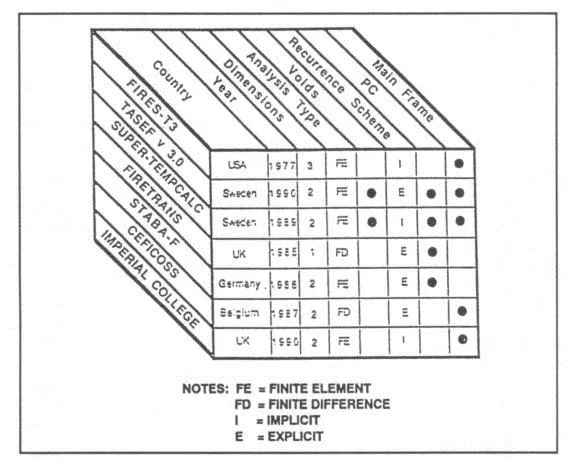
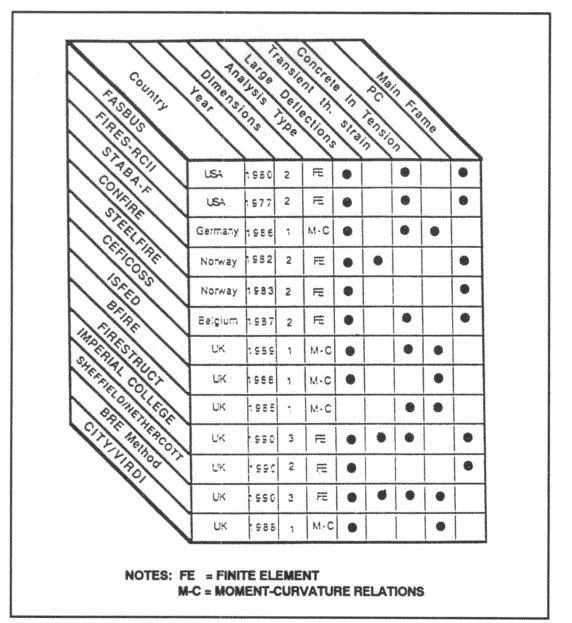
The following assumptions have been taken in the thermal analysis programs discussed in this chapter:
• The fire exposed material is assumed to be homogeneous, and effective values of thermal properties are used in the input data.
• The full effects of moisture movement and pore pressure build-up, including spalling are neglected in all programs.
• The calculation of the radiation and convection fluxes at the boundaries is simplified by the use of a resultant emissivity and convection factor which are derived by comparing predicted and measured temperature data in furnace tests.
However, despite the above-mentioned simplifications, complete reliance cannot be given to measured temperature data because of its dependency on the test conditions. Therefore, predicted temperatures using thermal analysis programs may be, in some cases, more reliable than the measured data. A few well-known fire-dedicated programs will be briefly described.
FIRES-T3
FIRES-T3 (Fire REsponse of Structures-Thermal, 3 dimensional version), is a nonlinear finite element thermal analysis program designed for the prediction of the temperature history in three dimensional continua exposed to fire conditions [4]. FIRES-T3, which can model the thermal flow in three dimensional continua, was developed by R. Iding, B. Bresler, and Z. Nizamuddin at UCB in 1977. This development research work was sponsored by the National Science Foundation and the National Bureau of Standards.
FIRES-T3 is capable of predicting the temperature distribution history in one, two or three dimensional continua consisting of different materials under fire attack.
The finite element library consists of:
1. Eight noded hexahedron and six noded tetrahedral isoparametric elements for three dimensional analysis.
2. Four noded quadrilateral and three noded triangular isoparametric elements for two dimensional analysis.
3. Two noded isoparametric bar element for one dimensional analysis.
The boundary conditions in FIRES-T3 can be Prescribed heat flow at the boundaries, known temperatures at nodes, or convection and radiation at the boundaries. FIRES-T3 can also analyze the exothermal heat generation of the body as a function of volume and time.
Heat transfer due to convection and radiation at the boundaries can be linear or nonlinear where the heat transfer coefficient is input as a function of temperature.
The thermal conductivity, specific heat capacity and density of the material are allowed to vary with temperature. The surface and gas properties are kept constant during the thermal analysis. The authors of the program recommend the use of a resultant emissivity ranging between 0.5 and 0.7 for concrete structures exposed to fire.
The time integration solution procedure implemented in FIRES-T3 is the backward...
Table of contents
- Cover
- Title Page
- Copyright Page
- Table of Contents
- Introduction
- CHAPTER 1 Critical Review of Fire-Dedicated Thermal and Structural Computer Programs
- CHAPTER 2 Reliability and Computer Models
- CHAPTER 3 The Potential of Expert Systems in Fire Safety Evaluation
- CHAPTER 4 A Model of Instability and Flashover
- CHAPTER 5 Causal Probabilistic Networks with Learning: A Diagnosis Decisional Tool
- CHAPTER 6 Limitations of Fire Models
- CHAPTER 7 The Numerical Simulation of Fire Spread Within a Compartment Using an Integrated Gas and Solid Phase Combustion Model
- CHAPTER 8 Numerical Modeling of Radiative Heat Transfer in Integrated CFD Fire Modeling
- Contributors
- About the Editor
- Index
Trusted by 375,005 students
Access to over 1.5 million titles for a fair monthly price.
Study more efficiently using our study tools.
Frequently asked questions
Yes, you can cancel anytime from the Subscription tab in your account settings on the Perlego website. Your subscription will stay active until the end of your current billing period. Learn how to cancel your subscription
No, books cannot be downloaded as external files, such as PDFs, for use outside of Perlego. However, you can download books within the Perlego app for offline reading on mobile or tablet. Learn how to download books offline
Perlego offers two plans: Essential and Complete
- Essential is ideal for learners and professionals who enjoy exploring a wide range of subjects. Access the Essential Library with 800,000+ trusted titles and best-sellers across business, personal growth, and the humanities. Includes unlimited reading time and Standard Read Aloud voice.
- Complete: Perfect for advanced learners and researchers needing full, unrestricted access. Unlock 1.5M+ books across hundreds of subjects, including academic and specialized titles. The Complete Plan also includes advanced features like Premium Read Aloud and Research Assistant.
We are an online textbook subscription service, where you can get access to an entire online library for less than the price of a single book per month. With over 1.5 million books across 990+ topics, we’ve got you covered! Learn about our mission
Look out for the read-aloud symbol on your next book to see if you can listen to it. The read-aloud tool reads text aloud for you, highlighting the text as it is being read. You can pause it, speed it up and slow it down. Learn more about Read Aloud
Yes! You can use the Perlego app on both iOS and Android devices to read anytime, anywhere — even offline. Perfect for commutes or when you’re on the go.
Please note we cannot support devices running on iOS 13 and Android 7 or earlier. Learn more about using the app
Please note we cannot support devices running on iOS 13 and Android 7 or earlier. Learn more about using the app
Yes, you can access Computer Application in Fire Protection Engineering by Paul R DeCicco, Paul DeCicco,Paul R DeCicco in PDF and/or ePUB format, as well as other popular books in Technology & Engineering & Computer Science General. We have over 1.5 million books available in our catalogue for you to explore.