- 600 pages
- English
- ePUB (mobile friendly)
- Available on iOS & Android
eBook - ePub
Integration Technologies for Industrial Automated Systems
About this book
If there exists a single term that summarizes the key to success in modern industrial automation, the obvious choice would be integration. Integration is critical to aligning all levels of an industrial enterprise and to optimizing each stratum in the hierarchy. While many books focus on the technological components of enterprise information systems, Integration Technologies for Industrial Automated Systems is the first book to present a comprehensive picture of the technologies, methodologies, and knowledge used to integrate seamlessly the various technologies underlying modern industrial automation and information systems.
In chapters drawn from two of Zurawski's popular works, The Industrial Communication Technology Handbook and The Industrial Information Technology Handbook, this practical guide offers tutorials, surveys, and technology overviews contributed by experts from leading industrial and research institutions from around the world. The book is organized into sections for cohesive and comprehensive treatment. It examines e-technologies, software and IT technologies, communication network-based technologies, agent-based technologies, and security in detail as well as their role in the integration of industrial automated systems. For each of these areas, the contributors discuss emerging trends, novel solutions, and relevant standards.
Charting the course toward more responsive and agile enterprise, Integration Technologies for Industrial Automated Systems gives you the tools to make better decisions and develop more integrated systems.
Information
Part 1
Introduction
1
Integration Technologies for Industrial Automated Systems: Challenges and Trends
1.1 Introduction
1.2 Integration Issues
1.3 Industrial Communication Systems: An Overview
Field Area Networks • Real-Time Ethernet (RTE) • Wireless Technologies and Networks • Security in Industrial Networks
References
1.1 Introduction
One of the fundamental tenets of the integration of industrial automated enterprises is unrestricted and timely flow of data between applications at different levels of the enterprise hierarchy — for example, between shop-floor and enterprise level — as well as between different applications at the same level. This data exchange takes place among various IT infrastructure elements functionality and performance requirements of which are determined by their level in the hierarchy and the application they support. They may be controllers and operator workstations at the manufacturing/process level; workstations supporting the Manufacturing Execution System application; gateway servers in between control networks and the plant network; workplaces at the enterprise or business level supporting, for example, the Manufacturing Resource Planning application; etc. The primary conduit of data exchange in modern automated systems is a specialized communication infrastructure that takes on a hierarchical arrangement, with individual networks reflecting to a large extent the needs of applications at different levels — in terms of functionality and performance (data size, throughput, delay, availability, etc.). The life cycle of a plant spans typically many decades of operation, resulting in heterogeneity of the manufacturing/process equipment installed, supporting IT infrastructure, and applications to operate and maintain the plant. This translates into a diversity of field devices and supporting industrial networks, software platforms supporting applications, and languages used to develop those applications. Integration of the communication infrastructure of a plant and applications (largely implemented in software) is needed to achieve the required seamless and timely data flow throughout the entire enterprise. This is the focus of this chapter and a large portion of the book.
Section 1.2 gives an overview of selected integration issues, followed by a section (1.3)that provides an overview of the fieldbus networks and real-time Ethernet with a focus on standards. Subsequently, wireless local and personal area networks, and wireless sensors and wireless networks in factory automation are presented, followed by selected security issues in automation networks. Because the chapter aims at providing a framework for the book, ample references are provided to cover individual topics.
1.2 Integration Issues
Advances in the design of integrated circuits and embedded systems, tools availability, and falling fabrication costs of semiconductor devices and systems (system-on-chip, SoC) have allowed for an infusion of intelligence, such as sensors and actuators into field devices. The controllers used with these devices typically provide on-chip signal conversion, data and signal processing, and communication functions. The increased functionality and processing capabilities of controllers have been largely instrumental in the emergence of a widespread trend for the networking of field devices around specialized networks, frequently referred to as field area networks [1].
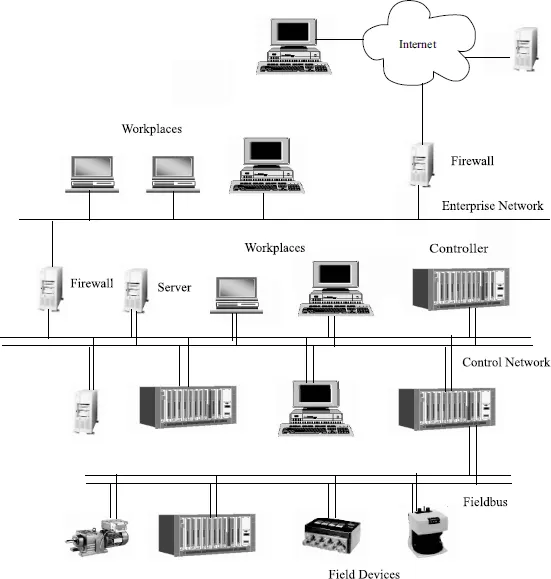
One of the main reasons for the emergence of field area networks in the first place was an evolutionary need to replace point-to-point wiring connections with a single bus, thus paving the road for the emergence of distributed systems and, subsequently, networked embedded systems with the infusion of intelligence into the field devices. A detailed description of the co-evolution of field area networks and plant automation concepts is provided in Chapter 13. A typical network architecture in industrial plant automation is shown in Figure 1.1.
The network — or a system of networks — may consist of a number of different types of networks to meet the functional and performance requirements of the enterprise hierarchy to be deployed. For example, a variety of field area networks, and sensor networks, are used at the manufacturing/process level. They are designed to support the exchange of small data records characteristic of monitoring and control actions, and are connected to process controllers. The traffic, which exhibits low data rates, is frequently subject to determinism of data transfer. To ensure the determinism, if mandated, the networks can be segmented to distribute the load. The control network(s) are used to exchange real-time data among controllers and operator workstations used for process control and supervision. There is a growing tendency for this level of networks to be based on the Ethernet and TCP/IP protocol suite. The major role play here field area networks that incorporate Ethernet for the lower two layers in the OSI model, such as PROFInet or EtherNet/IP; these are discussed in more detail in the following sections. Enterpriselevel networks are typically used for manufacturing/process execution and various enterprise management applications. The traffic is characterized by high data rates and large packets; determinism of data transfer is largely not an issue. These networks are predominantly based on the Ethernet and TPC/IP protocol suite.
The use of propriety field devices (sensors/actuators), machining tool controllers, and manufacturing/process machinery typically leads to the deployment of dedicated field area and control networks, developed to link specific devices and systems. This creates “islands of automation” integrated locally around specific and frequently incompatible network technologies and data representations. The integration solutions involve both communication infrastructure, and applications interfaces and data representation. The integration, in the context of communication aspects, involving different plant automation units or even separate automation sections within a unit, is frequently referred to as horizontal integration. The term vertical integration refers to the integration among different levels of the plant or enterprise hierarchy, from field devices via manufacturing execution systems to business applications. In general, the integration of the communication infrastructure can be achieved using, for example, generic concepts of gateways and protocol tunneling [2]; the ANSI/EIA-852 standard is discussed in Reference [3]. The use of “industrial Ethernet,” or Real-Time Ethernet (RTE), which supports real-time communication at the factory floor, is the emerging trend in both horizontal and vertical integration.
In RTE, the random and native CSMA/CD arbitration mechanism is being replaced by other solutions, allowing for deterministic behavior required in real-time communication to support soft and hard real-time deadlines, for example, time synchronization of activities required to control drives, and for exchange of small data records characteristic of monitoring and control actions. The direct support for the Internet technologies allows for vertical integration of various levels of the industrial enterprise hierarchy to include seamless integration between automation and business logistic levels to exchange jobs and production (process) data, transparent data interfaces for all stages of the plant life cycle, Internet- and web-enabled remote diagnostics and maintenance, and electronic orders and transactions. In addition, the use of standard components such as protocol stacks, Ethernet controllers, bridges, etc., allows for mitigating the ownership and maintenance cost.
The two most widely used industry standards intended to provide interfaces to hide the details of device-dependent communication protocols are the Manufacturing Messaging Specification (MMS) [4, 5] and OLE for Process Control (OPC) of the Open Control Foundation [6].
MMS is an application layer messaging protocol for communication to and from field devices such as remote terminal units, programmable logic controllers, numerical controllers, robot controllers, etc. MMS adopts the client/server model to describe the behavior of the communicating devices. The central element of this model is the concept of the Virtual Manufacturing Device (VMD), which embeds (abstract) objects representing physical devices such as sensors and actuators, for example. MMS defines a wide range of services to allow access to the VMD and manipulation of its objects, to mention some of the functions. Separate companion standards are required for the definition of application-specific objects. Most of the recent MMS implementations are built on top of TCP. A comprehensive overview of the MMS standards is presented in Chapter 6. Kim and Haas [7] reported ...
Table of contents
- Cover
- Half Title
- Title Page
- Copyright Page
- Dedication
- Preface
- Editor
- Contributors
- Table of Contents
- Part 1 Introduction
- Part 2 E-Technologies in Enterprise Integration
- Part 3 Software and IT Technologies in Integration of Industrial Automated Systems
- Part 4 Network-Based Integration Technologies in Industrial Automated Systems
- Part 5 Agent-Based Technologies in Industrial Automation
- Part 6 Security in Industrial Automation
- Author Index
- Index
Trusted by 375,005 students
Access to over 1.5 million titles for a fair monthly price.
Study more efficiently using our study tools.
Frequently asked questions
Yes, you can cancel anytime from the Subscription tab in your account settings on the Perlego website. Your subscription will stay active until the end of your current billing period. Learn how to cancel your subscription
No, books cannot be downloaded as external files, such as PDFs, for use outside of Perlego. However, you can download books within the Perlego app for offline reading on mobile or tablet. Learn how to download books offline
Perlego offers two plans: Essential and Complete
- Essential is ideal for learners and professionals who enjoy exploring a wide range of subjects. Access the Essential Library with 800,000+ trusted titles and best-sellers across business, personal growth, and the humanities. Includes unlimited reading time and Standard Read Aloud voice.
- Complete: Perfect for advanced learners and researchers needing full, unrestricted access. Unlock 1.5M+ books across hundreds of subjects, including academic and specialized titles. The Complete Plan also includes advanced features like Premium Read Aloud and Research Assistant.
We are an online textbook subscription service, where you can get access to an entire online library for less than the price of a single book per month. With over 1.5 million books across 990+ topics, we’ve got you covered! Learn about our mission
Look out for the read-aloud symbol on your next book to see if you can listen to it. The read-aloud tool reads text aloud for you, highlighting the text as it is being read. You can pause it, speed it up and slow it down. Learn more about Read Aloud
Yes! You can use the Perlego app on both iOS and Android devices to read anytime, anywhere — even offline. Perfect for commutes or when you’re on the go.
Please note we cannot support devices running on iOS 13 and Android 7 or earlier. Learn more about using the app
Please note we cannot support devices running on iOS 13 and Android 7 or earlier. Learn more about using the app
Yes, you can access Integration Technologies for Industrial Automated Systems by Richard Zurawski in PDF and/or ePUB format, as well as other popular books in Technology & Engineering & Computer Engineering. We have over 1.5 million books available in our catalogue for you to explore.