- 288 pages
- English
- ePUB (mobile friendly)
- Available on iOS & Android
eBook - ePub
Child Mental Health in Primary Care
About this book
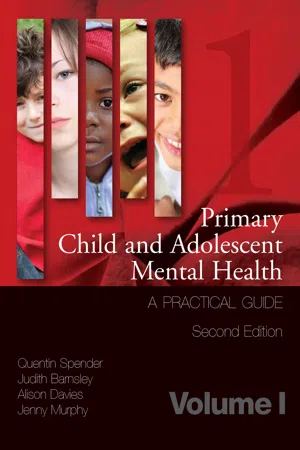
This book helps general practitioners, health visitors and other professionals working in primary care to assess, manage and refer children and adolescents with mental health problems. School medical officers, social workers and educational psychologists, many of whom are in the front line of mental health provision for children and young people, will also find it particularly useful. Each problem is covered in a uniform way, with definitions, assessment outlines, detailed management options and indications for referral. Numerous case examples further illuminate aspects of many conditions. The book supports service provision in the new primary care environment, and forms a comprehensive practical guide to the full range of difficulties and disabilities affecting the mental health of children and young people.
Information
Part 1
Introduction
Chapter One
Assessment in child mental health
Introduction
Definition of child mental health
Mental health in children and young people has been defined as:1
- a capacity to enter into and sustain mutually satisfying personal relationships
- a continuing progression of psychological development
- an ability to play and to learn so that attainments are appropriate for age and intellectual level
- a developing moral sense of right and wrong
- the degree of psychological distress and maladaptive behaviour being within normal limits for the child’s age and context.
Child mental health problems are therefore difficulties or disabilities in these areas that may arise from any number of congenital, constitutional, environmental, family or illness factors. Such problems have two components. First, the presenting features are outside the normal range for the child’s age, intellectual level and culture, and secondly, the child or others in contact with them are suffering from the dysfunction.
Prevalence
In UK studies, 2–5% of children seen in primary care settings are presented by their parents with mental health problems as the main complaint. Hyperactivity, anxiety or behavioural problems are the principal concerns.2 Interviews conducted with children and parents attending primary care services suggest that about 25% of all children who are seen by members of the primary care team have psychological difficulties associated with physical problems3 of a degree sufficient to be defined as a mental health disturbance.4 This is higher than the rate in the general population of 7–20% (varies with age, gender and locality). It is not always easy to tell whether the psychological symptoms are a consequence of the physical disorder, or whether the physical symptoms are a somatic presentation of a mental health problem (or both). The distinction is not always helpful, and it may be more valuable to view childhood illnesses as existing on a continuum from purely somatic to purely psychological (see Box 1.1).5
Box 1.1: The spectrum of childhood illness
Completely | Completely |
somatic | psychological |
The implication of these epidemiological findings is that many more children attend primary care settings who have disorders of child mental health than present with these, just as there are many children with mental health problems who do not present to primary care at all. It would not be appropriate to refer all such children to specialist settings, and in any case many parents and children do not want this. Children who are particularly likely to suffer from mental health problems are those with one or more of the risk factors shown in Box 1.2.
Box 1.2: Risk factors for psychological disturbance in children
- Chronic physical illness
- Low intelligence
- Damaged brain
- Parental psychiatric disorder
- Family disruption
- Angry, bitter family relationships
- Rejection by parents
- Rejection by peers
Assessment
The three most important parts of a child mental health assessment are the history of the presenting complaint, the developmental history and the family and social history.
The history of the presenting complaint includes what is bringing the family to the health centre, who is most worried about it, what it is they are most concerned about, what they think could be done about the problem, and why they are presenting now.
Case study 1.1
Tom, a previously healthy 9-year-old, was brought by his mother Sue to a fit-in appointment at the end of Monday morning surgery. Sue told the doctor that Tom had been suffering from stomach pains from time to time over the past few weeks, and had missed several days off school as a result. The pains were poorly localised and were not associated with any bowel or urinary symptoms, or with headaches. Tom was eating well and was as physically active as usual. The doctor examined him and could find no abnormality – indeed he seemed very well. She arranged for a urine specimen to be sent to the laboratory to exclude infection, and she advised Sue to give Tom some paracetamol and send him back to school.
Two weeks later Tom was again brought to a fit-in appointment, this time at the end of Monday evening surgery, with the same complaint. The pains were not being helped by paracetamol, and he had missed a few more days off school. Again, he appeared very healthy on examination. The urine specimen had tested negative for infection. The doctor asked whether everything was all right at school, and was told that there was no problem as far as Tom’s mother and teachers could tell. Tom did not always want to go to school, but Sue always made him go unless he was ill, when she felt she could not force him. She asked whether a blood test could be done, and the doctor agreed to send off a sample for a blood count, as she hoped that a negative result would reassure Tom’s mother that nothing too serious was going on.
At the follow-up consultation 10 days later the doctor assured Sue that the blood test was normal. However, Tom had missed several more days of school. The doctor asked if she could have a few words with Tom alone, and while his mother waited outside she asked Tom whether he was enjoying school, and about his friends. Tom was not very communicative, but denied that anything was wrong at home or at school, and told the doctor he was not afraid of anyone bullying him. The doctor informed Sue that stomach pains were quite common in children of Tom’s age, usually coming and going for a few months but then clearing up completely with time. Sue wanted to know the cause, and the doctor had to admit to uncertainty, but she explained that sometimes stomach pains were the first sign of migraine in a child. The doctor sensed that Sue was not reassured by this explanation, and offered to refer Tom for a specialist opinion. Tom’s mother then explained that she was satisfied with the doctor’s explanation, but that her husband John was worried that something serious was wrong. John insisted that if Tom was too ill to go to school he had to see the doctor the same day, so that Sue could tell John what the problem was when he came home from work that evening. John’s sister had died the previous year, at only 36 years of age, from cancer which had involved the liver, and Sue agreed that this might have made the whole family more concerned about the possible meaning of Tom’s pains. Sue felt that she should be more firm about making Tom go to school despite his pains, but that her husband would not support her in this course of action. The doctor agreed to see Tom with Sue again, but at an evening appointment when John could come along, too.
A clear description of what the child does can help enormously in understanding the nature of a problem. It is also illuminating to work out when the problem occurs, what triggers it, and how others respond to it. This may help to determine the perpetuating or maintaining causes that are keeping the problem at a troublesome level. It may be useful to ask parents to fill in an ‘ABC’ diary (see Box 1.3).
Box 1.3: An example of an ABC diary
Date, time, place | Antecedents | Behaviour | Consequences |
Tesco’s checkout, Friday, 11.00 a.m. | Being bored; seeing the sweets on the rack | Screaming, shouting, kicking | I was embarrassed – everyone was watching. I had to give in; then the screaming stopped |
Asking how and when the problem developed may help to shed light on the precipitating causes, although perpetuating causes may be more important. It is useful to bear in mind the three-part question ‘Why have this family come with this problem at this time?’6 A recently developed problem, or a chronic problem that has recently taken a turn for the worse, may provide a partial answer. In addition, it is worth enquiring about what shift in perception may have led the family to ask for help now. This may provide a clue as to how ready they are to change the way in which they currently cope with the problem.
The purpose of the developmental history is to find out whether there are any factors in the pregnancy or early years of childhood that might contribute to the current problem. It also helps to build a picture of whether attachment is secure or insecure. Some of this information may already be available in the primary care notes. Relevant factors include the following:
- medical difficulties in the pregnancy that might affect the mother’s attitude to the newborn child
- prematurity or being small for dates
- a period in the special-care baby unit
- maternal depression during the first year of the baby’s life
- difficulties with feeding, sleeping or excessive crying during the first year of life, which are usually synonymous with a difficult temperament
- developmental milestones – age of walking and progress in speech seem to be the easiest for parents to remember
- relationship difficulties between the parents during the first few years of the child’s life
- separation of the child from their primary caregiver
- excessive clinging
- integration into play group, nursery school and first full-time school
- any major losses for the child, such as death of a close relative, a parent leaving, or moving house.
The family and social history may be unnecessary if the family is well known to the practice, but there is always more to find out, and it can provide a good opportunity to involve the child. Information about who is living at home and what they do may be less important than the attitudes of different family members to the presenting problem, and the way in which it affects their lives. Additional questions that may be useful when taking the family history include the following.
- What makes this different from the other children?
- Does he remind you of anyone?
- What sort of things were you doing when you were his age?
From whom should you obtain the history?
The history is usually taken from the parents, but it is helpful if the child can contribute. The normal method used in paediatrics is to start taking the history from the parent or parents present, and then to involve the child once he is used to you. This technique can be equally useful in child mental health, but:
- it may be unpleasant for the child to hear a litany of negative comments about him. Ways around this include seeing the parents alone, or keeping the history of the presenting complaint very brief
- older children may prefer to be seen alone.
Interviewing the parents
If both parents can attend, this results in a more complete account, allows you a glimpse of the different parental perspectives, and provides an opportunity to see how the parents work together. However, it is nearly always mothers who bring children to see general practitioners, and fathers are often out at work when health visitors call, so there is little opportunity in primary care to practise interviewing two parents at once, or to reap the advant...
Table of contents
- Cover
- Title Page
- Copyright Page
- Contents
- Forewords
- Preface
- List of Contributors
- Part 1 Introduction
- Part 2 Problems that may Present at any Age
- Part 3 Problems that may Present in the First Few Years
- Part 4 Problems that may Present in School-Age Children
- Part 5 Problems that Present Mainly in Adolescence
- Part 6 Detailed Treatment Options
- Index
Trusted by 375,005 students
Access to over 1.5 million titles for a fair monthly price.
Study more efficiently using our study tools.
Frequently asked questions
Yes, you can cancel anytime from the Subscription tab in your account settings on the Perlego website. Your subscription will stay active until the end of your current billing period. Learn how to cancel your subscription
No, books cannot be downloaded as external files, such as PDFs, for use outside of Perlego. However, you can download books within the Perlego app for offline reading on mobile or tablet. Learn how to download books offline
Perlego offers two plans: Essential and Complete
- Essential is ideal for learners and professionals who enjoy exploring a wide range of subjects. Access the Essential Library with 800,000+ trusted titles and best-sellers across business, personal growth, and the humanities. Includes unlimited reading time and Standard Read Aloud voice.
- Complete: Perfect for advanced learners and researchers needing full, unrestricted access. Unlock 1.5M+ books across hundreds of subjects, including academic and specialized titles. The Complete Plan also includes advanced features like Premium Read Aloud and Research Assistant.
We are an online textbook subscription service, where you can get access to an entire online library for less than the price of a single book per month. With over 1.5 million books across 990+ topics, we’ve got you covered! Learn about our mission
Look out for the read-aloud symbol on your next book to see if you can listen to it. The read-aloud tool reads text aloud for you, highlighting the text as it is being read. You can pause it, speed it up and slow it down. Learn more about Read Aloud
Yes! You can use the Perlego app on both iOS and Android devices to read anytime, anywhere — even offline. Perfect for commutes or when you’re on the go.
Please note we cannot support devices running on iOS 13 and Android 7 or earlier. Learn more about using the app
Please note we cannot support devices running on iOS 13 and Android 7 or earlier. Learn more about using the app
Yes, you can access Child Mental Health in Primary Care by D. Phillips in PDF and/or ePUB format, as well as other popular books in Medicine & Family Medicine & General Practice. We have over 1.5 million books available in our catalogue for you to explore.