Engineers in all fields will appreciate a practical guide that combines several new effective MATLAB® problem-solving approaches and the very latest in discrete random signal processing and filtering.
Numerous Useful Examples, Problems, and Solutions – An Extensive and Powerful Review
Written for practicing engineers seeking to strengthen their practical grasp of random signal processing, Discrete Random Signal Processing and Filtering Primer with MATLAB provides the opportunity to doubly enhance their skills. The author, a leading expert in the field of electrical and computer engineering, offers a solid review of recent developments in discrete signal processing. The book also details the latest progress in the revolutionary MATLAB language.
A Practical Self-Tutorial That Transcends TheoryThe author introduces an incremental discussion of signal processing and filtering, and presents several new methods that can be used for a more dynamic analysis of random digital signals with both linear and non-linear filtering. Ideal as a self-tutorial, this book includes numerous examples and functions, which can be used to select parameters, perform simulations, and analyze results. This concise guide encourages readers to use MATLAB functions – and those new ones introduced as Book MATLAB Functions – to substitute many different combinations of parameters, giving them a firm grasp of how much each parameter affects results.
Much more than a simple review of theory, this book emphasizes problem solving and result analysis, enabling readers to take a hands-on approach to advance their own understanding of MATLAB and the way it is used within signal processing and filtering.
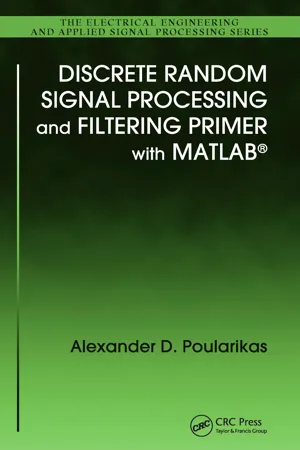
eBook - ePub
Discrete Random Signal Processing and Filtering Primer with MATLAB
- 300 pages
- English
- ePUB (mobile friendly)
- Available on iOS & Android
eBook - ePub
Discrete Random Signal Processing and Filtering Primer with MATLAB
About this book
Information
chapter one
Fourier analysis of signals
1.1 Introduction
One of the most fundamental information of any signal is its cyclic or oscillating activity. Our main interest is to determine the sinusoidal components of the signal, the range of their amplitude and frequency values.
Fourier analysis provides us with different tools, which are appropriate for particular type of signals. If the signal is periodic and deterministic, we use Fourier series analysis. If the signal is finite and deterministic, we use the Fourier transform (FT). For discrete time signals the discrete FT (DFT) is used, whereas the random signals need special approaches for their frequency content determination. Figure 1.1 shows a deterministic periodic, a deterministic finite and a random signal.
1.2 Fourier transform (FT)
The FT is used to find the frequency content of those signals that, at least, satisfy the Dirichlet conditions, which are (1) the signal has finite values of its maximum and minimum within a finite interval, (2) the signal has finite number of disco...
Table of contents
- Cover
- Half Title
- Title Page
- Copyright Page
- Table of Contents
- Preface
- Author
- Abbreviations
- Chapter 1 Fourier analysis of signals
- Chapter 2 Random variables, sequences, and stochastic processes
- Chapter 3 Nonparametric (classical) spectra estimation
- Chapter 4 Parametric and other methods for spectra estimation
- Chapter 5 Optimal filtering—Wiener filters
- Chapter 6 Adaptive filtering—LMS algorithm
- Chapter 7 Adaptive filtering with variations of LMS algorithm
- Chapter 8 Nonlinear filtering
- Bibliography
- Appendix A Suggestions and explanations for MATLAB® use
- Appendix B Matrix analysis
- Appendix C Lagrange multiplier method
- Index
Trusted by 375,005 students
Access to over 1.5 million titles for a fair monthly price.
Study more efficiently using our study tools.
Frequently asked questions
Yes, you can cancel anytime from the Subscription tab in your account settings on the Perlego website. Your subscription will stay active until the end of your current billing period. Learn how to cancel your subscription
No, books cannot be downloaded as external files, such as PDFs, for use outside of Perlego. However, you can download books within the Perlego app for offline reading on mobile or tablet. Learn how to download books offline
Perlego offers two plans: Essential and Complete
- Essential is ideal for learners and professionals who enjoy exploring a wide range of subjects. Access the Essential Library with 800,000+ trusted titles and best-sellers across business, personal growth, and the humanities. Includes unlimited reading time and Standard Read Aloud voice.
- Complete: Perfect for advanced learners and researchers needing full, unrestricted access. Unlock 1.5M+ books across hundreds of subjects, including academic and specialized titles. The Complete Plan also includes advanced features like Premium Read Aloud and Research Assistant.
We are an online textbook subscription service, where you can get access to an entire online library for less than the price of a single book per month. With over 1.5 million books across 990+ topics, we’ve got you covered! Learn about our mission
Look out for the read-aloud symbol on your next book to see if you can listen to it. The read-aloud tool reads text aloud for you, highlighting the text as it is being read. You can pause it, speed it up and slow it down. Learn more about Read Aloud
Yes! You can use the Perlego app on both iOS and Android devices to read anytime, anywhere — even offline. Perfect for commutes or when you’re on the go.
Please note we cannot support devices running on iOS 13 and Android 7 or earlier. Learn more about using the app
Please note we cannot support devices running on iOS 13 and Android 7 or earlier. Learn more about using the app
Yes, you can access Discrete Random Signal Processing and Filtering Primer with MATLAB by Alexander D. Poularikas in PDF and/or ePUB format, as well as other popular books in Technology & Engineering & Electrical Engineering & Telecommunications. We have over 1.5 million books available in our catalogue for you to explore.