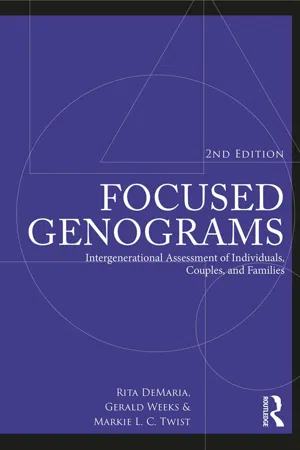
Focused Genograms provides a cutting-edge guide to utilizing the Intersystem Approach meta-framework and attachment theory to construct focused genograms. Focused genograms are graphic representations of intergenerational family interactions, and can be tailored to themes. This new volume includes nearly two decades of research, clinical experience, and theory; including rapidly expanding empirical support of attachment theory, gender, and trauma theory. It will allow the reader to comprehensively develop assessment and treatment planning for a wide range of client-systems. The clinical approach to using Focused Genograms traces intergenerational patterns of attachment and helps the therapist create an attachment-focused bond with client-systems of all types.
eBook - ePub
Focused Genograms
Intergenerational Assessment of Individuals, Couples, and Families
- 296 pages
- English
- ePUB (mobile friendly)
- Available on iOS & Android
eBook - ePub
Focused Genograms
Intergenerational Assessment of Individuals, Couples, and Families
About this book
Information
PART I
The Intersystem Approach and Integration of Attachment Theory
1
THE INTERSYSTEM APPROACH
Intergenerational Assessment and Clinical Practice
The Intersystem Model… stands as the most ambitious integrative couple therapy models to date.
—Gurman and Frankel (2002, p. 237)
Overview
The first edition of Focused Genograms: Intergenerational Assessment of Individuals, Couples, and Families (DeMaria, Weeks, & Hof, 1999) proposed a comprehensive model for developing genograms that included focused genograms for specific clinical issues, and introduced an attachment focused genogram. Family maps, timelines, and internal models maps were also introduced as part of this integrative approach to assessment. At that time, the second author (GW) had begun to clarify and expand the use of the Intersystem Approach (IA), an integrative model for assessment and treatment of individuals, couples (mono- and multi-partnered alike),1 and families (Weeks & Fife, 2014; Weeks & Hof, 1994; Weeks & Treat, 2001). As an important part of a systemic meta-framework, genograms are useful, not just in family assessment, but also in the assessment of any unit of treatment—individuals, couples, or families. Hereafter, when we (RD, GW, and MLCT)2 use the term client-system, we are referring to any unit of treatment whether it is an individual, a couple, or a family.
The purpose of this chapter is to give the reader an overview of the IA as the conceptual framework for this book and to introduce the integration of attachment theory (Ainsworth, 1973; Bowlby, 1969, 1973) as a new construct within the IA, especially as it applies to the intergenerational domain of the IA. In practice, the IA is a systemic approach that provides an integrative meta-framework that applies to individual, couple, and family therapy. This chapter summarizes the key developments and concepts of the IA as an integrative approach that allows the clinician to draw together multiple theories in understanding and treating client-systems. Gurman and Frankel (2002) noted in their millennial review that the IA “stands as one of the most ambitious integrative couple therapy models proposed to date” (p. 237).
The further integration of attachment theory within the IA as an intergenerational relational experience that affects individuals, couples, and families is the most notable, important, and exciting contribution in this second edition of Focused Genograms! The inclusion of attachment theory as an integrational construct is critical in understanding any client-system (Gold, 2011). Contemporary approaches for developing integrative approaches to treatment highlight the value of attachment theory as a component of integrative models (Connors, 2011). For example, Fitzgerald (2014) pointed out that attachment theory provides four dimensions for understanding assessment and treatment irrespective of the theoretical model being used. In fact, he demonstrated its utility with therapies such as schema, brief dynamic, interpersonal, emotionally focused, and other therapies. The four dimensions that are added through attachment theory include (1) a better understanding of the symptoms as an expression of the attachment system, (2) the primacy of emotion and its regulation, (3) making metacognition (reflection upon one’s own thoughts and feelings as changeable constructs) both a means and end in therapy, and finally (4) the creation of secure attachment experiences in the lives of clients. The outcome studies of emotionally focused couple’s therapy (Johnson, 2009) establish the reduction of relationship distress by establishing more secure connections between the couple.
Although attachment focused genograms were presented in the first edition, attachment theory is a new integrational construct for the IA across the three domains: the individual, the couple, and the intergenerational. The intergenerational domain of the IA extends attachment scripts that go beyond the usual three-generation, extending into family history or past generations (four generations or more), which allows important themes and legacies to emerge. Often family narratives, and in particular those that highlight attachment scripts, are important to explore in clinical practice. The contextual aspect of any client-system (outer dialectic) is a fourth domain (as proposed by Riegel, 1976), and it attends to external influences and provides a focus on postmodern family forms, culture, history, religion, and the physical environments such as geographical, political, climatic, and natural disasters. The postmodern family refers to any group of people who are highly committed to each other and involved in each other’s lives such as church family, fictive family, family of choice, or sorority family. The comprehensive meta-framework of the IA is consistent with Riegel’s dialectical theory and Wachtel’s (1997) concept of a theory that is integrative. These models were important to the integrative structure of the IA (see Table 1.1 for meta-framework of the IA to therapy).
The IA is an integrative approach to treatment, and it allows the clinician to transcend any particular model of individual or relational therapy by focusing on multiple aspects of the client-system and by linking intergenerational transmission of attachment processes to all facets of human development. For each particular client-system, the IA explores the individual, couple/partner(s), intergenerational (including multi-generational) as well as larger contextual factors such as culture, history, and the physical environment. The clinical model provided by the IA is based on a comprehensive or meta-theoretical paradigm of treatment. In this second edition of Focused Genograms, we have added a number of new concepts. These will all be discussed in Part I, which includes Chapters 1 and 2 that describe the IA and the Intergenerational Transmission of Attachment. Then, in Chapters 3 and 4, we describe the Focused Genogram Road Map, the Attachment Focused Mapping and Timelines, and Therapeutic Posture (TxP, the attachment focused bond within the therapeutic alliance). These chapters provide a comprehensive foundation for developing attachment focused assessment and interventions.
A new application of attachment theory in the IA is the use of an attachment focused therapeutic alliance, which attends to the goals, tasks, and bonds that develop in the beginning phase of treatment. The application of attachment theory in developing a therapeutic bond is termed therapeutic posture (TxP). The clinician’s role is to join and accommodate to the client-system (Asay & Lambert, 1999; Minuchin, 1974) in a unique way using TxP. In most approaches to therapy, the client-system must adapt to the therapeutic modality being offered by the clinician, as well as the interpersonal dynamics of the therapist. When the therapist uses the meta-theoretical framework of the IA, the therapy can be adapted to the client-system. The clinician particularly focuses on the intergenerational patterns of attachment transmission including how these patterns affect the relationship between the therapist and the client-system in each domain, regardless of the presenting constellation.
Therapeutic posture begins with an assessment of the client-systems’ individual attachment styles, the couple’s attachment interaction patterns, and intergenerational attachment scripts. The clinician adapts to these patterns at the beginning of treatment through joining and accommodation while establishing a unique therapeutic posture for each person in treatment. Through the use of therapeutic posture, the formation of a solid therapeutic alliance occurs with greater ease. This is because the therapist can immediately form a congruent relationship with the client-system based on an assessment of attachment styles. In short, the IA allows the clinician the flexibility to adapt to the relational needs of the client-system. We describe this attuned therapeutic posture in detail in Chapter 4. Simultaneously, differential theories and/or specific therapeutic models are chosen by the therapist that are then adapted to the particular client-system following the principles of the meta-theory. The IA directs the therapist’s attention in assessing each domain of behavior/influence with particular attention to understanding the client-system through the integrational constructs. This information allows the therapist to understand the etiology of the problem and how to treat it in a comprehensive way. The next step is to employ specific approaches to therapy in order to facilitate change.
Development of the Intersystem Approach
Early systems thinkers were so intent on differentiating themselves from intrapsychic approaches to therapy that they wholly discarded seeing the person as an individual within a system (Weeks & Hof, 1994; Weeks & Treat, 2001). The early systemic approaches focused on relational patterns and systemic processes, which, while innovative, neglected exploration of the self-system (Brown, 2010). The first rebuttal to this initial myopia toward the importance of the individual emerged in the 1980s at the Marriage Council of Philadelphia (now known as Council for Relationships). This paper was strongly grounded in psychodynamic concepts in which Berman, Lief, and Williams (1981) developed a “model of marital interaction” that was a preliminary attempt to bring together dynamic and systemic approaches, as well as adult development. They suggested an eclectic structure; drawing from a psychodynamic model for individual functioning, contract theory for couple relationship functioning and relationship development, and intergenerational transmission processes. However, because their model lacked any philosophical underpinning and the integrational constructs needed to connect the combined modalities, it did not qualify as an integrative theory (Van Kaam, 1969).
In an effort to meet the need for a truly integrative approach, Weeks presented his initial conceptualization of the Intersystem Model (now called the Intersystem Approach) in Treating Couples: The Intersystem Model of the Marriage Council of Philadelphia (Weeks, 1989). Weeks edited the book and included a chapter he authored on the Intersystem Model. The chapter laid a foundation for an integrative approach that he had been refining for a number of years (Bopp & Weeks, 1984; Weeks, 1977, 1986; Weeks & Wright, 1979). In these works, Weeks argued that the field needed to move beyond theoretical fragmentation, and he stated that too much emphasis was placed on purist models of therapy. An integrative approach based on theoretical constructs allows for a systematic melding of different approaches and for the conceptualization of the client-systems’ problems at multiple levels (Brown, 2010; L’Abate, 2012, 2013; Lebow, 1997).
Weeks proposed the first complete iteration of his IA in an edited book entitled The Marital-Relationship Therapy Casebook: Theory and Application of the Intersystem Model (Weeks & Hof, 1994). This presentation expanded on the ideas and concepts developed in the 1989 text. A series of books were published between 1987 and 1999: DeMaria et al. (1999), Weeks and Hof (1987, 1994), and Weeks and Treat (1992). These works are part of an ongoing series of other books, chapters, and journal articles that Weeks has authored, and that continue to expand. For example, another iteration of the theory can be found in a chapter on a new paradigm to sex therapy written by Weeks and Gambescia (2015). In 1995, Howard Protinsky reviewed five of these texts. He noted that the 1989 and 1994 (Weeks & Hof) texts presented a
Very sound explanation of the foundational and integrational constructs that are necessary for the creation of a comprehensive theoretical model… by using integrational constructs from social psychology, Weeks… was able to develop a truly integrative model rather than an eclectic approach. …Such a creation is unique in our field… (of a comprehensive model of marital interaction).
(Protinsky, 995, p. 373)
Weeks drew the philosophical underpinnings of the IA from concepts developed by Basseches (1980, 2005), Riegel (1976), and van Kaam (1969). These concepts included attention to the need for a foundational construct that included a meta-theory of change, the need for a meta-theory of human development, and a dialectical conceptual process that allowed for an understanding of dynamic relationships among systems. However, the IA needed more than these foundational constructs. Weeks refined the basic domains of the approach to include the individual (biological and psychological aspects), the couple, intergenerational or multi-generational, and contextual. In addition to the integrational constructs that were already part of the theory, DeMaria suggested the addition of attachment theory. Much of this volume will discuss the importance of attachment theory, especially in the development of the alliance with the client-system, and understanding the role of attachment in each of the behavioral domains.
Some past approaches to therapy consisted of the combination of two ‘pure’ approaches through a process of eclecticism rather than integration. Merely combining approaches in this way fails to address the flaw that prompted the need for hybrid theories in the first place—an incomplete conceptualization of the multi-dimensional nature of the family system! Effective theories must recognize that client-systems are composed of individuals who are the products of intergenerational systems and must draw from a wide array of techniques from several therapeutic modalities (Gurman & Frankel, 2002). Individually oriented theorists do not recognize the contextual or systemic nature of problems, and systems theorists fail to recognize that systems are composed of individuals who have unique attributes such as ego-defenses, attributional styles, attachment styles, individual psychopathologies, and so forth. In the IA, a wide lens is used that includes the domains of individual behavior, couple/partner(s) behavior, and intergenerational behavior within a larger context. Each domain of behavior is rich with theoretical and therapeutic concepts. In other words, we have a plethora of individual, couple, and family therapy approaches, which are often used in their “pure” form or eclectically, but very few approaches to therapy are defined as integrative. Thus, therapists working from our approach will be aware of all domains of a system and will have the ability to integrate a broad array of specific therapeutic approaches.
In order to develop a theoretically comprehensive or integrated approach, all three domains of behavior (the contextual domain is excluded because it is considered a domain of influence, not behavior) need to be included and integrational constructs need to tie them together in a systematic way. Weeks selected concepts from the work of Strong and Claiborn (1982) as the initial integrational constructs. These early integrational constructs included interpretation, definition, prediction, congruence, interdependence, and attribution. These concepts will be described later.
A meta-theoretical framework and integrational constructs allow for the systematic integration of a wide variety of therapeutic modalities or specific theories of therapy. Treatment approaches that have typically been applied to working with individuals, such as cognitive-behavioral, emotion focused, or psychodynamic models, may be incorporated into the IA, and then they become part of a systemic view of the client-system. These concepts may be used to conceptualize the functioning of the individual and those problems that stem from individually oriented phenomena including social, intellectual, and emotional developments. In the same way, treatment models that have typically been applied to working with couples and families with focus on interactional patterns are incorporated in the IA with attention to ...
Table of contents
- Cover
- Half Title
- Title Page
- Copyright Page
- Dedication
- Table of Contents
- List of Figures and Tables
- About the Authors
- Preface
- Acknowledgments
- Abbreviations
- Introduction
- PART I The Intersystem Approach and Integration of Attachment Theory
- PART II Re-Introducing Focused Genograms and Therapeutic Posture
- PART III The New and Expanded Attachment Focused Genograms
- Index
Trusted by 375,005 students
Access to over 1.5 million titles for a fair monthly price.
Study more efficiently using our study tools.
Frequently asked questions
Yes, you can cancel anytime from the Subscription tab in your account settings on the Perlego website. Your subscription will stay active until the end of your current billing period. Learn how to cancel your subscription
No, books cannot be downloaded as external files, such as PDFs, for use outside of Perlego. However, you can download books within the Perlego app for offline reading on mobile or tablet. Learn how to download books offline
Perlego offers two plans: Essential and Complete
- Essential is ideal for learners and professionals who enjoy exploring a wide range of subjects. Access the Essential Library with 800,000+ trusted titles and best-sellers across business, personal growth, and the humanities. Includes unlimited reading time and Standard Read Aloud voice.
- Complete: Perfect for advanced learners and researchers needing full, unrestricted access. Unlock 1.5M+ books across hundreds of subjects, including academic and specialized titles. The Complete Plan also includes advanced features like Premium Read Aloud and Research Assistant.
We are an online textbook subscription service, where you can get access to an entire online library for less than the price of a single book per month. With over 1.5 million books across 990+ topics, we’ve got you covered! Learn about our mission
Look out for the read-aloud symbol on your next book to see if you can listen to it. The read-aloud tool reads text aloud for you, highlighting the text as it is being read. You can pause it, speed it up and slow it down. Learn more about Read Aloud
Yes! You can use the Perlego app on both iOS and Android devices to read anytime, anywhere — even offline. Perfect for commutes or when you’re on the go.
Please note we cannot support devices running on iOS 13 and Android 7 or earlier. Learn more about using the app
Please note we cannot support devices running on iOS 13 and Android 7 or earlier. Learn more about using the app
Yes, you can access Focused Genograms by Rita DeMaria,Gerald R. Weeks,Markie L. C. Twist in PDF and/or ePUB format, as well as other popular books in Psychology & Mental Health in Psychology. We have over 1.5 million books available in our catalogue for you to explore.