- 324 pages
- English
- ePUB (mobile friendly)
- Available on iOS & Android
eBook - ePub
Staff Management in Library and Information Work
About this book
This standard text has been fully revised and updated for its fourth edition to reflect continuing technological changes, as well as issues such as social inclusion, lifelong learning and European employment legislation. Chapter 1 on the working environment has been completely rewritten. The present environment brings problems of staff motivation, de-professionalization and the loss of control: Chapter 2 reminds readers of basic motivation theories, now presented in a more logical sequence, and how to deal with such problems. Chapter 3 on workforce planning has been retitled Human Resource Planning and revised to take into account the modes of staffing appropriate for today's turbulent environment. Effective human resource planning requires excellent selection and recruitment procedures: best practice and developments in this area are explored in Chapters 4, Job Descriptions and Person Specifications, and 5, Recruitment and Selection of Staff. In Chapter 6 on staff appraisal more attention has been given to multi-rating approaches, such as 360° whereby different aspects of work can be assessed by different groups of people, and to appraisal of junior by senior staff. The last decade has seen increased emphasis on training and development to deliver high quality services in a climate of constant change. Chapter 7 has therefore been reordered and expanded in order to reflect new approaches and changes in this area. In Chapter 8, Staff Supervision and Interpersonal Skills, recent emphasis on leadership and counselling skills are reflected, as is the growing need to do more with less through enhanced time management and stress management techniques. With this new edition, this core guide brings professionals involved in managing library and information staff up to date with how to cope with the most pressing problems and challenges in today's fast-changing environment.
1 The working environment
Libraries and information units have become increasingly involved in management practices as their parent bodies (local authorities, educational institutions, voluntary organizations, industrial and professional firms) have adopted more systematic approaches to management, and so, in turn have impelled the information services to justify their operations in relation to user needs. Expenditure on staffing has not diminished, and in the vast majority of organizations it continues to account for over half the overall budget. Further staff are the means by which organizations can ensure that they deliver what their customers require. For these reasons, it is necessary to get the most value from this key resource, and this can be achieved by giving careful and well-informed attention to each stage in staff management.
First, it is important to analyse and evaluate existing jobs and staffing structures, and to modify them in relation to changing priorities, such as the delivery and support of information technology (see Chapter 4), whilst taking account of the balance between supply and demand for library and information workers (Chapter 3). Second, it is vital to have a well-thought out recruitment strategy using staff who are skilled in drawing up person specifications and following them through, in interviewing, and in other selection methods (see Chapter 5). Staff appraisal, whether formal or informal, reveals the success or otherwise of recruitment policies and practices, but staff cannot perform well if training and development are neglected. Frequently, appraisal reveals further training needs which, if met, will help staff to increase their expertise and overcome weaknesses in knowledge, skills or attitudes. Staff appraisal schemes are covered in Chapter 6, and training and development in Chapter 7.
All these phases in staff management can only be put into practice successfully by people with a range of communication skills, and an understanding of motivation at work. Chapter 2 considers motivation and job satisfaction. Chapter 8 suggests strategies for developing personal and interpersonal skills, particularly through assertiveness training, analysis of personal management styles, the management of stress, time management, and the development of skills which increase effectiveness in group work. It gives guidance on how to supervise staff, which seems to cause many problems in library and information work, both for new professionals and for more senior staff when promotion moves them to a job where they spend more time managing other people. Chapter 8 also discusses the need for strong leadership – essential in the climate of rapid change which has come to characterize all working environments.
A basic definition of management is ‘getting things done through people’, and the following questions, which are of current concern to library managers, indicate how pervasive staff management is in translating an organization’s goals into reality:
- How can we improve our performance by making more effective use of available resources such as funding, materials, accommodation and staff?
- How can we manage innovation and develop a positive approach to change?
- How can we evaluate information services, in order to justify our work to those who pay our salaries?
- How can we analyse work methods and procedures to develop cost-effectiveness?
- How can we ensure that staff development and organizational development take place, thus minimizing stagnation among more established staff, and frustration at lack of opportunities among new staff?
- How can we encourage staff at all levels to assume more responsibility, come up with ideas and initiate projects, rather than interpret their jobs as unchanging routines?
Anyone who is responsible for other staff, even one or two, is – or should be -engaged in staff management. The term ‘management’ is often misunderstood by librarians, who believe that only ‘managers’ manage, or that management is something that happens at the most senior levels. Management is in some minds seen as an undesirable activity which removes one from the ‘real’ professional practice of librarianship, and incarcerates one in an office, to work endlessly on new bureaucratic rules and procedures. The view taken in this book is that management skills are useful at all levels. They are just as important for a subject librarian planning an induction programme for new students, or a community librarian planning an information service for the unemployed or the housebound, as they are for senior staff planning a matrix management structure, or assessing priorities over the next five years for staff training and development. Staff also need to be able to analyse the way they are being managed, and to learn from the experience.
THE MANAGEMENT CYCLE
The management of staff does not take place in a vacuum. It requires a clear idea of what has to be done, and therefore an understanding of the cyclical nature of effective management. The starting point has to be the objectives of the library or information service, which will have been derived from an analysis of its role in relation to the objectives of the organization of which it is a part and an examination of the needs of the community it is serving. In today’s changing environment, in which political and economic pressures dominate, there is bound to be a good deal of heart-searching about the objectives or purposes of libraries.
The turbulent environment identified by such management gurus as Tom Peters has meant that organizations have had to develop ‘clear, agreed, definitions of corporate aims’ and have needed ‘to identify the implications of organizational objectives in terms of information needs and information activities to meet the objectives successfully’.1
The popularity of various management techniques has changed over the years, but there is an acceptance of the need to evolve processes which ensure that all managers aim for and achieve what the organization requires. Management By Objectives (MBO), which was commonplace in the 1970s, can be seen to have evolved into systems which are of use to many organizations. The Investors in People (IiP) standard in the UK can be viewed as a natural development of this approach, focusing as it does on the achievement of business objectives through the effective management of the workforce.
The Investors in People standard emerged in the early 1990s from the work of the National Training Task Force in collaboration with bodies such as the Confederation of British Industry (CBI), the Trades Union Congress (TUC) and the Institute of Personnel and Development (IPD). The original impetus for the work was concern over the reasons behind the UK’s lack of competitiveness within Europe. Following extensive testing, IiP was implemented in 1991:
The Standard provides a national framework for improving business performance and competitiveness, through a planned approach to setting and communicating business objectives and developing people to meet these objectives. The result is that what people can do and are motivated to do, matches what the organisation needs them to do. The process is cyclical and should engender the culture of continuous improvement.2
IiP provides a framework which enables managers to ensure that the performance of their service is focused, effective and responsive to the many changes which influence it. For example, in the public library sector, where managers must respond to requirements of Best Value – that is, deliver continuous improvement to services through a combination of economy, efficiency and effectiveness – IiP is ‘an opportunity to prove their business-like credentials’.3
The clear link within IiP between organizational objectives and the development of skills has led many to view the standard as being purely concerned with staff training. This is not the case: ‘the IiP focus is not just concerned with training and development on its own, but with the integration of human resources to corporate planning via a strategic framework’.4
There is often a good deal of confusion about objectives terminology. We have found it helpful to distinguish three types of objective:
- Aims (also referred to as philosophy, mission, overall objectives) state the business the library and information service believes it is engaged in, for example to promote the spread of knowledge, information, education and culture.
- Key tasks are broad statements which sum up the main objectives of the service, such as to encourage and support individuals in developing and maintaining the skill of reading.
- Specific objectives (also referred to as targets or goals) are usually concerned with specific services, or with management and administration, such as organizing customer care courses for all staff during the next twelve months.
The specific objectives and the key tasks need to be compatible with the aims. In many library and information services, staff will be required to decide upon specific objectives annually. The management style will dictate how decisions are made and who makes them. Chapters 2 and 8 will help readers to analyse management styles in their own institutions, which may well differ among departments. In a turbulent environment, staff have to change their objectives and priorities quickly, and the management style should not only permit this to happen, but should reward enterprise.
In order to achieve objectives, activities are needed, which require resources such as time, equipment and money. There should also be some control mechanisms to monitor and evaluate how well the objectives have been achieved, and to enable staff to learn from the experience and to make changes where necessary.
The management cycle will therefore resemble that shown in Figure 1.1.
The relationship between objectives, approaches and the appraisal of individuals can be readily appreciated, and is discussed further in Chapter 6.
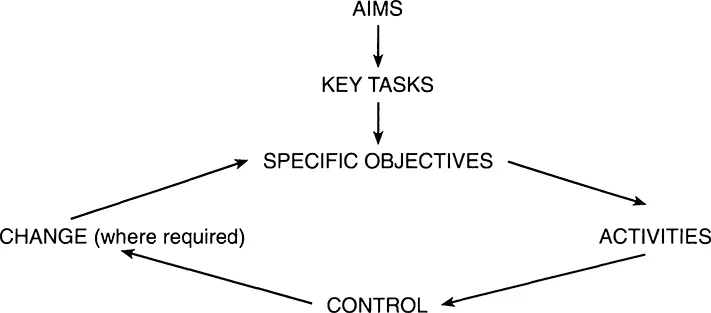
Figure 1.1 The management cycle
Drivers for Change
Legislation, public opinion, government policy and social change all affect the library and information sector. In her 1998 presidential address to the Institute of Information Scientists, Ward identified the following as factors which ‘are influencing and will continue to influence our development’:
- intensifying competition
- accelerating change
- continuing information explosion
- communication and information technologies
- information for all
- information and knowledge-based differentiation
- knowledge management.5
Each of these points has been the focus of UK government attention at some point since the change in government in 1997, and prominence on the political agenda magnifies the effect that these factors have upon the library and information sector. In the Foreword to Staff in the New Library: Skill Needs and Learning Choices, Kempster states: ‘Working in libraries will never be the same again.’6 This statement encapsulates the sense of immense change which the library and information sector has been experiencing over the last few years. Kempster was introducing a report on the findings of a project which focused on the public library sector, but with a liberal interpretation of ‘libraries’, her words are equally applicable to every aspect of today’s information profession. Continuous organizational change has become a feature in all sectors, and has been ‘made necessary by the effects of the convergence of information technology (IT) and communications’.7 This ongoing upheaval has led every part of the library and information sector to examine its role and function. Government, through its emphasis on issues such as competitiveness, lifelong learning and social inclusion, has provided impetus for this scrutiny and reappraisal of the role of the library/information professional. These factors, combined with the advent of a new millennium, have resulted in many projects, reports and articles in which the present and possible future roles of those working in the sector are explored and hypothesized.8
CHANGING ROLES
Libraries in higher education (HE) were prompted to reconsider their role ahead of other parts of the public sector when, in 1993, the Joint Funding Councils’ Libraries Review Group published the Follett Report, which high-lighted the expe...
Table of contents
- Cover Page
- Half title
- Title
- Copy
- List of figures
- List of tables
- Preface
- 1 The working environment
- 2 Motivation and job satisfaction
- 3 Human resource planning
- 4 Job descriptions and person specifications
- 5 Recruitment and selection of staff
- 6 Staff appraisal
- 7 Staff training and development
- 8 Staff supervision and interpersonal skills training
- References
- Index
Trusted by 375,005 students
Access to over 1.5 million titles for a fair monthly price.
Study more efficiently using our study tools.
Frequently asked questions
Yes, you can cancel anytime from the Subscription tab in your account settings on the Perlego website. Your subscription will stay active until the end of your current billing period. Learn how to cancel your subscription
No, books cannot be downloaded as external files, such as PDFs, for use outside of Perlego. However, you can download books within the Perlego app for offline reading on mobile or tablet. Learn how to download books offline
Perlego offers two plans: Essential and Complete
- Essential is ideal for learners and professionals who enjoy exploring a wide range of subjects. Access the Essential Library with 800,000+ trusted titles and best-sellers across business, personal growth, and the humanities. Includes unlimited reading time and Standard Read Aloud voice.
- Complete: Perfect for advanced learners and researchers needing full, unrestricted access. Unlock 1.5M+ books across hundreds of subjects, including academic and specialized titles. The Complete Plan also includes advanced features like Premium Read Aloud and Research Assistant.
We are an online textbook subscription service, where you can get access to an entire online library for less than the price of a single book per month. With over 1.5 million books across 990+ topics, we’ve got you covered! Learn about our mission
Look out for the read-aloud symbol on your next book to see if you can listen to it. The read-aloud tool reads text aloud for you, highlighting the text as it is being read. You can pause it, speed it up and slow it down. Learn more about Read Aloud
Yes! You can use the Perlego app on both iOS and Android devices to read anytime, anywhere — even offline. Perfect for commutes or when you’re on the go.
Please note we cannot support devices running on iOS 13 and Android 7 or earlier. Learn more about using the app
Please note we cannot support devices running on iOS 13 and Android 7 or earlier. Learn more about using the app
Yes, you can access Staff Management in Library and Information Work by Peter Jordan,Caroline Lloyd in PDF and/or ePUB format, as well as other popular books in Business & Information Management. We have over 1.5 million books available in our catalogue for you to explore.