- 336 pages
- English
- ePUB (mobile friendly)
- Available on iOS & Android
eBook - ePub
Cryptanalysis of Number Theoretic Ciphers
About this book
At the heart of modern cryptographic algorithms lies computational number theory. Whether you're encrypting or decrypting ciphers, a solid background in number theory is essential for success. Written by a number theorist and practicing cryptographer, Cryptanalysis of Number Theoretic Ciphers takes you from basic number theory to the inner workings of ciphers and protocols.
First, the book provides the mathematical background needed in cryptography as well as definitions and simple examples from cryptography. It includes summaries of elementary number theory and group theory, as well as common methods of finding or constructing large random primes, factoring large integers, and computing discrete logarithms. Next, it describes a selection of cryptographic algorithms, most of which use number theory. Finally, the book presents methods of attack on the cryptographic algorithms and assesses their effectiveness. For each attack method the author lists the systems it applies to and tells how they may be broken with it.
Computational number theorists are some of the most successful cryptanalysts against public key systems. Cryptanalysis of Number Theoretic Ciphers builds a solid foundation in number theory and shows you how to apply it not only when breaking ciphers, but also when designing ones that are difficult to break.
Information
Part I
Mathematical Foundations of Cryptanalysis
Chapter 1
Terminology of Cryptography
This chapter introduces the basic facts of cryptography. Refer to Denning [36] for more basic information on cryptography.
1.1 Notation
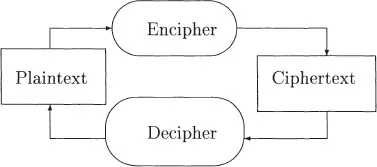
Cryptography is the study of secret writing. A cipher is a way of hiding ordinary text, called plaintext, by transforming it into ciphertext. This process is called enciphering or encryption of the plaintext into ciphertext. The reverse process is called deciphering or decryption. The following figure illustrates this terminology.
Ciphers are divided into two categories: substitution and transposition ciphers. Substitution ciphers replace letters or larger blocks with substitutes, usually of the same length. In a simple substitution cipher, the same alphabet is used for plaintext and ciphertext, and a fixed permutation of this alphabet gives the substitution rule. As an example, suppose the letters of the alphabet are arranged in a circle (with A following Z) and a message is encrypted by replacing each plaintext letter by the fifth letter after it in the circle. Thus, the message “SECRET” would be enciphered as “XJHWJY.” Decryption is performed by replacing each ciphertext letter by the fifth letter before it in the alphabet circle. This type of cipher, in which the alphabet is rotated, is called a Caesar cipher because Julius Caesar used it.
The letters in the ciphertext of a transposition cipher are the same letters, with the same frequencies, as the letters in the plaintext, but they are rearranged. A simple example of a transposition cipher uses a matrix. The plaintext and ciphertext are broken into blocks with length equal to the number of entries in the matrix. A message is enciphered by writing each block of plaintext into the matrix by rows and reading a ciphertext block out of the matrix by columns backwards. For example, suppose we use a 2 × 3 matrix to encipher the message “SECRET,” which has only one block. We form the matrix
and read the ciphertext “CTEESR.” Decryption is performed by writing each ciphertext block into the matrix by columns backwards and reading the plaintext block by rows.
Product ciphers are created by the composition of several ciphers whose types alternate between substitution and transposition. Substitution and transposition ciphers each have certain weaknesses which may be overcome by composing them in this alternating fashion. To give a simple example, compose the two ciphers above, using the Caesar cipher first. The plaintext “SECRET” is first changed into “XJHWJY.” This is written into the matrix
and the ciphertext is “HYJJXW.” The Data Encryption Standard, DES, and Rijndael are two well known examples of product ciphers.
Both encryption and decryption are controlled by keys. The key for a transposition cipher is the fixed permutation of the letters in a block. The key for a simple substitution cipher is the fixed permutation of the alphabet. In the simple case of the Caesar cipher, the key is the amount of shift of the alphabet.
1.2 Types of Attacks
Suppose E and D are the prototype encryption and decryption methods before the key is...
Table of contents
- Cover
- Halftitle Page
- Series Page
- Title Page
- Copyright Page
- Preface
- Dedication Page
- Table of Contents
- I Mathematical Foundations of Cryptanalysis
- II The Cryptographic Algorithms
- III Methods of Attack
- References
- Index
Trusted by 375,005 students
Access to over 1.5 million titles for a fair monthly price.
Study more efficiently using our study tools.
Frequently asked questions
Yes, you can cancel anytime from the Subscription tab in your account settings on the Perlego website. Your subscription will stay active until the end of your current billing period. Learn how to cancel your subscription
No, books cannot be downloaded as external files, such as PDFs, for use outside of Perlego. However, you can download books within the Perlego app for offline reading on mobile or tablet. Learn how to download books offline
Perlego offers two plans: Essential and Complete
- Essential is ideal for learners and professionals who enjoy exploring a wide range of subjects. Access the Essential Library with 800,000+ trusted titles and best-sellers across business, personal growth, and the humanities. Includes unlimited reading time and Standard Read Aloud voice.
- Complete: Perfect for advanced learners and researchers needing full, unrestricted access. Unlock 1.5M+ books across hundreds of subjects, including academic and specialized titles. The Complete Plan also includes advanced features like Premium Read Aloud and Research Assistant.
We are an online textbook subscription service, where you can get access to an entire online library for less than the price of a single book per month. With over 1.5 million books across 990+ topics, we’ve got you covered! Learn about our mission
Look out for the read-aloud symbol on your next book to see if you can listen to it. The read-aloud tool reads text aloud for you, highlighting the text as it is being read. You can pause it, speed it up and slow it down. Learn more about Read Aloud
Yes! You can use the Perlego app on both iOS and Android devices to read anytime, anywhere — even offline. Perfect for commutes or when you’re on the go.
Please note we cannot support devices running on iOS 13 and Android 7 or earlier. Learn more about using the app
Please note we cannot support devices running on iOS 13 and Android 7 or earlier. Learn more about using the app
Yes, you can access Cryptanalysis of Number Theoretic Ciphers by Samuel S. Wagstaff, Jr. in PDF and/or ePUB format, as well as other popular books in Computer Science & Cryptography. We have over 1.5 million books available in our catalogue for you to explore.