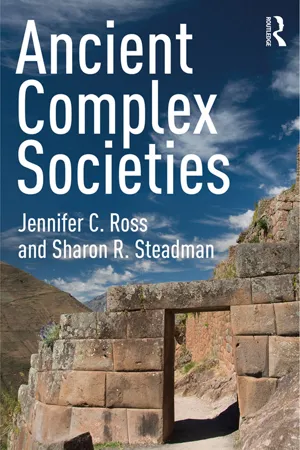
Ancient Complex Societies examines the archaeological evidence for the rise and functioning of politically and socially "complex" cultures in antiquity. Particular focus is given to civilizations exhibiting positions of leadership, social and administrative hierarchies, emerging and already developed complex religious systems, and economic differentiation. Case studies are drawn from around the globe, including Asia, the Mediterranean region, and the American continents. Using case studies from Africa, Polynesia, and North America, discussion is dedicated to identifying what "complex" means and when it should be applied to ancient systems. Each chapter attempts to not only explore the sociopolitical and economic elements of ancient civilizations, but to also present an overview of what life was like for the later population within each system, sometimes drilling down to individual people living their daily lives. Throughout the chapters, the authors address problems with the idea of complexity, the incomparability of cultures, and the inconsistency of archaeological and historical evidence in reconstructing ancient cultures.
- 428 pages
- English
- ePUB (mobile friendly)
- Available on iOS & Android
eBook - ePub
Ancient Complex Societies
About this book
Information
1
Complexity and Its Discontents
Complexity is a thorny topic. At the start of this book project, the two authors probably did not define it in the same way; in fact, we avoided any discussion of what we meant by “complexity.” By the end, we may have come to a common understanding of what complexity means to archaeologists and the methods by which they identify and analyze it. We hope that our readers will see it our way, though we certainly understand that you may not.
How did things get so complicated? In the chapters and case studies that follow, you will encounter cultural diversity in all its splendor. Yet the ancient societies we present are all generally agreed to have been “complex”—that is, archaeologists recognize a common set of institutions beyond kinship or family bonds that guided political, social, economic, and religious organizations. Complex societies typically exhibit centralization of population (but rely on rural members for sustenance) and a hierarchy of economic political positions (but with a variety of mechanisms to level out and disguise differences). Complex political systems integrate numerous interacting social groups so that conflicts of values and goals are avoided and peaceful relationships (on a human and cosmic level) are maintained. Yet conflict and competition fuel innovation and change, producing social dynamics and new formations that may merge the old and the new.
Theories and Theorists of Complexity
Studies of complex society got their start in the 19th century, as scholars in the newly developed fields of anthropology and sociology began to categorize extant societies into types on the basis of population, kinship and religious institutions, economic organization, and political structures. Characteristic of this work were the social evolutionary schemes of Lewis Henry Morgan and Edward Tylor that traced the development of human history from savagery and barbarism to civilization (Trigger 1989). This classificatory passion reached its peak with the work of Marshall Sahlins (1958) and Elman Service (1962), who independently outlined the features of four types of societies: band, tribe, chiefdom, and state. Sahlins and Service understood these categories to be ideal types, each distinct in terms of demography and its social, political, economic, and religious institutions. Still, their work contributed to a pre-existing tendency to see societal types as evolutionary, with a group of people “advancing” from one stage to another in an inevitable progression toward the institutions of modern life. Those that never “rose” to state level might be regarded as maladaptive, and every society was forced into one of the types, even if its components only partially matched the ideals. Numerous scholars in the social sciences have theorized the development and functioning of complexity since this time; we can divide them into those who look at all elements of society and those who see developments in terms of a “prime mover”—a single feature that led to the creation of state-level society.
Big Picture Theorists
One school of theory examines complexity in terms of the interacting and integrated “systems” of a society; these systems are the interwoven economic, social, religious, and political organizations that structure societies. Systems theory in archaeology had its origins in the 1960s, when archaeology as a discipline in the United States and Britain became more closely aligned with anthropology (after several decades of a “culture historical” orientation). Among the most prominent scholars studying the rise of complex societies using a systems framework were Kent V. Flannery and Robert M. Adams. They, and others, regarded every society as comprising a unique combination of interacting systems, on the model of the organs in a body. For example (see Chapter 5 for more detail), 1st millennium bce Mesopotamia relied on an agricultural economy with a high level of craft specialization, possessed social and administrative hierarchies that divided surplus wealth and distributed power, housed a multiethnic population, featured a polytheistic religion with a warrior god at its head, had a full-time military led by the king, and took an imperial stance that required constant expansion of territory. A change to any element in this overarching system—such as the accession of a weak king, incapable of leading the army or of bringing the priesthood under his control—would lead to changes in all other subsystems, including the loss of territory, military challenges, and social upheavals. The systemic whole might eventually be re-established after temporary instability, or permanent change could ensue that resulted in economic, social, religious, and political reorganization.
Challenges to systems models emerged in the 1980s, as archaeologists criticized them as too mechanistic and not flexible enough to account for human behaviors and social relationships. Still, the idea that culture may be divided into interrelated and interactive subsystems continues to generate theories of culture change, even ones that focus on social relations (Bender 1978; Hayden 1995). Among more recent scholars of culture, studies of power, its development, and its working through the subsystems of culture, have become prevalent. The anthropologist Eric Wolf (1999) and sociologist Michael Mann (1986) fall into this category. These scholars are particularly interested in tracing the causes of changes in the configurations of power and have devised a set of potential “push” factors that would present opportunities for aspiring leaders to acquire permanent powers by attracting increasing numbers of followers who permanently entrust a leader with rights over their labor and resources. Any one of these “sources of social power” (Mann 1986) could arise at any time in a group’s history; only under particular social, environmental, and historical circumstances will they become causes for political change. Mann (1986: 22–27) has identified four main potential sources of power, in what he calls his IEMP Model: ideological, economic, military, and political. Typically, no one source develops on its own, but some or all can be intertwined, working in concert to shape societal change.
Mann’s delineation of sources of power, and his initial application of the model to a number of ancient societies, generated a great deal of elaboration by scholars, and the refinement of categories and of their connections is ongoing (Yoffee 1993, 2005). Ideological power derives from the capacity to control meaning and perceptions, most often in support of an individual’s position. Economic power has a number of potential dimensions, including control over scarce or previously untapped resources (Eerkens 2009), or over property (Earle 1991a). Economic power can also originate in the accumulation of surplus staple goods, mobilized in feasts or at times of food scarcity (Bird and Bliege Bird 2009), in such a way that fosters a sense of social indebtedness. Control over labor and its products can lead to economic power (Arnold 2000, 2009; Berdan 1989). A number of scholars have investigated the benefits that accrue to individuals who manage long-distance trade, gaining access to particular exotic items (Helms 1993; Kipp and Schortmann 1989).
Military power denotes the management of both defensive protection and offensive territorial expansion. A leader with troops under his or her charge also commands respect and fear within a society, with the potential to recruit additional supporters (Stanish 2009). Finally, political power is the decision-making capacity described earlier and the organizational or management capability to carry decisions out.
Mann’s categories serve as ideal formulations, and the precise mechanisms of change in any given society may be difficult to determine, especially when one must rely only on archaeological evidence.
Theorists with Narrower Focus
Even before systems theory became a dominant framework for examining culture and, especially, relations of power, a number of theorists had identified specific elements or subsystems as the ones they thought best explained the development of inequality and of advanced civilizations. We will call these scholars “small picture theorists” because they focus on a much narrower range of cultural components than those described earlier. This does not mean that their ideas have had less impact on our understanding of complexity.
Chief among the theories that one element of culture has been responsible for the rise of civilizations across the globe are those that focus on economy—whether subsistence, technology, or exchange. Beginning in the 1930s, Karl Wittfogel (1957) proposed that, in the great river-based agricultural societies of the Old World (Mesopotamia, Egypt, China, and the Indus Valley), political power was in the hands of individuals and groups who controlled the flow of water through irrigation systems. Wittfogel’s “hydraulic hypothesis” envisioned a circumstance in which those who relied on irrigation for survival and prosperity became permanently dependent on the few people who regulated and maintained irrigation canals. Wittfogel’s hypothesis obviously does not apply to environments, like Greece and Rome, where agriculture is dependent on rainfall, nor did archaeological evidence for the earliest state organizations support his ideas.
V. Gordon Childe, in the 1920s, also tied the development of state systems to economic concerns. Childe’s work was especially focused on major societal shifts in land and labor organization, changes he called, in the Marxist terminology of his day, “revolutions.” Both the Neolithic (agricultural) and the Urban Revolutions were topics of Childe’s archaeological and theoretical studies (1936, 1950). To explain the origins of agriculture, he posited a major environmental change that brought humans, plants, and animals into proximity. With the development of agriculture, the harvesting of surpluses of food made possible the next step, as some people turned from agricultural pursuits in the countryside to occupational specializations (metallurgy, especially) in towns: the Urban Revolution.
These environmental, subsistence, and labor-related explanations for major transformations in human history are very much in keeping with economic models of human behaviors proposed in later decades. Chief among these is Immanuel Wallerstein’s World-Systems theory (1974), first developed to explain the rise and dominance of capitalism over the world’s economies. In Wallerstein’s view, powerful nation-states impose an extractive economic system on weaker and dependent states. The dominant states form a core, extracting raw materials, subsistence, goods, and labor from their peripheral dependencies, then transforming these materials and selling the finished products back to the peripheral nations. Wallerstein believes that such unequal economic relationships had their origins in Renaissance Europe but that the system spread and expanded into a system of political dominance as western European states sent colonies to Africa, the Americas, and Australia. Since Wallerstein’s formulation of World-Systems theory, a number of scholars have attempted to apply its fundamental principles of an unequal set of economic relationships between cores and peripheries to a variety of settings in the ancient world, with varying degrees of success. Perhaps most useful here is the idea that these economic relationships across cultural boundaries have the potential to transform all societies that are part of the network.
While the majority of theorists who focus on just one or two aspects of society as primary factors in major societal changes prefer to see economics as the prime mover in cultural evolution, a few point to non-economic causes. Primary among these is Robert Carneiro (1970), whose “circumscription theory” proposed that, in areas where a populations is geographically circumscribed, meaning that environment and subsistence practices, especially agriculture, prevent people from easily moving away, warfare promotes state development. Because a defeated population is tied to its land, it must submit to its conquerors, thus expanding the amount of land and numbers of people they control. Carneiro applied this theory to early state development in Egypt, China, the Indus Valley, Mesopotamia, and parts of Peru. Scholars have expanded on Carneiro’s ideas by suggesting factors beyond geography, such as social and religious ties, as responsible for circumscription.
Critiques of Complexity
Two powerful critiques of the archaeological study of complex society, from the mid-2000s, built on a growing sense of dissatisfaction with the concepts of cultural evolution and the stages proposed by Sahlins and Service. Norman Yoffee’s Myths of the Archaic State (2005) took on the idea that early states could be characterized by a list of traits; to Yoffee, the word “complexity” itself implies intricacies of interrelationships among people and institutions that elude classification. Timothy Pauketat’s Chiefdoms and other Archaeological Delusions (2007) makes a similar point about the difficulty and danger of making generalizations about ancient societies. Both Pauketat and Yoffee focus on “difference” as the most characteristic quality of societies; every civilization has a unique set of characteristics, and the impetuses that guided changes in societal organization worked in distinctly different ways. Complex societies can thus be hierarchical or not; hierarchically organized societies may retain and even promote heterarchical or heterogeneous aspects. Regional and historical contingencies play a significant role in the development of every culture; predictable or inevitable trajectories toward complexity are, therefore, nonexistent.
The Book in Your Hands
Keeping in mind these critiques, the book that follows is necessarily detail oriented, with attention to environmental, historical, and socioeconomic conditions that contributed to the development of complex societies. Our approach will be open-ended and bottom-up, emphasizing circumstances and conditions over direction. It is also heavily archaeological, with additional evidence provided by the written record, as these evidentiary sources provide the raw data on which reconstructions of daily life and social relationships depend.
Organization
This book is intended to provide you with a wide array of studies that will present the concepts and data for studying complexity in the ancient world. The two chapters that follow this one (Chapters 2 and 3) introduce much of the terminology of complexity and the cultural institutions (social, economic, and political) that comprise it. Chapter 3 also describes the major political systems, ranging in complexity from forager to state, and the evidentiary basis by which those categories are constructed. A final chapter in this section, Chapter 4, examines several societies whose placement into one of the four main sociopolitical categories is debated. These provide archaeologists with the opportunity to examine variability in the organization of cultural institutions, and to challenge the utility of using the blanket typology of political forms.
The bulk of this book is devoted to case studies of ancient complex societies around the globe. Chapters 5 through 7 look at the geographic regions and cultures of the Middle East and Mediterranean, areas perhaps most often noted as the “cradle(s) of civilization” and of Western political values and institutions. In Chapters 8 through 10, three south and southeast Asian regions are examined, while Chapters 11 to 13 turn to the ancient cultures of the Americas. While these areas are not the only ones that exhibited complexity in antiquity (northern and western Europe are notably absent here, as they fall outside our own areas of expertise), they provide examples from a wide range of physical environments and exhibit significant variability in the configurations of social and political institutions they possessed. A final chapter (Chapter 14), on collapse in complex societies, will make the point that full societal collapse and dissolution is a rare circumstance; more often in the ancient world, the upper echelon of political leaders may have been displaced, and some of the trappings of administration may have disappeared. But cultural systems, values, and populations remained relatively stable.
We hope that this book encourages you to explore these ancient cultures and their institutions further. An extensive bibliography at the end of the book should help.
2
Human Cultural Institutions
Critical Elements in Complex Society
Introduction
We use the phrase “cultural institutions,” which derives from cultural anthropology, to refer to the pillars that combine to create every human culture. Although there are many “cultural institutions,” including aspects of human societal structure such as art, marriage and residence patterns, and education, this chapter takes up the components that comprise the societal institutions often cited as the elements of “complexity” in ancient civilizations. Four cultural institutions, central components of human social organization, are explored here: kinship relationships and associated social relationships, religious belief systems, economic systems, including aspects of exchange patterns, and political structures. It is the latter two, economic and political systems, that are most often associated with the development of complex society, and these receive the most discussion here.
Kinship, Social Networks, and Social Differentiation
At the heart of human social institutions is kinship, which embodies far more than just who an individual considers to be “family” and who is not (Foley 2001). Primary to human societies is survival; kinship structure can serve as a critical factor in risk management activities, particularly in highly mobile or small-scale sedentary societies, in which individuals depend on cooperative family relationships for survival. Kinship relationships not only provide social identity and confer status but are also crucial for determining appropriate marriage partners and economic and political allies, and they often dictate proper methods of worship and ...
Table of contents
- Cover
- Title
- Copyright
- Contents
- List of Figures
- List of Tables
- Acknowledgments
- 1 Complexity and Its Discontents
- 2 Human Cultural Institutions: Critical Elements in Complex Society
- 3 Ancient Systems: From Forager to State
- 4 Scales of Complexity: Case Studies
- 5 Southwest Asia: Ancient Mesopotamia and Its Neighbors
- 6 The Nile Valley of Egypt
- 7 The Aegean Bronze Age and the Classical World
- 8 The Indus Valley Civilization
- 9 Ancient Chinese Civilizations
- 10 Empires in Southeast Asia
- 11 The Mississippian System in the American Bottom
- 12 Ancient Mesoamerican Cultures
- 13 Andean Civilizations and Empires
- 14 Why Complex Societies Collapse
- Bibliography
- Index
Trusted by 375,005 students
Access to over 1.5 million titles for a fair monthly price.
Study more efficiently using our study tools.
Frequently asked questions
Yes, you can cancel anytime from the Subscription tab in your account settings on the Perlego website. Your subscription will stay active until the end of your current billing period. Learn how to cancel your subscription
No, books cannot be downloaded as external files, such as PDFs, for use outside of Perlego. However, you can download books within the Perlego app for offline reading on mobile or tablet. Learn how to download books offline
Perlego offers two plans: Essential and Complete
- Essential is ideal for learners and professionals who enjoy exploring a wide range of subjects. Access the Essential Library with 800,000+ trusted titles and best-sellers across business, personal growth, and the humanities. Includes unlimited reading time and Standard Read Aloud voice.
- Complete: Perfect for advanced learners and researchers needing full, unrestricted access. Unlock 1.5M+ books across hundreds of subjects, including academic and specialized titles. The Complete Plan also includes advanced features like Premium Read Aloud and Research Assistant.
We are an online textbook subscription service, where you can get access to an entire online library for less than the price of a single book per month. With over 1.5 million books across 990+ topics, we’ve got you covered! Learn about our mission
Look out for the read-aloud symbol on your next book to see if you can listen to it. The read-aloud tool reads text aloud for you, highlighting the text as it is being read. You can pause it, speed it up and slow it down. Learn more about Read Aloud
Yes! You can use the Perlego app on both iOS and Android devices to read anytime, anywhere — even offline. Perfect for commutes or when you’re on the go.
Please note we cannot support devices running on iOS 13 and Android 7 or earlier. Learn more about using the app
Please note we cannot support devices running on iOS 13 and Android 7 or earlier. Learn more about using the app
Yes, you can access Ancient Complex Societies by Jennifer C. Ross,Sharon R. Steadman in PDF and/or ePUB format, as well as other popular books in Social Sciences & Ancient History. We have over 1.5 million books available in our catalogue for you to explore.