- 168 pages
- English
- ePUB (mobile friendly)
- Available on iOS & Android
eBook - ePub
About this book
This title includes Foreword by David Taylor, Professor and Vice Dean of Leicester Medical School. Preparing for the Part 2 MRCOG examination remains a daunting and complex task, particularly as learning and revision often need to fit around clinical commitments. Much has been written about how to prepare for and pass exams, yet it remains surprising how often well-read candidates provide unsatisfactory answers in areas which they know well. Clearly, a sound understanding of the topic area is essential, but deeper knowledge also increases uncertainty, and the vast developments in the field mean that proficiency in all areas is next to impossible. Thus a critical point for postgraduate candidates, who more often than not will prepare for the examination in isolation, is to develop a real understanding of what the examination is meant to assess...This revision aid in obstetrics and gynaecology is based on the Extended Matching Question format (EMQ). It contains forty-two questions of varying degrees of difficulty, along with detailed answers. "MRCOG Part 2 Essential EMQs" is an indispensable study and revision aid for postgraduate medical students preparing for Part 2 of the Membership of the Royal College of Gynaecologists (MRCOG) examination or equivalent. "The number of published revision aids including this question format in postgraduate Obstetrics and Gynaecology remains limited. With this book we wanted to produce a comprehensive selection of EMQ, covering broad areas relevant to the speciality, which would be useful those preparing for postgraduate examinations at Part 2 MRCOG level or equivalent." - Marwan Habiba, Andrea Akkad, Justin Konje.
Information
Questions
Applied basic sciences
Q1
Options:
A | Mullerian agenesis |
B | Incomplete division of metanephric diverticulum |
C | Absent fusion of paramesonephric ducts |
D | Incomplete lateral fusion/septum resorption |
E | Right-sided Mullerian duct hypoplasia |
F | Incomplete vertical fusion of sinovaginal bulb with Mullerian system |
G | Absent mesonephric ducts |
H | Absence of Mullerian-inhibiting substance |
I | Incomplete fusion of paramesonephric ducts |
J | Agenesis of Wolffian ducts |
K | Left-sided Mullerian duct hypoplasia |
Lead-in:
For each of the following presentations of genital tract mal-development, please select the most likely embryological mechanism from the option list. Each option may be used once, more than once, or not at all.
Q1A 19-year-old woman is referred to a gynaecology clinic because of absent menstruation. Her thelarche and pubarche are both Tanner stage 5. Abdominal examination is unremarkable, and she appears to have normal external genitalia. An ultrasound scan reports normal ovaries, but insufficient bladder filling precludes any comment on size or shape of the uterus.
Q2A 33-year-old woman undergoes a Caesarean section for a breech presentation at term. At Caesarean section the obstetrician can only identify one Fallopian tube, which is situated in the midline due to extreme dextro-rotation of the uterus.
Q3A 29-year-old woman presents in the gynaecology clinic with a six-year history of primary infertility. You make a clinical assessment in outpatients, and can ascertain that the patient’s cervix is duplicated.
Q4A 16-year-old girl presents in the paediatric gynaecology clinic with her mother because of recurrent lower abdominal pain. She has not yet started to menstruate. On examination her thelarche and pubarche are Tanner stage 4; on abdominal palpation she has a tender mass arising from the pelvis.
Q5A 41-year-old woman undergoes a hysteroscopy because of recurrent vaginal bleeding. She has a single cervix and lower uterine cavity, but a uterine septum is visualised in the upper part of the uterus.
Q2
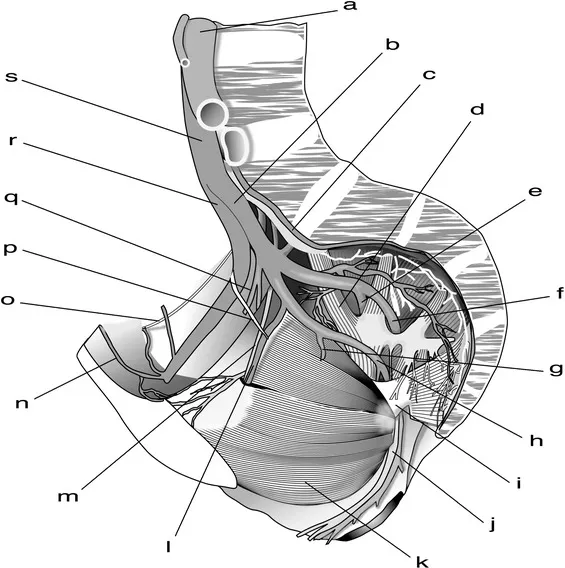
Lead-in:
For each clinical case of gynaecological surgery below, please select the most relevant structure from the diagram above. Each option may be used once, more than once, or not at all.
Q6A 30-year-old woman of Afro-Caribbean origin with multiple large uterine fibroids opts for a minimally invasive procedure. You arrange a consultation with an interventional radiologist.
Q7A 79-year-old woman develops a vault prolapse following abdominal hysterectomy. You suggest a repair operation that can be performed vaginally.
Q8A 45-year-old woman undergoes an operation for cervical cancer. Postoperatively, she suffers with difficulty walking. She is noted to have external rotation of her right foot.
Q9A 76-year-old woman with a complete procidentia undergoes vaginal hysterectomy. Postoperatively, she is noted to be anuric, and does not respond to fluid challenge.
Q10A 35-year-old woman undergoes laparoscopic ablation to endometriosis. She develops...
Table of contents
- Cover Page
- Title Page
- Copyright Page
- Contents
- Foreword
- Preface
- About the authors
- Introduction
- Reading list
- Abbreviations
- Questions
- Answers
- Index
Trusted by 375,005 students
Access to over 1.5 million titles for a fair monthly price.
Study more efficiently using our study tools.
Frequently asked questions
Yes, you can cancel anytime from the Subscription tab in your account settings on the Perlego website. Your subscription will stay active until the end of your current billing period. Learn how to cancel your subscription
No, books cannot be downloaded as external files, such as PDFs, for use outside of Perlego. However, you can download books within the Perlego app for offline reading on mobile or tablet. Learn how to download books offline
Perlego offers two plans: Essential and Complete
- Essential is ideal for learners and professionals who enjoy exploring a wide range of subjects. Access the Essential Library with 800,000+ trusted titles and best-sellers across business, personal growth, and the humanities. Includes unlimited reading time and Standard Read Aloud voice.
- Complete: Perfect for advanced learners and researchers needing full, unrestricted access. Unlock 1.5M+ books across hundreds of subjects, including academic and specialized titles. The Complete Plan also includes advanced features like Premium Read Aloud and Research Assistant.
We are an online textbook subscription service, where you can get access to an entire online library for less than the price of a single book per month. With over 1.5 million books across 990+ topics, we’ve got you covered! Learn about our mission
Look out for the read-aloud symbol on your next book to see if you can listen to it. The read-aloud tool reads text aloud for you, highlighting the text as it is being read. You can pause it, speed it up and slow it down. Learn more about Read Aloud
Yes! You can use the Perlego app on both iOS and Android devices to read anytime, anywhere — even offline. Perfect for commutes or when you’re on the go.
Please note we cannot support devices running on iOS 13 and Android 7 or earlier. Learn more about using the app
Please note we cannot support devices running on iOS 13 and Android 7 or earlier. Learn more about using the app
Yes, you can access MRCOG by Marwan Habiba,Andrea Akkad,Justin Konje in PDF and/or ePUB format, as well as other popular books in Medicine & Gynecology, Obstetrics & Midwifery. We have over 1.5 million books available in our catalogue for you to explore.