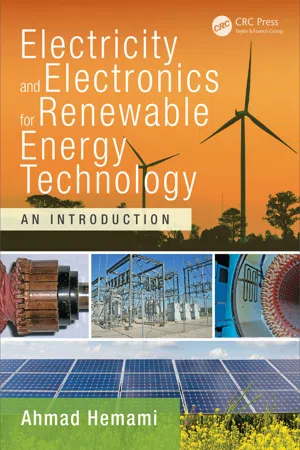
Electricity and Electronics for Renewable Energy Technology
eBook - PDF

Electricity and Electronics for Renewable Energy Technology

An Introduction

  1. 802 pages
  2. English
  3. PDF
  4. Available on iOS & Android
eBook - PDF

Electricity and Electronics for Renewable Energy Technology

An Introduction

About this book

Electricity and Electronics for Renewable Energy Technology: An Introduction provides a foundational understanding of electricity and the methods and devices specific to electricity from renewable sources.

The book begins with a brief explanation of the necessary mathematics and then:

  • Addresses the basics of electricity and relationships, motors and generators, transformers, and networks and distribution
  • Tackles the key concepts associated with electronics, diodes and transistors, switching devices, and power converters
  • Covers digital electronics from number systems and logic circuits to encoders and decoders
  • Explores advanced subjects such as reactive power and the operation of a transistor


A lab manual andPowerPoint presentation are available with qualifying course adoption.

Featuring extensive review questions and practice problems at the end of each chapter, Electricity and Electronics for Renewable Energy Technology: An Introduction instills an essential knowledge of electricity and electronics required for work with renewable energy.

Frequently asked questions

Yes, you can cancel anytime from the Subscription tab in your account settings on the Perlego website. Your subscription will stay active until the end of your current billing period. Learn how to cancel your subscription.
At the moment all of our mobile-responsive ePub books are available to download via the app. Most of our PDFs are also available to download and we're working on making the final remaining ones downloadable now. Learn more here.
Perlego offers two plans: Essential and Complete
  • Essential is ideal for learners and professionals who enjoy exploring a wide range of subjects. Access the Essential Library with 800,000+ trusted titles and best-sellers across business, personal growth, and the humanities. Includes unlimited reading time and Standard Read Aloud voice.
  • Complete: Perfect for advanced learners and researchers needing full, unrestricted access. Unlock 1.4M+ books across hundreds of subjects, including academic and specialized titles. The Complete Plan also includes advanced features like Premium Read Aloud and Research Assistant.
Both plans are available with monthly, semester, or annual billing cycles.
We are an online textbook subscription service, where you can get access to an entire online library for less than the price of a single book per month. With over 1 million books across 1000+ topics, we’ve got you covered! Learn more here.
Look out for the read-aloud symbol on your next book to see if you can listen to it. The read-aloud tool reads text aloud for you, highlighting the text as it is being read. You can pause it, speed it up and slow it down. Learn more here.
Yes! You can use the Perlego app on both iOS or Android devices to read anytime, anywhere — even offline. Perfect for commutes or when you’re on the go.
Please note we cannot support devices running on iOS 13 and Android 7 or earlier. Learn more about using the app.
Yes, you can access Electricity and Electronics for Renewable Energy Technology by Ahmad Hemami in PDF and/or ePUB format, as well as other popular books in Physical Sciences & Energy. We have over one million books available in our catalogue for you to explore.

Information

Publisher
CRC Press
Year
2017
eBook ISBN
9781482261783
Edition
1
Subtopic
Energy
10 
Electricity 
and 
Electronics 
for 
Renewable 
Energy 
Technology
Review 
Questions
1. 
Why 
should 
we 
be 
concerned 
about 
energy?
2. 
Is 
electric 
energy 
the 
only 
type 
of 
energy 
we 
need?
3. 
If 
we 
have 
only 
electric 
energy 
(suppose 
sometime 
in 
the 
future), 
is 
it 
responsive 
to 
all 
our 
needs? 
Explain.
4. 
Presently, 
what 
are 
the 
sources 
of 
energy?
5. 
What 
is 
the 
advantage 
of 
electrical 
energy 
over 
other 
types?
6. 
How 
can 
we 
store 
electrical 
energy?
7. 
How 
can 
we 
store 
mechanical 
energy?
8. 
Why 
is 
safety 
so 
important?
9. 
Give 
few 
examples 
of 
static 
electricity.
10. 
What 
are 
the 
main 
causes 
of 
accidents?
11. 
What 
is 
the 
difference 
between 
electricity 
and 
static 
electricity?
12. 
Is 
electricity 
dangerous? 
If 
so, 
in 
what 
ways?
13. 
Can 
static 
electricity 
be 
dangerous? 
Explain.
14. 
What 
does 
OSHA 
stand 
for?
15. 
What 
is 
OSHA?

Table of contents

  1. Front Cover
  2. Dedication
  3. Contents
  4. Preface
  5. Acknowledgments
  6. Author
  7. 1: Energy and Electricity
  8. 2: Basic Mathematics and Systems of Measurement Units
  9. 3: Atomic Structure of Materials
  10. 4: DC and AC Electricity
  11. 5: Voltage, Current, and Power
  12. 6: DC Circuits Relationships
  13. 7: DC Motors and Generators
  14. 8: AC Circuits Relationships
  15. 9: Three-Phase Systems
  16. 10: Transformers
  17. 11: AC Motors and Generators
  18. 12: Electric Power Transmission and Distribution
  19. 13: Electronic Components, Functions, and Devices
  20. 14: Diode
  21. 15: Regulating Diodes and Applications
  22. 16: Diode Rectifiers and Filters
  23. 17: Transistor
  24. 18: Transistor Circuits
  25. 19: Switchable Diodes and Gated Transistors
  26. 20: Power Converters
  27. 21: Electronic Power Converters in Wind Turbines and Solar Photovoltaic Systems
  28. 22: Digital Electronics
  29. 23: Logic Circuits and Applications
  30. 24: Encoders and Decoders
  31. Glossary
  32. Appendix A: Internal Resistance of Batteries and Battery Aging
  33. Appendix B: Switches
  34. Appendix C: Special Transformers
  35. Appendix D: Mil and Circular Mil
  36. Appendix E: Standard Resistors
  37. Appendix F: Quality Factor of RLC Circuits
  38. Appendix G: Structure of Logic Gates
  39. Back Cover