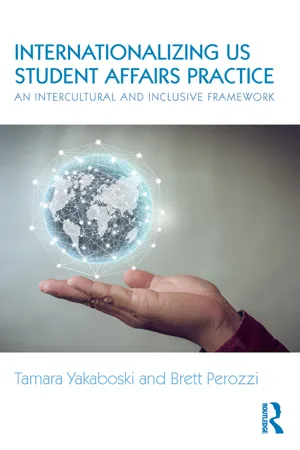
Grounded in research and theory, Internationalizing US Student Affairs Practice presents an inclusive framework for enhancing the intercultural competencies of practitioners, students, and faculty in institutions of higher education. This cutting-edge book explores how student affairs practitioners are well positioned to integrate internationalization strategies across student affairs divisions and functions. Each chapter intentionally incorporates theories and literature from higher education and student affairs disciplines infused with international and multicultural education. "Promising Practices"—case studies written and submitted by practitioners around the world—appear throughout the book to demonstrate practical applications in non-US settings. The strategies in this book help student affairs practitioners enhance the intercultural development of support programs and services, all without leaving the home campus.
eBook - ePub
Internationalizing US Student Affairs Practice
An Intercultural and Inclusive Framework
- 194 pages
- English
- ePUB (mobile friendly)
- Available on iOS & Android
eBook - ePub
Internationalizing US Student Affairs Practice
An Intercultural and Inclusive Framework
About this book
Information
Chapter 1
Introduction
Internationalization for US Student Affairs
Proponents of internationalizing higher education espouse that it has many benefits for students, such as increasing employability (Ripmeester, 2016), developing global citizenship (Knight, 2007), and offering global student learning outcomes through an internationalized curriculum (Jones, 2016; Leask, 2016). At the institutional level, internationalization may increase campus prestige or reputation, promote strategic international partnerships, advance academic knowledge markets, and increase revenue sources (Rumbley, Altbach, & Reisberg, 2012). Student affairs is a leader in the higher education sector for helping students gain experiences and develop concomitant skills and abilities to develop as global citizens. While student affairs practitioners have increased their international involvement and activities over the last decade (Dalton & Sullivan, 2008; Osfield & Terrell, 2009), this is a more recent development when compared to peers in academic affairs who deal with student and scholar mobility and recruitment, transnational or joint degrees, programs in English, and collaborative research (Knight, 2013; Roberts & Komives, 2016). Yet, internationalization of higher education in the US lags behind other countries (Green, 2015) and student affairs remains under-involved in ventures that will have significant impact in a rapidly changing world.
The attention given to student affairs in internationalization literature comes predominately labeled as “extra-curricular” or “cocurricular” and focuses mostly on clubs and services for international students and diversity programming (Knight, 2007, 2012; Ward, 2016) or on how to improve services or programming for international students and domestic students (Dalton & Sullivan, 2008; Latham & Dalton, 1999; Walker, Hart, Jackson, Roberts, & Ludeman, 2014). Practitioners who have a solid understanding of the global stage and its influence on higher education can contribute meaningfully to internationalization processes and dialogues taking place on their campuses, prepare themselves to operate in this challenging milieu, and prepare students to be global citizens who can incorporate interculturally inclusive practices. An understanding of the ubiquity of internationalization in higher education and the role that student affairs plays requires knowing that bringing international students to US campuses and sending US students abroad are only two components of the larger work to internationalize. Increasingly, the changing societal and institutional contexts require student affairs practitioners to integrate internationalization strategies and pay more attention to the experiences and development of all diverse students.
Today, internationalization requires more critical work from faculty and student affairs practitioners to support intercultural development and global competencies. Significant new or growing trends are likely to affect internationalization efforts of higher education institutions (HEIs) and the work of student affairs globally for years to come. Polarization in societies around the world, as evidenced by the “Brexit” vote in the United Kingdom, the election of Donald Trump in the US, many countries’ response to the refugee crisis, and tribal politics in many African countries’ elections, to name a few, will influence internationalization in both the short and long term. Violence and hate related to neo-Nazism, anti-Semitism, and anti-Muslim sentiments reverberate around the world. The narrow emphasis on mobility within US internationalization, combined with these trends, limit HEIs’ ability to offer a positive response to anti-immigration and anti-internationalization acts (de Wit, 2017). Calls for racial justice such as with the Black Lives Matter movement, which has spread around the world, reflect global demands for racial equity and the end of oppression and discrimination against minoritized and Indigenous peoples. The polarization of these trends elicits student unrest and campus protests, not to mention damage to values of inclusivity and sense of belonging. Cultural and affinity centers on US campuses have borne the “brunt of the responsibility for cultural education and programming” (Patton & Hannon, 2008, p. 139); however, these trends show that all stakeholders have responsibility for creating inclusive communities. Student affairs practitioners have to practice within global and intercultural frameworks so that diversity and social justice and inclusion (SJI) efforts, policies, and programs are inclusive of various identities including nationalities, citizenship status, religious practice, languages, and more. Internationalizing US Student Affairs Practice builds a case for why it is necessary to address internationalization at multiple levels within US student affairs, and how to promote continued intercultural development of students, student affairs practitioners, graduate students in higher education and student affairs (HESA) graduate preparation programs, and the faculty who support these programs and services, all without having to leave the home campus.
THE INTERCONNECTION OF GLOBALIZATION, INTERNATIONALIZATION, AND INTERCULTURALISM
While similar in nature and occasionally used interchangeably, globalization and internationalization are closely related but distinct concepts. Globalization broadly involves economic, social, and political forces that create an interdependence and connection between nation states. Specifically, in relation to higher education, globalization is “the reality shaped by an increasingly integrated world economy, new information and communications technology, the emergence of an international knowledge network, the role of the English language, and other forces beyond the control of academic institutions” (Altbach, Reisberg, & Rumbley, 2009, p.7). With that, internationalization flows from globalization in how government, business, and HEIs respond to the forces of an ever-expanding society. As many scholars (e.g., de Wit, 2010; Hudzik, 2015; Knight, 2007) note, the term internationalization has varied meaning, occasionally is used interchangeably, albeit incorrectly, with related terms of globalization and interculturalism, and is applied in a variety of ways around the world. However, most scholars agree that internationalization is a process.
A holistic perspective expands the worldviews and education of all students, helps them develop global or intercultural competencies, and infuses student affairs programs and services with global perspectives and practices, all of which are desirable components of internationalization for student affairs. The most common definition for internationalization, used in US and European higher education literature, explains internationalization at national, sector or regional, and institutional levels as “the process of integrating an international, intercultural or global dimension in the purpose, functions or delivery of post-secondary education” (Knight, 2007, p. 214). Where internationalization was once seen as the “toolkit” companion to globalization, it is now seen as core or imperative to higher education institutions (Hudzik & Stohl, 2012; Knight, 2007, 2012; Rumbley et al., 2012). Internationalization has two components: Internationalization at Home (IaH) and Internationalization Abroad (de Wit, 2010), also called cross-border education or education abroad, which refers specifically to mobility of people, programs, services, and policies (Knight, 2012).
To combat a world of political instability, interculturalism is a “response both to the increased mixing of peoples in that world and the skills needed to interact with people from varying cultural backgrounds and social locations” (Cornwell & Stoddard, 1999, p. 17). The concept of interculturalism connects to internationalization by relating to the learning and individual development of attitudes, behaviors, knowledge, and communication skills (Deardorff, 2006). “Internationalization is also about relating to diversity of cultures that exist within countries, communities, institutions, and classrooms so intercultural is used to address aspects of cultural diversity” (Knight, 2012, p. 30, italics in original). With this definition as a guide, throughout this book, we connect internationalization and interculturalism to US contexts of multiculturalism, diversity, and SJI work.
Given the advanced development of student affairs as a profession in the US, practitioners have great potential to contribute to campus internationalization and students’ intercultural development in many ways (Dalton & Sullivan, 2008; Osfield & Terrell, 2009). Recently, the American Council on Education (ACE) published a report on student affairs involvement in serving the increase of international students and facilitating all students’ intercultural competencies because “student affairs is on the front lines of internationalization” (Ward, 2016, p. 5). However, there has been little guidance outside of graduate preparation programs’ education abroad trips and international or comparative courses, and professional associations’ pre-conference workshops and conference sessions (e.g., Kruger & Dungy, 1999; Perozzi & Havlic, 2011; Schultz, Lee, Cantwell, McClellan, & Woodard, 2007; Yakaboski & Birnbaum, 2017). By understanding why and how to internationalize, practitioners can enhance the intercultural development competencies and practices for high quality programs and services that meet the needs of institutional and student affairs divisional goals and place student learning at the heart of the process. The term internationalization gained dominance during the 1980s to promote international studies and educational mobility; now it largely refers to the international dimension of higher education as implemented through the various frameworks of Comprehensive Internationalization, Internationalization of the Curriculum, and Internationalization at Home.
COMMON INTERNATIONALIZATION FRAMEWORKS
Comprehensive Internationalization
Comprehensive Internationalization (CI) is the most dominant framework used in the US as an “institutional imperative, not just a desirable option” (Hudzik & Stohl, 2012, p. 66). The usage of the term “comprehensive internationalization” increased in the early 2000s with a series of American Council on Education (ACE) publications and the creation of NAFSA: Association of International Educators’ Paul Simon Award for Comprehensive Internationalization (Hudzik, 2015). Before that, beginning in the 1960s as a response to growing anxiety over the increasing reality of globalization, US higher education mainly internationalized the curriculum with geographical areas of study and language programs (Hudzik & Stohl, 2012). ACE (2017) defines CI as “a strategic, coordinated process that seeks to align and integrate international policies, programs, and initiatives, and positions colleges and universities as more globally oriented and internationally connected” (para 1). Furthermore, CI is not just campus focused but influences “the institution’s external frames of reference, partnerships and relationships” (Hudzik & Stohl, 2012, p. 66). While CI includes internationalizing the curriculum, cocurriculum, and learning outcomes as one of its six interconnected target areas, its structure implies a top-down process that may remove agency from faculty and programs, as well as student affairs divisions. Interestingly, it places student mobility, outgoing and incoming, as separate from the curriculum. For a more comprehensive review of CI, see Hudzik’s (2015) Comprehensive Internationalization: Institutional Pathways to Success.
The CI framework is meant to be systematic and inclusive, yet it is not accessible to all areas of higher education or all institutions, as recently revealed by the UNESCO-based worldwide association of HEIs, International Association of Universities (IAU) 4th Global Survey of Internationalization of Higher Education (Egron-Polak & Hudson, 2014; Hudzik, 2015). The IAU survey showed that US institutions have not prioritized internationalization like that of their global counterparts. Specifically, outgoing student mobility is the most important internationalization activity across Europe, Latin America, the Caribbean, and North America. In the US, the top activity is increasing the recruitment of fee-paying international students. In Africa, Asia and Pacific islands, and the Middle East, increasing international research is the most important activity (Egron-Polak, & Hudson, 2014). Only 14% of the survey respondents (1,336 institutions across 131 countries) view internationalizing the campus curriculum as important, which sets up the need for this book’s emphasis on internationalizing the cocurriculum and broader student affairs work. Overall, IAU’s survey leads to two questions. What is the role of educators in preparing students for life and work in a global economy when preference is still being given to heavy reliance on mobility and online opportunities to internationalize student learning (Egron-Polak, & Hudson, 2014)? And we would add: what is the role of student affairs practitioners as educators in the cocurriculum in supporting internationalization?
This overview does not assume to do justice...
Table of contents
- Cover
- Half Title
- Title Page
- Copyright Page
- Table of Contents
- List of Figures and Tables
- Acknowledgments
- Preface
- 1 Introduction: Internationalization for US Student Affairs
- 2 Connection of Internationalization to Multiculturalism, Diversity, Social Justice and Inclusion
- 3 Intercultural and Related Competencies for Student Affairs
- 4 Organizational Alignment of Student Affairs for Internationalization
- 5 Student Engagement and the Cocurriculum
- 6 An Internationalized Context for Professional Development
- 7 Recommendations and Implications for Practice
- Biographies of the Authors and Promising Practices Contributors
- Index
Trusted by 375,005 students
Access to over 1.5 million titles for a fair monthly price.
Study more efficiently using our study tools.
Frequently asked questions
Yes, you can cancel anytime from the Subscription tab in your account settings on the Perlego website. Your subscription will stay active until the end of your current billing period. Learn how to cancel your subscription
No, books cannot be downloaded as external files, such as PDFs, for use outside of Perlego. However, you can download books within the Perlego app for offline reading on mobile or tablet. Learn how to download books offline
Perlego offers two plans: Essential and Complete
- Essential is ideal for learners and professionals who enjoy exploring a wide range of subjects. Access the Essential Library with 800,000+ trusted titles and best-sellers across business, personal growth, and the humanities. Includes unlimited reading time and Standard Read Aloud voice.
- Complete: Perfect for advanced learners and researchers needing full, unrestricted access. Unlock 1.5M+ books across hundreds of subjects, including academic and specialized titles. The Complete Plan also includes advanced features like Premium Read Aloud and Research Assistant.
We are an online textbook subscription service, where you can get access to an entire online library for less than the price of a single book per month. With over 1.5 million books across 990+ topics, we’ve got you covered! Learn about our mission
Look out for the read-aloud symbol on your next book to see if you can listen to it. The read-aloud tool reads text aloud for you, highlighting the text as it is being read. You can pause it, speed it up and slow it down. Learn more about Read Aloud
Yes! You can use the Perlego app on both iOS and Android devices to read anytime, anywhere — even offline. Perfect for commutes or when you’re on the go.
Please note we cannot support devices running on iOS 13 and Android 7 or earlier. Learn more about using the app
Please note we cannot support devices running on iOS 13 and Android 7 or earlier. Learn more about using the app
Yes, you can access Internationalizing US Student Affairs Practice by Tamara Yakaboski,Brett Perozzi in PDF and/or ePUB format, as well as other popular books in Education & Education General. We have over 1.5 million books available in our catalogue for you to explore.