- 176 pages
- English
- ePUB (mobile friendly)
- Available on iOS & Android
eBook - ePub
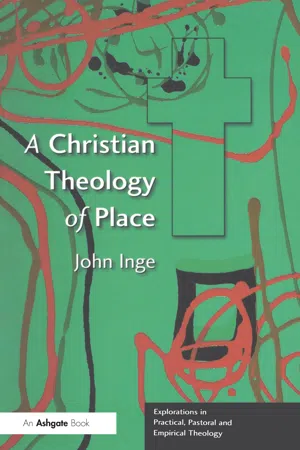
A Christian Theology of Place
About this book
The place in which we stand is often taken for granted and ignored in our increasingly mobile society. Differentiating between place and space, this book argues that place has very much more influence upon human experience than is generally recognised and that this lack of recognition, and all that results from it, are dehumanising. John Inge presents a rediscovery of the importance of place, drawing on the resources of the Bible and the Christian tradition to demonstrate how Christian theology should take place seriously. A renewed understanding of the importance of place from a theological perspective has much to offer in working against the dehumanising effects of the loss of place. Community and places each build the identity of the other; this book offers important insights in a world in which the effects of globalisation continue to erode people's rootedness and experience of place.
Information
Chapter 1
Place in Western Thought and Practice
The Demise of Place
Place and Space
In order to be clear about the use of terms we need to begin by teasing out the difference between the two terms ‘space’ and ‘place’ as I shall use them in what follows. Many people, including theologians, use the terms interchangeably, but this leads to the concept being rather unclarified. Einstein pointed out the difficulty when he wrote that when different authors use words like ‘red,’ hard’ or ‘disappointed’, no one doubts that they mean more or less the same thing, because ‘these words are connected with elementary experiences in a manner which is difficult to misinterpret. But in the case of words such as “place” or “space”, whose relation with psychological experience is less direct, there exists a far reaching uncertainty of interpretation’.1 The situation is complicated by the fact that, as the geographer David Harvey reminds us, the term ‘place’ has an extraordinary range of metaphorical meanings: ‘We talk about the place of art in social life, the place of women in society, our place in the cosmos, and we internalise such notions psychologically in terms of knowing our place, or feeling that we have a place in the affections or esteem of others.’2 He goes on to remind us that by putting people, events and things in their proper place we express norms, and concludes that ‘place’ is one of the most multipurpose words in the English language.
Even when we restrict our attention to physical place, we have to contend with the fact that, as another geographer, Yi-Fu Tuan, observes ‘space and place are basic components of the lived world; we take them for granted which means that “in experience, the meaning of space often merges with that of place”.’3 However, despite all these difficulties, it is possible to see broad differences between the way in which the words are used, since ‘space’ is more abstract than ‘place’. What begins as undifferentiated space becomes place as we get to know it better and endow it with value. It is from there, from the security and stability of place, we are aware of the openness, freedom and threat of space, and vice versa. These observations elucidate some basic points about the way in which the two words are in general use. When we think of space, most of us will tend to think of ‘outer space’ and ‘infinity’, but when we think of place, on the other hand, we will tend to think of locality, a particular spot. What is undifferentiated space becomes for us significant place by virtue of our familiarity with it. The two terms might be thought of as tending towards opposite ends of a spectrum which has the local at one end and the infinite at the other. Spaces are what are filled with places.
Though some thinkers take a different line,4 this distinction between the terms ‘place’ and ‘space’ is in common usage and has honourable precedent. It is the one which I shall follow as we go on to look at the history of ‘place’ and ‘space’ so defined in Western thought.
The Greek Inheritance
In what follows I shall argue that there are two ways in which our approach to place is construed. The first, as intimated above, builds upon our experience. Such experience begins very early. As Tuan expresses it:
The infant acquires a sense of distance by attending to the sound of a human voice that signals the approach of his mother. A child is walked to school a few times and thereafter he can make the journey on his own, without the help of a map; indeed, he is able to envisage the route. We are in a strange part of town: unknown space stretches ahead of us. In time we know a few landmarks and the routes connecting them. Eventually what was strange town and unknown space becomes familiar place. Abstract space, lacking significance other than strangeness, becomes concrete place, filled with meaning. Much is learned but not through formal instruction.5
This is the manner in which we begin to be able to organize our experience and differentiate between what I have described as ‘space’ and ‘place’. However, as our consciousness develops, what we learn from our everyday experience is affected by the manner in which the society in which we live conceives these notions, and such conceptions will be affected by a long history of thought and practice. The philosopher Michel Foucault observed that ‘a whole history remains to be written of spaces – which would at the same time be a history of powers – from the great strategies of geopolitics to the little tactics of the habitat’.6 This equivalence of a history of powers with a history of spaces is obvious in the case of geopolitics. Power has, for example, been concentrated in particular places during colonial eras, and how we conceive of such places is still affected by a colonial perspective. But what Foucault is suggesting here is that this power and space are connected right across the spectrum from such a macro scale to the ‘little tactics of the habitat’. We can see at the outset that it will be necessary to allow some flexibility with our definitions, since Foucault’s use of the terms ‘spaces’ and ‘habitat’ in translation are more or less equivalent to what I have designated a ‘place’. In the realm of geopolitics we could say that a nation is better referred to as a place than as a space: none of us would think of the country in which we live primarily as a ‘space’ because, as we have noted, the word ‘space’ carries with it connotations of infinity and emptiness, it is something to be filled. These connotations derive both from our own experience, as accrued in the manner Tuan has suggested, and from implicit modes of thinking inherent in our society. Foucault’s words, then, imply that we should not be surprised if investigation of the history of the consideration of place reveals hitherto hidden powers at work in contemporary understanding.
Since ‘place’ and ‘space’ are an essential part of our experience we would expect them to have been the subject of much contemplation from the earliest times, and this is indeed the case. The manner in which they are conceived in our Western society owes a great deal to the influence of Greek thinking and what developed from it, since until the fourteenth century all theories of space were developments of Aristotle’s and Plato’s conceptions. It is therefore to these conceptions that we shall now turn our attention.
In Plato’s account of creation by the Demiurge in his epic Timaeus, space is preexistent and the task of the Demiurge is to convert this pre-existent ‘space’ into defined ‘places’, though Plato does not use these terms in exactly the manner I have been using them above. He talks of creation as occurring in and with a pre-existent body, which he names necessity (ananke) and space (chora). Space, then, is there in the beginning, and since space precedes creation, the Demiurge is far from omnipotent. Plato also uses the term ‘receptacle’ to describe this space in which creation takes place. This receptacle is a complex thing since it ‘appears to possess different qualities at different times’, so that it is not a void but a passive medium in which the action of the Demiurge takes place. Although Plato does not always distinguish between chora (space) and topos (place), he needs to state the difference when he comes to discuss the ‘primary bodies’ created by the Demiurge. Creation by the Demiurge consists of the configuration of these ‘primary bodies’ within a previously existing space, which is there as ‘a matrix for everything’,7 and the Timaeus is thus a story of implacement. This placement is, as Plato himself says, ‘ever-lasting’. Hence place is of great importance in Plato’s cosmology – and it is possible to see how it can be differentiated from space as I have defined in the latter. Plato’s account remained very influential as a standard text in the West for Plato’s Timaeus, and was succeeded by Aristotle’s Physics only in the middle of the twelfth century.
In Aristotle’s writing we find ourselves moving to a world where Plato’s interest in cosmology disappears to give way to the much more down-to-earth approach of the Physics, where place is conceived of as a container. Aristotle adopts a characteristically practical as much as a scientific approach to place: he looks at our experience of place as a starting point. In book four of the Physics, he writes that there are regions or kinds of place – up and down and the others of the six directions. He suggests that such distinctions (up and down, right and left, and so on) do not hold only in relation to us: ‘To us they are not always the same but change with the direction in which we are turned: that is why the same thing may be both right and left, up and down, before and behind ... but in nature each is distinct, taken apart by itself.’8 His empirical approach led him to construe where something is as a basic metaphysical category but, as Thomas Torrance notes, his analysis was affected by the way in which he misunderstood Plato at two important points:
He misconstrued the Platonic separation (chorismos) as a local or spatial separation, and mistook the Platonic ‘receptacle’ or ‘matrix’ for the original stuff or substrate from which bodies are derived. This was due to his very different approach, from the empirical situations where one body is in fact contained by another and is thus ‘in place’. He listed ‘space’ among the categories and so thought out his conception of it within a substance-accidents scheme of things. As a category, then, space was regarded not only as a fundamental way in which we conceive of things but an actual way in which things exist, and so Aristotle associated space with, and sometimes included it in, the category of quantity. This led him to develop a predominantly volumetric conception of space, which was reinforced through the attention he devoted to place, or the specific aspect of space that concerned him in natural science.9
Torrance’s observations are interesting not only because of his comments on the manner in which the thinking of Plato and Aristotle on place are related, but also because of his revealing description of place as a ‘specific aspect of space’. We have already noted a tendency among many thinkers to confuse the two terms. It should be said, however, that Aristotle’s doctrine of place in the Physics is not a doctrine of space. Since neither here nor elsewhere does Aristotle say much about space – chora – he cannot be said to have a theory about it.
In devoting attention to place, Aristotle argues that place must be the boundary of the containing body at the points at which it is in immediate contact with the contained body. He uses the analogy of the vessel to pursue this line of thinking: in the same way as a vessel, say a jug or a cup, holds its contents by surrounding them, so place surrounds the body or group of bodies located within it. Aristotle recognizes, however, that a vessel can be transported whereas a place cannot, and in the light of this he refines his definition to make clear that place is a vessel that cannot be moved around. Place is thus defined as ‘the innermost motionless boundary of what contains’, in other words the innermost unmoved limit of the container which immediately encompasses each body. Place so defined is determined to be a unique and irreducible part of the material universe. Place, as bounded container, has a dynamic role in enabling a thing to be somewhere, for according to this manner of thinking, without place things would not only fail to be located, they would not even be things. Thus place has for Aristotle a uniquely important role within the material world so that, in his own words, ‘the potency of place must be a marvellous thing, and takes precedence of all other things’.10 However, Torrance reminds us that the most influential part of Aristotle’s thinking about place is the idea of the container.
The container was the most prevalent notion of space found in Greek thought and this notion was very powerful in fostering the conviction that place is simply an inert environment in which things happen. A consequence of this view is that if...
Table of contents
- Cover
- Title Page
- Copyright
- Contents
- Introduction
- Acknowledgements
- 1 Place in Western Thought and Practice
- 2 Place and the Scriptures
- 3 Place and the Christian Tradition
- 4 Place and the Christian Tradition
- 5 A Renewed Appreciation of Place
- Bibliography
- Index
Trusted by 375,005 students
Access to over 1.5 million titles for a fair monthly price.
Study more efficiently using our study tools.
Frequently asked questions
Yes, you can cancel anytime from the Subscription tab in your account settings on the Perlego website. Your subscription will stay active until the end of your current billing period. Learn how to cancel your subscription
No, books cannot be downloaded as external files, such as PDFs, for use outside of Perlego. However, you can download books within the Perlego app for offline reading on mobile or tablet. Learn how to download books offline
Perlego offers two plans: Essential and Complete
- Essential is ideal for learners and professionals who enjoy exploring a wide range of subjects. Access the Essential Library with 800,000+ trusted titles and best-sellers across business, personal growth, and the humanities. Includes unlimited reading time and Standard Read Aloud voice.
- Complete: Perfect for advanced learners and researchers needing full, unrestricted access. Unlock 1.5M+ books across hundreds of subjects, including academic and specialized titles. The Complete Plan also includes advanced features like Premium Read Aloud and Research Assistant.
We are an online textbook subscription service, where you can get access to an entire online library for less than the price of a single book per month. With over 1.5 million books across 990+ topics, we’ve got you covered! Learn about our mission
Look out for the read-aloud symbol on your next book to see if you can listen to it. The read-aloud tool reads text aloud for you, highlighting the text as it is being read. You can pause it, speed it up and slow it down. Learn more about Read Aloud
Yes! You can use the Perlego app on both iOS and Android devices to read anytime, anywhere — even offline. Perfect for commutes or when you’re on the go.
Please note we cannot support devices running on iOS 13 and Android 7 or earlier. Learn more about using the app
Please note we cannot support devices running on iOS 13 and Android 7 or earlier. Learn more about using the app
Yes, you can access A Christian Theology of Place by John Inge in PDF and/or ePUB format, as well as other popular books in Theology & Religion & Christian Rituals & Practice. We have over 1.5 million books available in our catalogue for you to explore.