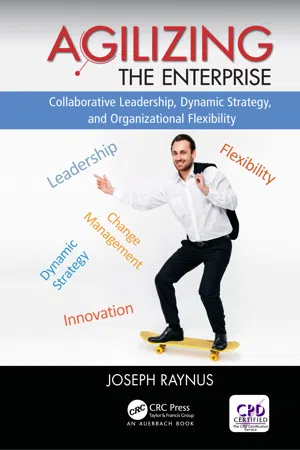
Are you still searching for the workplace that deserves someone like you? Do you really have a good understanding about what is going on out there, in the business world? In this book, we will discuss the importance of agility and how it affects the solutions that are being delivered by an organization. We will also talk about how a blend of strategic innovation, visionary leadership, and organizational agility go hand in hand to ensure the success of an organization. Enterprise agility is not a far-fetched possibility. Once the problems of the organization are identified, with the right tools and effort, the agility, efficiency, and effectiveness of an organization, as well as the processes that the success of the organization are based on, can all be maximized. This book will broaden your thinking and will help you expand your horizons.
- 240 pages
- English
- ePUB (mobile friendly)
- Available on iOS & Android
eBook - ePub
Agilizing the Enterprise
About this book
Information
Publisher
Auerbach PublicationsYear
2018Print ISBN
9781032476148
9781138197978
Edition
1eBook ISBN
9781351985925
Contents
Dedication
Foreword
Preface
Acknowledgments
About the Author
1 Meeting at the Airport
2 Searching for Answers in History
3 Searching for the Age of Agility
4 Searching in Change Management
5 Searching in Strategic Leadership
6 Searching for Agile Organizations
7 Searching for Agile Leadership Qualities
8 Searching for Problem Solving and Decision Making
9 Searching for Innovation
10 Moving to the Age of Agility
Index
Foreword
Joe Raynus often stops by my office, plops himself down in a chair, and with a twinkle in his eyes makes a controversial statement to see how I will respond and to get the conversation going. He loves to discuss business theories to probe what works in what context. He will argue using his vast knowledge of the theories and his industry experience. His stories usually make me laugh, but I also usually learn something new. I am happy to see that Joe has used this “approach” in his new book, Agilizing the Enterprise: Collaborative Leadership, Dynamic Strategy, and Organizational Flexibility—a book that tells stories but also gives information.
The book does not just discuss agility, however, but also covers how agility is tied into dynamic strategies, dynamic capabilities, organizational change, and change management. The information part of the book demonstrates how one theory cannot be used in isolation from others and then goes on to discuss how to apply them in the real world. To work, this requires deep knowledge of the pros and cons of each theory, experience to understand the challenges of implementing the theories, and empathy for human nature as to how people actually behave in organizations. Joe can do this because of his experience as both a teacher and a consultant to many organizations.
The style Joe uses in imparting this information is a story as in a novel. This allows him to romp through ancient history, philosophy, and science, as well as to use business examples. The read is breezy, easy, and fun. But, you will learn something new, just as I do in our office conversations.
— John H. Friar
Executive Professor of Entrepreneurship
D’Amore-McKim School of Business
Northeastern University
Boston, MA
Executive Professor of Entrepreneurship
D’Amore-McKim School of Business
Northeastern University
Boston, MA
Preface
Agility has become a prerequisite for organizations and companies in every industry worldwide. With digital transformations underway in nearly every industry, it is difficult for organizations to survive without the ability to adapt and change according to the world around them. The number one reason for the failure of businesses and organizations throughout the world is that they lack the ability to make the decision to renew themselves and revamp their business models and processes according to the changing environment.
Contrary to popular belief, agility is not synonymous with the stability of an organization. In fact, stability is one of the requirements for an organization to be agile. For an organization to successfully be agile, it is extremely necessary for it to have a stable foundation. What this means, in simple terms, is that even though changes in the environment and industry may require a business or organization to revise and revamp, the core of the organization should remain unshaken by any and all types of changes that are bound to occur within the industry and the organization itself.
Dynamic strategy is another aspect that is necessary for agility. Unless an organization has dynamic capabilities, it is bound to fail in the domains of responsiveness, speed, and nimbleness, all because the organization did not have the ability to move as fast as was necessary.
In this book, we will discuss the importance of agility and how it affects the solutions that are being delivered by an organization. We will also talk about how a blend of strategic innovation, visionary leadership, managed resilience, and organizational agility go hand in hand to ensure the success of an organization. Enterprise agility is not a far-fetched possibility. Once the problems of the organization are identified, with the right tools and effort, the agility, efficiency, and effectiveness of an organization, as well as the processes that the success of the organization are based on, can all be maximized.
Acknowledgments
One evening in a conversation with my wife, Gail, I complained that many professional books written today are not particularly enjoyable to read; the dry content can make these books heavy going—unless the book is a “how to” manual with a silver bullet solution inside, which may not work anyway.
Gail looked at me with her very serious “Gail look” and said, “Stop complaining! You are good with stories. Why don’t you write one?”
So, I did.
Thank you, Gail! Without your help, support, and inspiration I would never have been able to start and complete this project.
Talking and writing on the subject of agility is easier said than done.
I want to thank my friends in industry and academia who helped me to complete my research and get this book into shape during many after-hours discussions.
I’m really thankful to Dr. John Friar. I appreciate the time he spent with me and the way he patiently expanded my understanding of the subject of agility and entrepreneurship.
Thank you, John!
I would like to thank Steve Kasmouski for his time, wisdom, and support of this project.
Thank you, Steve!
Thank you, Dr. Hans Mulder, for your guidance and for sharing your thoughts on innovation and organizational structure with me. Your input into this book has been invaluable.
Thank you, Hans!
Thank you, Marje Pollack (DerryField Publishing Services), my copy editor and typesetter, for keeping me focused. Thank you for your diligence and attention to minor details. It has been an incredibly rewarding learning experience working with you.
Thank you, Marje!
Dr. John Wyzalek (Senior Acquisitions Editor, Taylor & Francis), you published my first book 20 years ago, and you have supported all of my projects, including this one. Thank you for your enthusiasm and support.
Thank you, John!
It was a long and challenging journey that would have been impossible to complete without many people who helped me to shape the content and gave me the opportunity to communicate my thoughts and implement my methodology.
THANK YOU ALL!!!!!!!!!!!!!!
About the Author
Joseph Raynus is a speaker, author, trainer, and consultant who brings a unique blend of practical hands-on experience with innovative ideas and solutions to deal with the real-world challenges of complex environments.
He is a recognized expert in strategic program management and performance improvement. He has facilitated large-scale organizational change, designed and led comprehensive training programs, managed multi-milliondollar technology projects, and mentored diff erent levels of management.
Joseph teaches a variety of undergraduate and graduate courses at the D’Amore-McKim School of Business at Northeastern University, in Boston, Massachusetts. He is a founder of the consulting company, ShareDynamics, Inc., providing training and consulting services to enable enterprise agility and facilitate the development of roadmaps that align value delivery at both strategical and tactical levels.
He is a frequent speaker at industry events and is the author of several books, including Software Process Improvement with CMM (Boston, Artech House, 1998), which is also available in the Japanese and Chinese languages.
Joseph’s book, Improving Business Process Performance: Gain Agility, Create Value, and Achieve Success (New York, Taylor & Francis, 2011), was recognized by the KPI Institute as one of the top 10 books in the Business Performance Management and Operational Performance Management categories in 2013.
Chapter 1
Meeting at the Airport
There I was, sitting and watching TV in one of the bars at Newark Liberty International Airport. The weather forecast was not really promising, which is why many flights were delayed or cancelled. My flight back to Boston, too, was delayed—a typical mid-February day in the Northeast.
For the last four hours, I had been waiting for my flight to Boston to be announced. A lot had happened in these four hours—a gate change, announcements of flight delays, losing my seat once due to an overbooked flight. Having already finished all of the reading material I was carrying, it’s fair to say that I wasn’t having one of the best days of my life.
I decided to buy a new book at the airport’s bookstore to kill time without ruining my IQ by mindlessly watching TV. Who knew how long it would be before my flight back home would be announced? As soon as I got up to head to the bookstore, a commercial came on the TV. It was one of those commercials that paid a lot of money for 30 seconds of air time. The kind of commercials that are aimed at convincing executives to invest millions in a technological product that would act as an elixir of sorts to get their company out of all of the problems that it has ever seen.
I love watching commercials that target business audiences. In this TV commercial, a group of C-level executives are sitting around the conference table during the wee hours of the night with piles upon piles of papers before them. It is implied that these executives, along with their CEO, are trying to decide how they can save money and cut the budget.
To make things worse, the CEO makes a statement that they will not leave the room until the crisis is resolved. Agony and defeat is evident on the faces of these executives. Exhausted and disheveled, these executives look at each other in search of answers—each of them more tense and tired than the other.
Suddenly, the focus shifts to one of the more senior-looking executives, who looks like a revelation just dawned on him.
“What about this?” he asks, pointing at the pile of papers. “They cost millions!”
And in that very instant, the solution was found. The next thing you see is signs of relief on the faces of the executives who were worried sick just a few moments ago.
Another crisis is resolved. Everybody can go home now. See you next time when another crisis hits. The elephant was swallowed in one bite. The executives found a solution in technology to cover their own deficiencies. A technological solution was decided upon in lieu of the wisdom and solutions that should have come from the minds of the CEO and the overworked executives.
I smirked to myself at the superficiality of the commercial, but a thought crossed my mind: Maybe executives really are convinced by the commercial. Why else would such a hefty sum be spent on advertising the product?
I sensed a shadow of a person who was probably watching the commercial as intently as I was. With a touch of gray hair, the man standing behind me looked like he was in his mid-40s. He was tall, too—probably 6’2”. He was wearing khakis and a sports jacket, brown leather loafers, wiry glasses, and a baseball cap. He had a computer bag on his left shoulder, a smartphone in his right hand, and a half-empty water bottle in his left hand. His face was slightly tanned, indicating that he flew in from a warm and sunny place.
As I caught a glimpse of his face, I couldn’t help but feel like I knew the guy from somewhere—but where? I couldn’t guess for the life of me.
“How are you? I’m Bill. I was a student of yours.”
The question was addressed to me.
I turned around.
My former student was evidently pleased to see me. The former student I couldn’t remember.
“Do you remember me? I was a student in one of your MBA strategy classes.”
“Sure, I remember you,” I lied. “How are you? Are you working somewhere?”
Bill happened to be a product executive in one of the most well-known public firms on the East Coast. His appearance gave that much away even if he hadn’t told me. No wonder he was so interested in the commercial, I thought to myself. The newest victim of business travels, he sat down next to me and we started a conversation.
The conversation ...
Table of contents
- Cover
- Halftitle Page
- Title Page
- Copyright
- Dedication
- Table of Contents
Trusted by 375,005 students
Access to over 1.5 million titles for a fair monthly price.
Study more efficiently using our study tools.
Frequently asked questions
Yes, you can cancel anytime from the Subscription tab in your account settings on the Perlego website. Your subscription will stay active until the end of your current billing period. Learn how to cancel your subscription
No, books cannot be downloaded as external files, such as PDFs, for use outside of Perlego. However, you can download books within the Perlego app for offline reading on mobile or tablet. Learn how to download books offline
Perlego offers two plans: Essential and Complete
- Essential is ideal for learners and professionals who enjoy exploring a wide range of subjects. Access the Essential Library with 800,000+ trusted titles and best-sellers across business, personal growth, and the humanities. Includes unlimited reading time and Standard Read Aloud voice.
- Complete: Perfect for advanced learners and researchers needing full, unrestricted access. Unlock 1.5M+ books across hundreds of subjects, including academic and specialized titles. The Complete Plan also includes advanced features like Premium Read Aloud and Research Assistant.
We are an online textbook subscription service, where you can get access to an entire online library for less than the price of a single book per month. With over 1.5 million books across 990+ topics, we’ve got you covered! Learn about our mission
Look out for the read-aloud symbol on your next book to see if you can listen to it. The read-aloud tool reads text aloud for you, highlighting the text as it is being read. You can pause it, speed it up and slow it down. Learn more about Read Aloud
Yes! You can use the Perlego app on both iOS and Android devices to read anytime, anywhere — even offline. Perfect for commutes or when you’re on the go.
Please note we cannot support devices running on iOS 13 and Android 7 or earlier. Learn more about using the app
Please note we cannot support devices running on iOS 13 and Android 7 or earlier. Learn more about using the app
Yes, you can access Agilizing the Enterprise by Joseph Raynus in PDF and/or ePUB format, as well as other popular books in Business & Decision Making. We have over 1.5 million books available in our catalogue for you to explore.