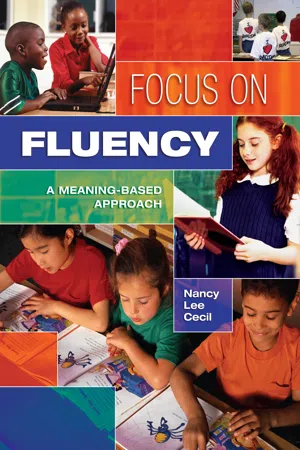
This valuable book is written for preservice and inservice teachers who are searching for best practices with which to promote fluency in reading and writing. Fluency is one of the primary building blocks for creating successful readers and writers, and the practical discussions and activities found here will help teachers develop effective ways to promote fluency and to engage and motivate children, while always remembering that the essential purpose of reading is to gain meaning from text and that of writing is to convey meaning through text.
- 168 pages
- English
- ePUB (mobile friendly)
- Available on iOS & Android
eBook - ePub
About this book
Information

Preface
1 FLUENCY DEFINED
Why is Fluency Important?
Defining Fluency
Rate
Accuracy
Prosody
A Brief History of Fluency Instruction
Current Practices for Teaching and Assessing Fluency
What Can be Done to Improve Fluency?
REFERENCES
2 ORAL READING AND FLUENCY
The Value of Repeated Readings
Repeated Reading Activities
activity FLUENCY DEVELOPMENT LESSON
activity REVISED RADIO READING
Poetry and Fluency
activity POEM IN MY POCKET
activity POETRY RECONSTRUCTION
Poetry Readings
Singing and Fluency
activity CLASSROOM SING-ALONGS
Modeling Fluent Reading
SUMMARY
REFERENCES
3 CHORAL READING AND FLUENCY
How to Initiate a Choral Reading
activity CREATING A CHORAL READING
Teaching Typographical Cues
activity MINI-LESSON ON TYPOGRAPHICAL CUES
Five Choral Reading Formats
Unison Reading
Echoic Reading
Verse and Refrain Reading
Cumulative Reading
Antiphonal Reading
Especially for Early Readers
Multimedia Extensions
Art
Drama
Music
SUMMARY
REFERENCES
4 DRAMA AND FLUENCY
Reading Commercial Plays
Performing Readers Theatre
Selecting Literature for Scripts
Adaptations
activity ADAPTING STORIES TO READERS THEATRE
Creating Original Drama
SUMMARY
REFERENCES
5 ASSISTED READING AND FLUENCY
Teacher-Directed Assisted Reading Techniques
The Neurological Impress Method
Echo Reading
Use of Phrase Markings
activity USING PHRASE MARKINGS TO INCREASE FLUENCY
Skimming and Scanning
Fluency-Oriented Reading Instruction
activity USING FLUENCY-ORIENTED READING INSTRUCTION
Oral Recitation Lesson
activity INITIATING AN ORAL RECITATION LESSON
Tape-Assisted Reading
Student- and Parent-Assisted Fluency Techniques
Dyad Reading
Parent Partners
Teachers and Peers as Fluency Coaches
The Teacher
Student Tutors
SUMMARY
REFERENCES
6 INDEPENDENT SILENT READING AND FLUENCY DEVELOPMENT
Fostering Independent Reading in Class
Developing a Classroom Climate That Fosters Autonomy
Concept-Oriented Reading Instruction
In-Class Silent Reading
Fostering Independent Silent Reading at Home
Incentives
Communicating with Parents About Fluency
Recorded Texts
Closed-Caption Television
Real World Reading Activities
activity BIKE REPAIR
activity ANIMAL FACTS
activity CAREER QUEST
activity ENVIRONMENTAL PRINT
SUMMARY
REFERENCES
7 FOSTERING WRITING FLUENCY
The Writing Process
Prewriting
Drafting
Revising
Editing
Publishing
Fostering Writing Speed
Speedwriting
activity SPEEDWRITING
Story Retelling
activity RETELLING A STORY
Generating Ideas for Writing
Prompts
Dialogue Journals
Automaticity in Writing
Teacher Modeling of Automaticity in Writing
Spelling Concerns and Writing Fluency
Especially for Early Writers
Allowing for Developmental Differences
Interactive Writing
Morning Message
SUMMARY
REFERENCES
8 FLUENCY AND TECHNOLOGY
Choosing Software
Interactive Reading and Writing: Electronic Books
The Reader Rabbit Series
Illuminatus 4.5
Start-to-FinishTM
Guidelines for Choosing Electronic Books
Supplemental Programs Focusing on Repeated Readings
Read Naturally
Great Leaps Reading Program
Programs Offering Feedback and Support
Soliloquy Reading Assistant
Computer Programs to Enhance Writing Fluency
Tools to Increase Reading Rate
AceReader
Reading Speed Drills
Mechanical Devices
SUMMARY
REFERENCES
9 FLUENCY AND ASSESSMENT
Formative Assessment
Summative Assessment
Assessing Reading Rate
Assessing Accuracy
Assessing Prosody
Self-Evaluation of Reading Fluency
Formal Standardized Assessments
Dynamic Indicators of Basic Early Literacy (DIBELS)
The Gray Oral Reading Test, Fourth Edition (GORT-4)
Test of Word Reading Efficiency (TOWRE)
Assessing Writing Fluency
SUMMARY
REFERENCES
APPENDICES
appendix A CHILDREN’S LITERATURE RESOURCES
Children’s Literature for Oral Reading
Books for Poetry and Choral Reading
Songbooks
Plays and Readers Theatre
appendix B READING INTEREST INVENTORY
appendix C ELECTRONIC RESOURCES TO INCREASE FLUENCY
Author and Title Index
Subject Index

Across the United States, fluency has become an important topic. In 2000, the National Reading Panel presented fluency as one of the five building blocks to successful reading. Soon after that, educators in every state began to grapple with the issue of how to create more fluent readers and writers. Journal articles discussed how to increase fluency and professional literacy conferences soon devoted major strands to instruction in fluency. Despite this increased attention on fluency, however, discussions continue about what exactly is meant by the concept fluency.
Fluency in literacy is commonly defined as the ability to read and write accurately and rapidly and, in the case of reading, with appropriate expression. Too often, however, fluency instruction is operationalized in classrooms through having children endlessly practice reading passages as fast as they can or having them reread material they have just read without giving them any real reason to do so. Focus on Fluency: A Meaning- Based Approach is designed to ensure that meaning and fluency remain fully intertwined. We must teach children, especially when they are learning to read fluently, that the essential purpose of reading is always to gain meaning from the printed page.
This book is a supplementary text for preservice and inservice teachers searching for best practices with which to promote fluency in their K-6 learners. It will help educators develop effective ways to promote fluent reading and writing, thereby engaging children in meaningful experiences with text and motivating them to read. Such experiences create a wonderful cycle of practice leading to more fluent reading, and more fluent reading leading to a desire to read more—and thus more practice!
The contents and organization of this book reflect the belief that teachers will not own a method or procedure—that is, will not fully incorporate a practical activity into their repertoire of teaching methods— unless they understand the reason behind the technique and see how it fits into the larger goal of creating literate human beings. In addition, preservice and practicing teachers studying the art and science of teaching need real examples of classroom practice that make sense to them. In this book, educators will find explanations and clear purposes for each instructional activity and step-by-step examples of how the activity might be used in the classroom setting.
Children can experience difficulty with fluency at any point in their literacy development. Children for whom English is a second language may experience difficulties, but so may those who are native speakers. To assist teachers working with culturally diverse children at a variety of skill levels, I have included instructional activities easily modified for grade levels from primary through middle school as well as activities appropriate to English learners.
SPECIAL FEATURES
To go beyond techniques to foster rereading, the most commonly accepted way to increase fluency, this book includes the follo...
Table of contents
- Cover
- Title
- Copyright
- Table of Contents
Trusted by 375,005 students
Access to over 1.5 million titles for a fair monthly price.
Study more efficiently using our study tools.
Frequently asked questions
Yes, you can cancel anytime from the Subscription tab in your account settings on the Perlego website. Your subscription will stay active until the end of your current billing period. Learn how to cancel your subscription
No, books cannot be downloaded as external files, such as PDFs, for use outside of Perlego. However, you can download books within the Perlego app for offline reading on mobile or tablet. Learn how to download books offline
Perlego offers two plans: Essential and Complete
- Essential is ideal for learners and professionals who enjoy exploring a wide range of subjects. Access the Essential Library with 800,000+ trusted titles and best-sellers across business, personal growth, and the humanities. Includes unlimited reading time and Standard Read Aloud voice.
- Complete: Perfect for advanced learners and researchers needing full, unrestricted access. Unlock 1.5M+ books across hundreds of subjects, including academic and specialized titles. The Complete Plan also includes advanced features like Premium Read Aloud and Research Assistant.
We are an online textbook subscription service, where you can get access to an entire online library for less than the price of a single book per month. With over 1.5 million books across 990+ topics, we’ve got you covered! Learn about our mission
Look out for the read-aloud symbol on your next book to see if you can listen to it. The read-aloud tool reads text aloud for you, highlighting the text as it is being read. You can pause it, speed it up and slow it down. Learn more about Read Aloud
Yes! You can use the Perlego app on both iOS and Android devices to read anytime, anywhere — even offline. Perfect for commutes or when you’re on the go.
Please note we cannot support devices running on iOS 13 and Android 7 or earlier. Learn more about using the app
Please note we cannot support devices running on iOS 13 and Android 7 or earlier. Learn more about using the app
Yes, you can access Focus on Fluency by Nancy Cecil,Nancy L Cecil in PDF and/or ePUB format, as well as other popular books in Education & Education General. We have over 1.5 million books available in our catalogue for you to explore.