- 238 pages
- English
- ePUB (mobile friendly)
- Available on iOS & Android
eBook - ePub
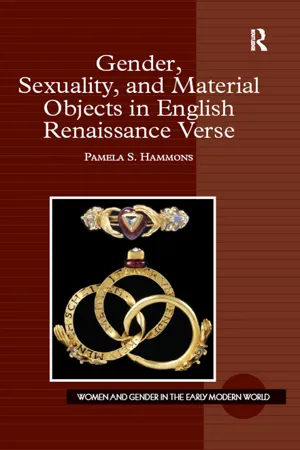
Gender, Sexuality, and Material Objects in English Renaissance Verse
About this book
An important contribution to recent critical discussions about gender, sexuality, and material culture in Renaissance England, this study analyzes female- and male-authored lyrics to illuminate how gender and sexuality inflected sixteenth- and seventeenth-century poets' conceptualization of relations among people and things, human and non-human subjects and objects. Pamela S. Hammons examines lyrics from both manuscript and print collections"including the verse of authors ranging from Robert Herrick, John Donne, and Ben Jonson to Margaret Cavendish, Lucy Hutchinson, and Aemilia Lanyer"and situates them in relation to legal theories, autobiographies, biographies, plays, and epics. Her approach fills a crucial gap in the conversation, which has focused upon drama and male-authored works, by foregrounding the significance of the lyric and women's writing. Hammons exposes the poetic strategies sixteenth- and seventeenth-century English women used to assert themselves as subjects of property and economic agents"in relation to material items ranging from personal property to real estate"despite the dominant patriarchal ideology insisting they were ideally temporary, passive vehicles for men's wealth. The study details how women imagined their multiple, complex interactions with the material world:the author shows that how a woman poet represents herself in relation to material objects is a flexible fiction she can mobilize for diverse purposes. Because this book analyzes men's and women's poems together, it isolates important gendered differences in how the poets envision human subjects' use, control, possession, and ownership of things and the influences, effects, and power of things over humans. It also adds to the increasing evidence for the pervasiveness of patriarchal anxieties associated with female economic agency in a culture in which women were often treated as objects.
Information
Chapter 1
Introduction:
His and Hers
His and Hers
On February 14, 1665, Katherine Austen (1629–1683), a young London widow, composed a love lyric and copied it into her commonplace book, “Book M,” which contains documents ranging from financial accounts, to sermon notes, to over thirty original poems. Since the death of her husband, Thomas, in 1658, Katherine had dedicated herself to managing her children and the family property: she hired lawyers to protect her interests, fought for possession of her estate at Highbury, built new properties, and invested in the East India Company.1 Given how entangled Austen’s widowhood was in property management, it is perhaps no wonder that her love lyric, “On Vollantines day this 14 ffeb: 1665 / My Jewel,” celebrates a miraculous gift of material wealth. Having accidentally found a rich jewel near an old wall, Austen portrays the gem in her poem as a Valentine’s Day gift to herself—from God. In these opening lines, she celebrates her love token:
Wellcome thou best of Vollantines
ffirmer to me then Lover’s twines
Allas they vanish but this tye
A pledge, a suertie Annually. (Austen fol. 108v)2
Unexpectedly finding a precious jewel inspires this young widow to write what is effectively a love lyric to herself. Austen was a prolific occasional poet, so it was not unusual for her to transpose events from her daily life into verse. However, she typically wrote poems concerned with religious meditation and thanksgiving, prophecies, and family matters. While “On Vollantines day this 14 ffeb: 1665 / My Jewel” retains a religious theme, it is particularly interesting because it is Austen’s poem that most closely engages with the commonplaces of Renaissance love lyrics. The poetic scenario Austen creates—Providence chooses her as the special recipient of a valuable, material love token from God—enables her to display her knowledge of secular heteroerotic love conventions and to bend them to her will without disrupting her self-figuration throughout “Book M” as an upstanding, chaste widow of rank.3 In other words, celebrating her jewel, poetically imagining her relationship to a material possession, plays a crucial role in helping her to move beyond her tendency towards unexceptional religious meditations in verse, into new poetic territory.
Austen first describes the fortuitous discovery of her jewel early in “Book M” alongside her account of a prophetic revelation granted to “Henery a Germiane prince,” by which he “was admonished…to search for a writing in an old Wall,” which foretells his future emergence as “Emperour of Germany” (fol. 12r). Of her own similar, seemingly providential encounter with another old wall, the widow writes:
I had noe fore admonishment to look for the Jewel I found. Yet I found it out of an Old Wall, tho by meere accident. What it may certainly import to me I cannot surely detirmine. Yet sure I think it nearely concernes me. I wish I may as piously attend a circumspection of my daies as this happy person [the German prince] in the story: 1662. (Austen fol. 12r)
Here Austen hints at her desires for vast wealth and elevated status; she hopes the jewel she has found materially embodies a divine promise of socioeconomic advancement. Austen’s discovery of her jewel appears to have been very meaningful to her because she returns to the topic repeatedly, both in a prose spiritual meditation, “Upon my Jewel,” and her poem, “On Vollantines day this 14 ffeb: 1665 / My Jewel.”
In her prose meditation, Austen writes,
[s]urely in the sparkes of this Jem I can see the sparkes and shinnigs of Gods love dart out to me. O that I may waight at his Alter, all the dayes of my life, and pay my vowes which I have made to him when I was in trouble. And tho I have pased that time I expected some issues of Divine providence wud perticular attend me, and be explained to me. I may stil waight, and still learne to be assured, as a propitious hand hath bin my attendant all the yeares of my afflictions. And in a most supporting maner at the conclusion of that time, When sickenes and opposition meet together; (And that I was defended): O that I may find the same protecting guard in every remaynder Moment of my life, Then shal I not onely find This Embleeme as an Ambassador of peace to me formerly, but in the future too. (fol. 74v)
Austen takes very seriously the idea that her jewel has prophetic meaning and assumes that—despite her ongoing legal and economic frustrations—it proves God’s continuing protection of her and future assurance of something great. To her, the jewel’s sparkle does not merely represent but actually is God’s love for her: in its materiality, she encounters the divine. Its lively shine animates it, and Austen ascribes agency to it. Her sparkling stone speaks as God’s “Ambassador of peace.”
Similarly, her poem on the same topic, “On Vollantines day this 14 ffeb: 1665 / My Jewel,” apparently written three years after her providential discovery of God’s gift, continues to undermine clear distinctions between people and things. Although Austen’s poetic speaker asks herself, “Why shud I speake thus to a stone? / Unto a thing that life has none?” she does, regardless, hold a conversation with her jewel (21–2). As she indicates, the gem is “a thing” that is lifeless, but it is neither static nor passive. Her verse attributes to it active characteristics: the divine gem—already identified in her prose meditation as God’s “Ambassador of peace”—has the capacity to “hold” “secreets” and to “Declar[e] stories” (Austen 24, 30). It is likely that Austen, a woman of considerable wealth who longed for gentle status, had other precious ornaments with which to adorn herself, but it is the object she believes to be God’s own love token that actually talks to her. In trying to convey the capacity for movement she associates with her jewel, she asserts that “its a key, or is the door” (Austen 28). It is a material item that speaks, unlocks, opens, and provides entry.
When Austen’s poetic speaker asks, “Why may not I this Jewel prize / Wherein Misterious record lies,” she implies that part of its value is its ability to serve as a “record” — in this case, of God’s favor to her (25–6). Like any love token, it reminds the wearer of the donor’s love. Furthermore, it symbolizes in little God’s greatest gift to her. The small object, which she calls “a stone,” is a miniature figure for heaven itself: “Heaven is my great restoring Rocke / There am I Harbour’d in my shocke” (Austen 21, 31–2). Finding her jewel and writing a love poem to herself about it and her divine lover allows Austen not only to imagine having direct access, in the present tense, to heaven—the precious “Rocke” that is her ultimate love token from God—but also to imagine receiving special favor from the very hand of God (or Christ the bridegroom): “ffrom thence his Hand will place a Crowne / Of ample joyes sink sorrowes downe” (33–4). At first glance, these lines appear to express Austen’s fantasy of an afterlife as a joyful queen in heaven: in such a reading, the embattled young widow, sorely vexed over property management and economic concerns in life, is brought in death to the heavenly court and crowned by her divine prince. As we will see in Chapters 4 and 5, poetic meditations upon material possessions are inextricably intertwined with thoughts of death for such diverse women poets as Eliza, Margaret Howard, Isabella Whitney, and Anne Bradstreet. While it is possible to read the end of Austen’s poem as creating closure by suggesting that her earthly troubles will be rewarded in the afterlife, however, lines 31–4 curiously resist this straightforward spiritual commonplace. At the very moment during which the poet writes, “Heaven is [her] great restoring Rocke” (my italics)—not at some later, deferred time. Furthermore, when her supernatural lover rewards her, “ffrom thence his Hand will place a Crowne” (my italics). Apparently, Austen’s providential jewel—itself hard, material evidence for the interruption of the sacred into mundane reality—opens up heaven to her on earth; she is “Harbour’d” there in the present moment. Although her divine prince is firmly located in the heavenly court and will crown her “ffrom thence,” the young widow imagines receiving her regal gift while still quite alive. The poet’s overlapping play with images of jewels, stones, rocks—especially durable, tangible objects—underpins her pragmatic fantasy of a happy, abundant earthly elevation. Like Henry the German prince whose encounter with writing on an old wall presages his promotion to emperor, Austen’s discovery of her jewel near an unassuming old wall must surely point somehow to her own precipitous rise.
Austen’s poem does more than to use religious discourse to explore and to shape her wishes for material advancement. As I discuss in Chapter 4, throughout “On Vollantines day this 14 ffeb: 1665 / My Jewel,” Austen locates her poem clearly in relation to secular verse from the English Renaissance love lyric tradition on the theme of gift giving: in fact, her lyric answers back to her male predecessor poets. Contrasting Austen’s poem to similar ones by John Donne and Richard Fanshawe, for example, not only reveals her high degree of familiarity with the commonplaces of amorous verse focused upon the exchange of love tokens but also her efforts to rewrite those conventions to minimize her own association with problematic figurations of femininity. Ultimately, Austen’s poem reveals compelling insights regarding how women related to the world of objects in Renaissance England.
I begin this study with Austen’s virtually unknown Valentine’s Day poem because it centers upon a material possession. When she finds the gem, she assumes it must be hers: her poem’s subtitle, “My Jewel,” highlights her possessive attitude towards it. Her lines apostrophize it, animating the object itself and foregrounding its effects on her poetic speaker. Austen’s lyric thus serves as an especially striking example of how poetry can help to reveal the parameters of possibility for how men and women imagined relations between people and material objects. By contextualizing poems disseminated in manuscript and print in relation to legal theories, autobiographies, biographies, plays, and epics, Gender, Sexuality, and Material Objects in English Renaissance Verse seeks to illuminate the range of ways in which sixteenth- and seventeenth-century poets conceptualized relations among people and things, human and non-human subjects and objects. It focuses primarily upon what we can learn about women and the material world by studying their verse alongside that of their male contemporaries. While many previous studies of Renaissance material culture have focused primarily upon narrative forms—especially male-authored drama, with a particular emphasis on Shakespeare’s plays—and visual art, this book insists that we cannot fully understand gendered relations among people, things, subjects, and objects unless we analyze women’s writing, in addition to men’s, and unless we attend specifically to poetry.4
Because this study has emerged out of a unique archive of male-and female-authored verse, it analyzes the specific categories of material items—love tokens and real estate—that most frequently become central preoccupations in that particular group of poems. In other words, in setting out to learn about how English Renaissance poets imagined relations among people, things, subjects, and objects, I discovered that men and women alike wrote a substantial number of poems—particularly when one includes manuscript verse—focused thematically upon the exchange of a wide variety of material items used as love tokens and upon real property, including rooms, gardens, land, and houses. Treating male-authored verse alone might have led to an emphasis upon a different set of material objects; however, because I wanted to establish a sound basis for comparing men’s and women’s verse, I deliberately sought areas of thematic overlap for which I could find many women’s poems, as well as men’s. Renaissance love lyrics and country house verse are poetic kinds especially important to Gender, Sexuality, and Material Objects in English Renaissance Verse, even though my analyses extend well beyond them to investigate many other related texts.
The subtitle of this Introduction—“His and Hers”—calls attention to intersections among gender, objects, and possession. Today, in the early twenty-first century, the syntactic balance of “his and hers” is likely to underscore an egalitarian illusion, as if the unnamed things implied by the gendered possessives are paired or matching items, distinguished only by some feature connecting the objects to the genders of their possessors. Furthermore, the phrase might seem to point to a clear divide between person and thing, a subject who possesses and an object that is possessed. The implied hierarchy between subject and object is strong enough that the invocation of the possessor’s agency seems not necessarily to require specification of the possession: in other words, in this commonplace expression, the subject can entirely eclipse the object. Used casually in colloquial speech today, the phrase might call to mind commonplace domestic objects, such as towels that are “his and hers”: they are the same thing, maybe, except for being marked by differently gendered embroidered names (Bill and Sue) or colors (blue and pink). Or perhaps the expression “his and hers” summons images of body parts—his and her genitalia, again assumed to have a kind of logically balanced equivalence and complementarity, but in this case, demarcating less clearly (if at all) a division between person and thing.
As I hope to show, the tidy, evocative syntactic balance of “his and hers” and the implied division between subject and object gloss over far more complex and multiple asymmetrical relations, especially in the case of sixteenth- and seventeenth-century England. After all, the early seventeenth-century legal treatise The Lawes Resolutions of Womens Rights pairs its section title, “That which the Wife hath is the Husbands,” with “That which the Husband hath is his owne” (130, 129): the common law theory of coverture promoted, even if it failed to ensure, a marital scenario of “his and more of his,” rather than “his and hers.” This Introduction’s subtitle foregrounds the phrase “his and hers” to subject it to careful scrutiny and to underline the importance of how gender and sexuality mark relations among people, things, subjects, and objects differently, unevenly, and sometimes, unpredictably. Gender, Sexuality, and Material Objects in English Renaissance Verse is meant as a corrective to previous studies of material culture or subjects and objects that approach gender and sexuality through analyses exclusively or primarily of male-authored texts. In this regard, the Introduction’s subtitle serves as a reminder of what can get left out and therefore requires special emphasis: his and hers.
People, Things, Subjects, Objects
Investigating relations among people, things, subjects, and objects can sound both deceptively simple and impossibly broad. Perhaps not surprisingly, as the title of this book suggests, in sixteenth- and seventeenth-century England, gender profoundly marked a person’s manner of relating to the things making up her or his world. Perhaps in less immediately obvious ways, sexuality, too, was central to the intertwined lives of people and things. For women poets, life stage and marital s...
Table of contents
- Cover
- Half Title
- Title Page
- Copyright Page
- Table of Contents
- List of Figures
- Note on Manuscript Transcriptions
- Acknowledgements
- 1 Introduction: His and Hers
- Part 1 Love Tokens
- Part 2 Houses and Land
- Bibliography
- Index
Trusted by 375,005 students
Access to over 1.5 million titles for a fair monthly price.
Study more efficiently using our study tools.
Frequently asked questions
Yes, you can cancel anytime from the Subscription tab in your account settings on the Perlego website. Your subscription will stay active until the end of your current billing period. Learn how to cancel your subscription
No, books cannot be downloaded as external files, such as PDFs, for use outside of Perlego. However, you can download books within the Perlego app for offline reading on mobile or tablet. Learn how to download books offline
Perlego offers two plans: Essential and Complete
- Essential is ideal for learners and professionals who enjoy exploring a wide range of subjects. Access the Essential Library with 800,000+ trusted titles and best-sellers across business, personal growth, and the humanities. Includes unlimited reading time and Standard Read Aloud voice.
- Complete: Perfect for advanced learners and researchers needing full, unrestricted access. Unlock 1.5M+ books across hundreds of subjects, including academic and specialized titles. The Complete Plan also includes advanced features like Premium Read Aloud and Research Assistant.
We are an online textbook subscription service, where you can get access to an entire online library for less than the price of a single book per month. With over 1.5 million books across 990+ topics, we’ve got you covered! Learn about our mission
Look out for the read-aloud symbol on your next book to see if you can listen to it. The read-aloud tool reads text aloud for you, highlighting the text as it is being read. You can pause it, speed it up and slow it down. Learn more about Read Aloud
Yes! You can use the Perlego app on both iOS and Android devices to read anytime, anywhere — even offline. Perfect for commutes or when you’re on the go.
Please note we cannot support devices running on iOS 13 and Android 7 or earlier. Learn more about using the app
Please note we cannot support devices running on iOS 13 and Android 7 or earlier. Learn more about using the app
Yes, you can access Gender, Sexuality, and Material Objects in English Renaissance Verse by Pamela S. Hammons in PDF and/or ePUB format, as well as other popular books in Literature & Feminist Literary Criticism. We have over 1.5 million books available in our catalogue for you to explore.