Exploring Communication Law, Second Edition, provides an overview of the law as it pertains to print, broadcast, and online journalism, as well as non-journalistic forms of expression. It begins by introducing students to the First Amendment in a general sense, then explores how the principles of free speech are applied in various circumstances, such as political speech, sexual expression, and K-12 and college campuses. The text also explains the fundamentals of media law in areas such as defamation, privacy, the media and the courts, confidentiality and privilege, access to information, broadcasting, and cyberspace.
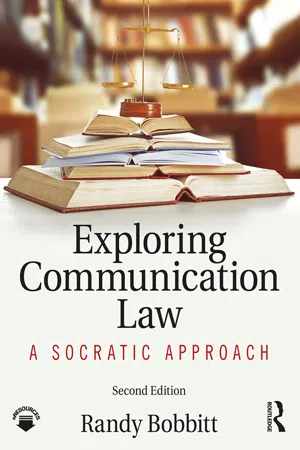
- 352 pages
- English
- ePUB (mobile friendly)
- Available on iOS & Android
eBook - ePub
p.1
Chapter 1
Getting Started: Basic Concepts and Definitions
FREEDOM OF EXPRESSION AROUND THE WORLD
The history of free speech dates back to ancient Greece and civilizations established there between 800 and 400 BC. The city-state of Athens, Greece, pioneered the idea of freedom of expression, but it was inconsistently applied as many prominent philosophers of the time, including Socrates, were tried and executed for promoting ideas inconsistent with those of the government. For the next several decades, scientists throughout Europe and Asia met similar fates for teaching radical ideas such as evolution (not creationism) and the sun (not the earth) being the center of the universe.
As European governments began allowing for more social freedoms around 1000 AD, free speech (as well as other political and social rights) applied only to men or, in some cases, only men who owned property and paid taxes.1
In those cultures, the punishment for libelous communication—or any expression deemed to be offensive—was severe. Violators could be imprisoned for life, have their tongues excised, or both. First-time offenders might get off with a lighter sentence, such as being required to stand in the public square holding a sign reading “liar.”2
In the sixteenth century, European governments established the tradition of “prior restraint” with a series of laws designed to protect their citizens from “blasphemous” and “heretical” books. King Henry VIII began the tradition in 1538, and it was in place until Parliament voted to discontinue it in 1694.3
On an international scale, free speech was an important part of the newly formed United Nations “Universal Declaration of Human Rights,” (UDHR) enacted in 1948. Eleanor Roosevelt, the first lady of the United States, was influential in the development of the document. Article 19 of the UDHR states that “Everyone has the right to freedom of opinion and expression; this right includes the freedom to hold opinions without interference and to seek, receive, and impart information and ideas through any media and regardless of frontiers.”4
p.2
Following World War II, many countries in Europe saw a decline in the number and popularity of daily newspapers. In Sweden, Finland, and Norway, governments recognized the importance of journalism and literacy to the success of their cultures and responded by subsidizing small newspapers in major cities in order to help them compete with more established and successful papers. Media critics elsewhere in the world criticized the arrangement and claimed that newspapers “propped up” by the government would be reluctant to criticize that government, but several studies found that the quality and thoroughness of the reporting was not affected.5
The UDHR is theoretically still in effect today but, as a practical matter, governments that recognize the value of free speech are rare. The best examples are the governments of the United States, Canada, New Zealand, Uruguay, and most countries in Western Europe. Many of those countries have government documents similar to the US Bill of Rights. Germany’s Article 5 of Basic Law and Canada’s Charter of Rights and Freedoms, for example, provide for both freedom of speech and freedom of the press in those countries. South Africa’s relatively new constitution provides that its citizens have freedom of speech, press, artistic creativity, academic discourse, and scientific research.
In other countries, free speech is assumed as a right without being specified by law. In Australia and England, for example, freedom of expression is not mentioned in government documents, but courts typically recognize it as an important part of representative democracy.
By contrast, many countries ruled by military dictators or heavily influenced by religious doctrine allow for little or no freedom of speech or press. In many countries in Asia, Africa, Central America, South America, and Eastern Europe, cultural norms dictate that individual rights are subservient to the welfare of the society as a whole and can therefore be limited with little or no justification.
“Free speech, once seen as close to an absolute right in some countries, is beginning to conflict with other values, such as security, the protection of children, and the desire not to offend religious sensibilities, not just in the Middle East but in much of the world, including Western Europe,” wrote political commentator Alan Greenblatt in a 2013 issue of CQ Researcher. “Concerns are widespread that commentators, journalists, bloggers—and even comedians—are being intimidated into silence.”6
Just as some governments have outlawed comments critical of Islam or denying the history of the Holocaust, others go as far as prohibiting negative depictions of Jesus or past government leaders. In Russia, for example, the government prosecutes anyone detracting from the legacy of Vladimir Lenin, who led the Russian Revolution in the early twentieth century.
In India, movie scripts written by non-residents must be submitted to the Ministry of Information and Broadcasting for approval before any production work can be done within the country. That limitation was unknown to most outsiders until it was revealed in Michael Bamberger’s biography of film director M. Night Shyamalan, who was born in the United States to Indian parents. His 2006 film, Lady in the Water, was nearly derailed by the lengthy permitting process.7
p.3
In many communist countries, the lack of press freedom includes the inability to interview potential sources. In Cuba, for example, the government has deemed that only official sources can be interviewed and quoted in media stories; private individuals can be interviewed only with permission. American author and filmmaker Brin-Jonathan Butler faced this hurdle in 2000 when he traveled to Cuba to produce a documentary about Cuban boxers hoping to compete at the international level. Butler, whose finished product was titled Split Decision, had to interview boxers in secret and disguise their names and faces.8
In Great Britain, where is there no First Amendment nor any other over-arching protections for free speech, the Official Secrets Act provides that a newspaper can be subject to injunctions before publishing a story and to punishment after the fact for ignoring them.9
In many Eastern European countries, governments heavily regulate both the print and broadcast media. By comparison, in the United States only broadcast media are regulated, and not to the same degree as in Eastern Europe.
Unlike in the United States, where federal law provides immunity for Internet service providers (ISPs) for allegedly defamatory material posted online, ISPs in many countries enjoy no such protection. In 2000, for example, a British scientist was awarded $25,000 in damages and legal fees when he sued an ISP that carried defamatory comments about him on a message board.10
Some European countries even go as far as enforcing laws dictating the naming of children. In Iceland, Sweden, and Germany, for example, governments publish lists of “approved” names for newborns.11
Each year around the world, hundreds of journalists are unduly arrested, kidnapped, or even murdered either by their own governments, political parties, military dictators, terrorists, or drug cartels. In addition, newsrooms are bombed or subject to searches and confiscation of news materials. The worst cases generally occur in Africa, Asia, South America, and Eastern Europe.12
Around the world, one of the most dangerous activities for both journalists and ordinary citizens is criticism of government officials or questioning government policy. A recent report from the U.S. State Department indicated that while in the past totalitarian governments would concentrate on punishing citizens who protested in the streets or outside government buildings, today they spend an increasing amount of money and manpower attempting to limit controversial speech taking place on electronic forums such as electronic mail and social media.13
The Committee to Protect Journalists reports that Iran is the second most frequent jailer of journalists (behind only China), and that it has been among the worst three in the world each year since 2009.14 Other examples include Nepal, Egypt, and Myanmar, where governments shut down or severely limited access to the Internet and other forms of communication as those countries dealt with political turmoil.15 In China and Myanmar, government officials used reporters’ cellular telephones to track their locations and eavesdrop on their conversations with other journalists, their editors, and their sources.16
p.4
In 2012, the government of China blocked its citizens from accessing the website of the New York Times. The government also prohibits citizens, as well as journalists, from criticizing the government, political parties, or individual political leaders. China allows its citizens to use Weibo, the equivalent of Twitter, but employs more than 4,000 operatives to monitor the site for controversial commentary....
Table of contents
- Cover Page
- Exploring Communication Law
- Title Page
- Copyright
- Contents
- Preface to the Second Edition
- About the Author
- 1 Getting Started: Basic Concepts and Definitions
- 2 An Overview of the First Amendment
- 3 The First Amendment and Political Speech
- 4 The First Amendment and Sexual and Violent Content
- 5 The First Amendment and Campus Issues
- 6 Defamation
- 7 Privacy
- 8 Problems in Newsgathering
- 9 Broadcasting and Cable
- 10 The Internet and Social Media
- Appendix A Sources/Suggestions for Further Reading
- Appendix B Legal Research and Writing
- Case Index
- Subject Index
Trusted by 375,005 students
Access to over 1.5 million titles for a fair monthly price.
Study more efficiently using our study tools.
Frequently asked questions
Yes, you can cancel anytime from the Subscription tab in your account settings on the Perlego website. Your subscription will stay active until the end of your current billing period. Learn how to cancel your subscription
No, books cannot be downloaded as external files, such as PDFs, for use outside of Perlego. However, you can download books within the Perlego app for offline reading on mobile or tablet. Learn how to download books offline
Perlego offers two plans: Essential and Complete
- Essential is ideal for learners and professionals who enjoy exploring a wide range of subjects. Access the Essential Library with 800,000+ trusted titles and best-sellers across business, personal growth, and the humanities. Includes unlimited reading time and Standard Read Aloud voice.
- Complete: Perfect for advanced learners and researchers needing full, unrestricted access. Unlock 1.5M+ books across hundreds of subjects, including academic and specialized titles. The Complete Plan also includes advanced features like Premium Read Aloud and Research Assistant.
We are an online textbook subscription service, where you can get access to an entire online library for less than the price of a single book per month. With over 1.5 million books across 990+ topics, we’ve got you covered! Learn about our mission
Look out for the read-aloud symbol on your next book to see if you can listen to it. The read-aloud tool reads text aloud for you, highlighting the text as it is being read. You can pause it, speed it up and slow it down. Learn more about Read Aloud
Yes! You can use the Perlego app on both iOS and Android devices to read anytime, anywhere — even offline. Perfect for commutes or when you’re on the go.
Please note we cannot support devices running on iOS 13 and Android 7 or earlier. Learn more about using the app
Please note we cannot support devices running on iOS 13 and Android 7 or earlier. Learn more about using the app
Yes, you can access Exploring Communication Law by Randy Bobbitt in PDF and/or ePUB format, as well as other popular books in Law & Communication Studies. We have over 1.5 million books available in our catalogue for you to explore.