![]()
Part I
Philosophical meditations
![]()
2
Beyond belief
Religion as the ‘dynamite of the people’
Bruno Latour
Introduction
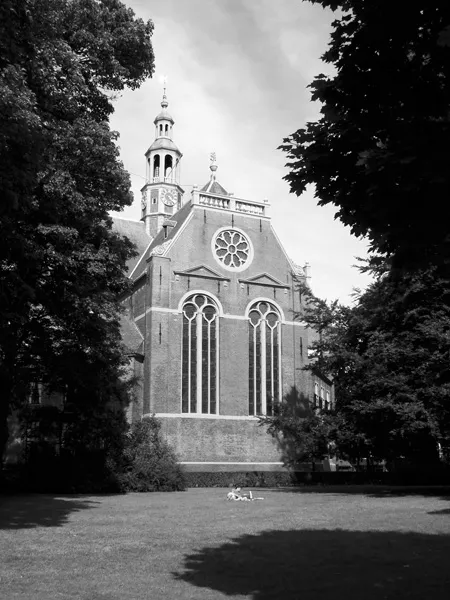
In my contribution to the debate on postsecularity I wish to revisit my long fascination with the dichotomy between knowledge and belief based on a keynote lecture I gave in Groningen, the Netherlands, in 2014 (see Figure 2.1).1 I’ll posit the idea that a plurality of templates to measure and understand the world could be conducive to a new public space that would allow respect towards religion as much as politics without mixing the two.
As Jan Assmann (2009a) has suggested in a recent book on ‘religion and violence’, how much we regret the time when religion was the ‘opium of the people’. Now, it is rather the ‘dynamite of the people’! From a drug putting the damned of the world into somnolence instead of doing revolution, religion has become the spear of revolutionary changes, and not always for the better. Religious studies have become an entry into the most misunderstood source of extreme violence and radical politics, and this is true not only of Islam, but is everywhere visible, from India to the evangelical church of North America, all the way to Russian orthodoxy, without forgetting the violent act of destruction of idols and fetishes that keep accompanying so much of the missionary work. While the state of the planet leaves everybody cold, the destruction of someone else’s cult brings vast masses into action immediately. While modernism had long been defined by ‘secularization’, it seems that we are witnessing a reinforcement of modernist violence through new type of what should be called religious wars.
But far from being a ‘remnant of the past’ or an ‘archaic return to the past’, this metamorphosis of opium into dynamite proves that religion has to be taken as a fully modernist attitude. Specialists of religious studies should be ideally capable of probing this odd novelty—and if there is one place where all the tension of religion with modernity is being open to inquiry, it is in Europe, with its long history of simultaneously pluralism and most recently the hard testing of the extreme fragility of tolerance. So, what I want to do in this contribution to the volume is to follow the metaphor of the drug but to add to it what biochemists would call the study of its potentialization. It used to be a drug that put people to sleep—opium—and now it makes them active to the point of frenzy: it has been ‘potentialised’. We have to discover what chemists call the action principle of this drug that explains such metamorphosis. I’ll undertake this task in three parts, trying to find out why is it that this drug has become so strange. One part is, very quickly, about social explanation, the other about belief in belief, and the third one about politics. I will show that the three are actually combined together, which might explain some of the difficulty we have in understanding this contemporary emergence of religious wars.
Figure 2.1 Protestant Nieuwekerk, Groningen: venue for the keynote lecture
Source: Wikipedia Commons: photo: Edi Weissmann.
The limit of social explanation of religion
So, let me start with the first one. We are not much helped in this search by the sociological principle—most clearly articulated, to take a classic case, by Emile Durkheim—that religion is made of the rites and words put in place to hide and reveal the existence of what he called ‘society’. Durkheim (1947[1915]), as everybody knows, initiated a long set of studies that try to replace the enigmatic nature of religion by an even more enigmatic set of entities called society or social relations. As any sociologist will tell you, Durkheim claimed that the impersonal force of society was the only reality behind the vast mythical elaboration of religion. But what is not as often underlined is how strange, how active, and how enigmatic was the so-called impersonal force claimed by Durkheim to be the reality behind the enigma. One example:
Society could not abandon the categories to the free choice of individual […]. For this reason, society uses all its authority upon its members to forestall such dissidences […] it is frequently rude to individuals; it is constantly doing violence to our natural appetites.
(my emphasis) (cited in Latour 2014)
That’s a lot of action for something that is supposed to be impersonal.
It is not too complicated to divine behind the impersonal agent implied by Durkheim (and sociology of religion after him)—the very personal agent implied by monotheistic religions. It’s hard not to see in those ‘social explanations’ of religion, the mere replication of the being that Western religions invoke at the origin of their social life. The notion of ‘society’ is the ‘one God, one people’ of tradition. To put it bluntly, ‘society’ is the name given to a barely secularized ‘Yavhé’ (Karsenti 2017).
So, secularization has always been an attempt at reinforcing the ‘one God, one society’ argument. The obsession of sociology for explaining the obscure by appealing to what is more obscure is based on the denegation that there is something that makes people act, something whose agency has to be carefully scrutinized on its own term and for which the umbrella term ‘religion’ is terribly inadequate and which is not ‘society’. In other words, it is not society that is behind religion; on the contrary, society is made in part by connections made by people with highly specific types of beings. This reversal in the direction of explanation is essential if we want to understand and avoid the ‘one people, one God’ argument. Society is what is to be explained, not what brings any explanation, especially not when by ‘society’ scholars of a Durkheimian persuasion mean, in effect, the God of Israel and Christianity. Religion, just like science or law, is not what is to be explained by alluding to social ties but includes some of the ingredients, making the social ties hold. At least this is the general principle of actor-network theory of the social order, a principle especially forgotten when religion is ‘explained’ away by sociologists (Latour 2005). If we consider how religious people define the beings that they encounter, it seems that a better definition would be that there are agents on which they have limited control and whose disappearance will make them die. Let’s call them, for this reason, beings of salvation and try to get at them without using the sociological notion of belief.
Belief as a category mistake
This brings me to the second problem that renders the potentialization of opium into dynamite difficult to follow. This time it is not due to the explanation that appeals to the society instead of explaining the religious contribution to the solidity of social ties. The problem is due—and often on the part of those who pride themselves in being ‘religious’—to what makes them act in competition with science. By science I mean at least information to render the idea of a totally utopian space where things, argument, people, and goods could be transported without being transformed. Transportation without transformation has always been my personal nemesis. This is what I call double-click information (Latour 2013b).
My thesis is that it is the spread of double-click information that is at the origin of the invention of obscurantism in matters of religion, that is, the idea articulated by opponents as well as by proponents of religion that there is something ‘occult’ in its rituals and practices. The very use of the word ‘religion’ has come to mean what is inexplicable, irrational, what requires an appeal to an extraordinary set of drives (for the analyst), or what requires supra-natural entities for those who are called ‘believers’ who are forced to accept belief as what accounts for their faith. This requires some explanation.
I claim that there is nothing obvious in this link of religion with the strange, the occult, the supernatural, nor, to use the main notion that rocks any understanding of the question, with ‘belief’. The idea of belief is the result—and an unhappy one—of interrogating a mode of existence by using another mode. I want to try to propose that belief is always the result of an unfortunate crossover between two modes of existence. The use of the notion of belief proves that there has been a conflict during an interchange in the templates we should use to define an entity on its own terms. This is what I call a category mistake (Latour 2013a).
Those category mistakes are banal, but very often they don’t have the huge consequences we are witnessing in the potentialization of the opium into explosive. For instance, if, after a judge has rendered her verdict, you, the plaintiff, keep saying ‘I don’t feel appeased by this judgement’, your lawyer will be right to say psychological peace of mind is not what law is about—a verdict has its own logic and nobody hearing it would conclude that law is irrational, occult, or obscure. You might keep complaining against the formalism of law, but most probably you will not conclude that law is ‘irrational’. You most probably conclude that law has its own strange and painful way of being right. Thus, law seems to resist the accusation of being ‘just about irrational belief’ (Latour 2009).
Ideally, we should be able to say the same thing when registering any crossing between two incompatible templates. Such is the principle of an inquiry into modes of existence: double-click is not the universal template for every encounter. Faced with a judgement of law, you simply recognized that as far as psychological appeasement is concerned, legal vectors are found wanting. No more, no less.
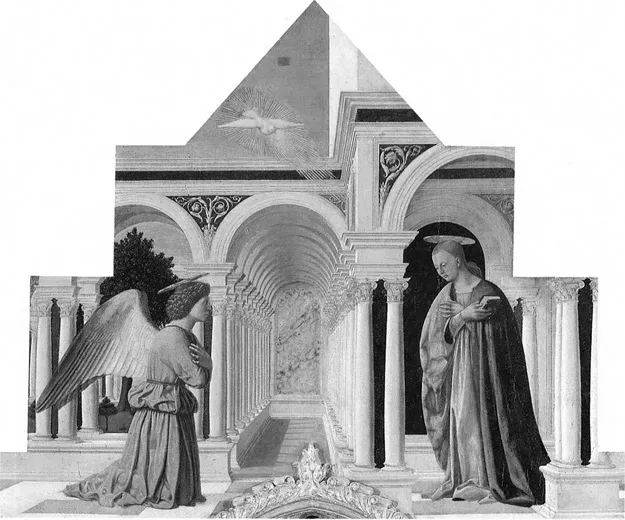
So now we can ask ourselves how come that the same thing does not happen when you ask the carriers of religious salvation—Bible, angel, sermon, or icons—how come they are not producing accurate information about a certain state of affairs? Why don’t we simply conclude: ‘well religious vectors are simply not good at transferring facts because they do something else that facts are not asked to do: namely to transform those who are addressed by religious beings’. Imagine the Virgin Mary asking Gabriel what information he is carrying. He should obviously reply: ‘I’m not carrying information, I’m transforming you!’ Information content: zero, transformation content: maximum, that is, the birth of the Son of God! The idea of some occult kind of message would only be produced if, by mistake, the answer was: ‘there is a message (that is, an information), but it is encoded in some mysterious language’. At this point, the transformative (by opposition to the informative) mode would be lost for good.
The difference between modes has been well demonstrated by Louis Marin commenting on the famous ‘Annunciation’ by Piero della Francesca (Marin 1989; Marin 1991) (see Figure 2.2). Piero painted an annunciation, and he did it very beautifully so that the angel is actually hidden by the pillar; there is no way for the Virgin in the newly invented perspective space to see Gabriel! Piero della Francesca was amazingly careful in his disposition of objects in space—after all, he invented this new optical regime!—and that’s why he made it absolutely clear that the Virgin should not see Gabriel in that space to indicate as clearly as possible to the viewer that Gabriel was not a carrier of information but a completely different type of vector. Marin comments that to make sure the difference of the two modes is understood, perspective logic is used to render the protagonists invisible to one another. But it has nothing to do with the obfuscation of a message that could be clarified by painting Gabriel facing Mary straight on.
Figure 2.2 The Annunciation, Piero della Francesca, 1460
Source: WikiArt.
The notion that religion is about the irrational is thus the result of an embarrassment. Gabriel would be embarrassed at being asked the wrong question, at being interrogated in the wrong key: ‘What information (meaning exact information) do you bring to me?’ Poor Gabriel would not know what to say. But you would agree that it would be worse if we concluded from his unease that he has something to hide, another more esoteric and less rational message. He has nothing to hide, he does something else. He brings a total transformation of Mary.
Belief arises when we have two exit routes left. One is to withdraw into a rather shameful ‘yes, I believe in strange things but I won’t tell anybody’, and the other is, on the contrary, to assert that ‘yes, indeed, there is a world that belief can access just as much as information can access the world of common sense, except it’s a supra natural world of beyond to which you have no access’. This means that you are not transformed by the message but left simply hanging eyes looking up. Belief has eaten up the originality of religion. There is a totally invented competition between the double-click messages transporting information about the natural world and double-click information transporting information about the supra natural world.
At this point, the poison comes in when belief that started as a misunderstanding on the part of the interrogator is accepted by the interrogated as what he or she has to hold in order to be respected. This is where the difference between religion and law is most striking. The lawyer will never say, ‘law is exactly as information transfer except it is much more esoteric’. He or she will say, ‘law’s job is not to carry information nor is it to cure psychological miseries. Dura lex sed lex’. But in matter of religion, religious people themselves have accepted to submit to the power of double-click when they begin to confess: ‘Yes, I believe in what cannot be explained by normal means but you are right that it is a message’.
What started as absurdity on the part of interrogator, not using the correct template, becomes now what the wrongly understood soul begins to hold most dearly to. That sits at the heart of the question because now there is a deep lack of authenticity in accepting to be a believer yourself because of the way you have been requested to bear witness for the beings who make you act. The potentialization of opium into dynamite comes, in my view, from this operation by which the imputation of belief by the outside observer has been interiorized by the agent as the only way to understand what makes him or her act. ‘Yes, you’re right, after all I believe in occult, irrational, supernatural sort of things’. Except this cannot be true. Belief is not, and cannot be, the sincere and authentic way in which you are acted by the being activating you. Belief is always a mistake, whether it is imputed from the outside or accepted as inside as the only definition of the situation.
Since it is what I call a category mistake, it deprives the now entrenched believer of any possibility of rearticulating what makes him or her act. Now the believer is poisoned from the inside by this imputation of believing into something strange that does not correspond at all on how he or she is acted upon by the beings coming to make him or her saved. I claim that this is the source of the modernist form of fundamentalism—a fully modern extension of the poisonous notion of belief, coming at first from the outside as a category mistake on what it is to be acted upon and then interiorized as the only positive way to assert oneself in the face of a confrontation by people who don’t understand what you are. At this point, violence is the only solution.
I am not suggesting an old, premodern, archaic violence. Assmann, in The Price of Monotheism (2009b), is really interesting in this regard....