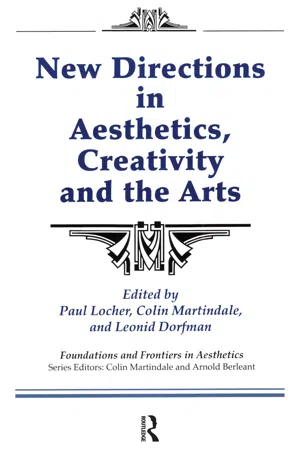
The contributing authors to this book, all pre-eminent scholars in their fields, present their current thinking about the processes that underlie creativity and aesthetic experience. They discuss established theory and research and provide creative speculation on future problems for inquiry and new approaches to conceptualising and investigating these phenomena. The book contains many new findings and ideas never before published or new by virtue of the novel context in which they are incorporated. Thus, the chapters present both new approaches to old problem and new ideas and approaches not yet explored by leading scholars in these fields. The first part of the book is devoted to understanding the nature of the perceptual/cognitive and aesthetic processes that occur during encounters with visual art stimuli in everyday settings, in museums and while watching films. Also discussed in Part I is how cultural and anthropological approaches to the study of aesthetic responses to art contribute to our understanding about the development of a culture's artistic canon and to cross-cultural aesthetic universals. Part II presents new dimensions in the study of creativity. Two approaches to the development of a comprehensive theory of creativity are presented: Sternberg's Investment Theory of Creativity and a systems perspective of creativity based on a metaindividual world model. Also covered are the factors that contribute to cinematic creativity and a film's cinematic success, and the complex nature of the creative processes and research approaches involved in the innovative product design necessitated by the introduction of electronics in consumer products. Part III deals with the application of concepts and models from cognitive psychology to the study of music, literary meaning and the visual arts. The contributors outline a model of the cognitive processes involved in real-time listening to music, investigate what readers are doing when they read a literary text, describe what research shows about the transfer of learning from the arts to non-arts cognition and discuss the kinds of thinking skills that emerge from the study of the visual arts by high school students. In Part IV, the authors focus on the interactive contribution of observers' personalities and affect states to the creation and perception of art. The chapters include a discussion of the internal mechanisms by which personality expresses itself during the making of and the response to art; the relationship between emotion and cognition in aesthetics, in terms of the interaction of top-down and bottom-up processes across the time course of an aesthetic episode; the affective processes that take place during pretend play and their impact on the development of creativity in children and the causes and consequences of listener's intense experiences while listening to music.
eBook - ePub
New Directions in Aesthetics, Creativity and the Arts
- 288 pages
- English
- ePUB (mobile friendly)
- Available on iOS & Android
eBook - ePub
New Directions in Aesthetics, Creativity and the Arts
About this book
Information
Part I
Visual Aesthetics
Chapter 1
Perception and Moving Pictures: From Brunelleschi and Berkeley to Video and Video Games
Julian Hochberg and Virginia Brooks
How pictures function tells us much about how we perceive the world, and their makers’ discoveries guided yesterday’s philosophy and science. Today, moving pictures help in raising and answering questions of concern to cognitive psychologists, to neurophysiologists, to aestheticians, and to those computer scientists who automate our interaction with the visual world and its representations. This is increasingly true as we start to learn how meaningful sequences are processed, and how the perceptual system routinely draws on creative anticipatory abilities which can be aroused by filmmakers and other artists, but are not invented by them.
There is obviously still a great deal to learn about moving pictures before we can expect computers to create them with only cursory human supervision; however, if Pixar, which is heavily computer-executed, can now make a $400 million profit on a $100 million cost (see Stross, 2004), we are at least on the road. More important to us here, by studying how movies work, we can learn more about human perceptual mechanisms that have real-life consequences. In this chapter, our two main concerns are these: to make a start on how objects integrate across views, and on how scenes integrate across cuts.
First, we sketch yesterday’s approach as a backdrop and reminder of what won’t work.
How We Used to Explain Seeing
Until quite recently (about 50 years ago—recent to some of us) it was widely assumed that the purely visual components of what we perceive are tiny points of color at various loci in 2D space, while the rest of our perceptions—shapes, motions, depth, gestures, and above all the integrated views of the world that span our successive glances—were all assumed to be clusters of sensory and motor memories. Mapping the photoreceptors’ sensitivities, the associative learning curve, etc., and measuring the probabilities with which different aspects of our ecology co-occur (and thereby become associated, in the likelihood principle), were all challenging but eminently possible, publishable, and rewarding activities.
The fact that perceived motion could be produced by successions of static pictures, i.e., moving pictures, did not in itself offer the classical view a serious problem (although some writers on film did fuss about uncritical issues, like the phi phenomenon of apparent motion, and “persistence of vision”; to put those in perspective, see Steinman, Pizlo , & Pizlo, 2000, for the first, and Anderson & Anderson, 1983, for the second). Classically, perceived movement was simply considered a perception that was composed of memories of sensations at successive loci in the retinal image, so that was not then a problem in itself.
However, combining the images of objects and scenes, as viewpoints change, was (and is) another story: That we seem able to integrate the glimpses of the world given by successive eye movements was usually explained as compensation for how the eye muscles had moved the eye. Much work was done on this quite difficult question. It came to very little: We do not in fact firmly transfer information about retinal position when moving our eyes (e.g., Jonides, Irwin, & Yantis, 1983). The use of view-changes (cuts) in films and in dioramic slide-shows really told us that by the dawn of the 20th century.
We still do not have a good account of what accrues across glances.
Film makers, on the other hand, have long since (since the early 1900s) shown that one can provide information across viewpoints comprehensibly, so that moving pictures may suggest alternatives to the approach outlined above. And such help is needed because, as we all now know, the classical approach to perception is no longer viable for other reasons as well. Some of those reasons are particularly relevant here.
How Looking Looks Now
1. Neural structures in eye and brain respond not to individual points, but to extended patterns (even to faces!), so we do not yet know the full vocabulary with which the visual system analyzes what it receives. It is therefore prudent to include representative stimuli like those we use outside the laboratory as we formulate and test any a new approach.
2. As incoming visual signals enter the earliest cortical region VI, they confront output from various higher cortical levels, including pre-frontal cortex (the top-most and most anticipatory level; see Lennie, 1998), so the brain is not merely a passive associative network.
3. The biggest fact is this: Laboratory experiments show that each saccade only occurs after a purposeful shift of attention (see Hoffman & Subramaniam, 1995; Kowler, Anderson, Dosher, & Blaser, 1995). Each new glance is thus purposefully directed to some place that is likely to have been seen, but only peripherally, during a previous glance. This vindicates older claims that glances are normally purposeful, and directed by a perceptual question or an anticipation about what information can be found (Hochberg, 1970; Hochberg & Brooks, 1970; see also Cavanagh, Labianca, & Thornton, 2001, Gottesman & Intraub, 2003). We therefore next look briefly at looking as a purposeful behavior.
Purposeful Looking at Objects and Scenes
The fact that real eye movements have two purposeful antecedents— the posing of a visual question, and the likelihood of preceding extrafoveal glimpses—makes them very different from cuts between shots in moving pictures (although cuts can approximate glances in some ways and thereby help investigate the nature of perceptual inquiry).
Saccadic eye movements themselves have usually been studied while stationary viewers read or looked at pictures, but the eyes move quite similarly in many other situations. In fact, a freely moving viewer’s gaze touches the sites of planned actions long before those actions are undertaken (Pelz & Canosa, 2001). In as many as 4-5 saccades per second, the eye directs its high-resolution fovea to some point that was previously seen by the eye’s periphery, which has only extremely low acuity and loses information further by “crowding” (see Tripathy & Cavanagh, 2002). Therefore anything not fixated has little or no detail; in any case, features which do not fit the visual question that the glance is asking are subsequently disregarded as irrelevant (Hochberg, 1970; Hochberg & Brooks, 1970). Furthermore, how scenes are remembered shows signs of what are most likely the preparations for further restricted glances (Gottesman & Intraub, 2003). In short, each individual glance picks up and retains very little (about 4 letters) out of a page full of text, and comparably sparse encodings when viewing brief pictorial displays (see review on sparseness by Intraub, 1997; see Potter, Staub, & O’Connor, 2004, for the time course of response to briefly-exposed pictures; also see Hollingworth, 2004, on the memories of individual meaningful items flagged and looked at within a meaningful scene).
Simply put, what is not attended is likely to be not looked at, likely to be not encoded, and likely to be not remembered. This was a major point in Neisser’s 1967 comprehensive initiation of modern cognitive psychology, a concern of other less ambitious theories (Hochberg, 1968; Treisman & Geffen, 1967) and the focus of what Mack and Rock (1998) later called inattentional blindness. (That now-popular term obscures the fact that the supposedly-lost information has detectible consequences, as shown by Becker & Egeth, 2000, so inattentional disregard or neglect is the term used here.) Around that issue, a growing body of research has studied attentional effects on moving pictures of real people, starting with Neisser and Becklen (1975), then using superimposed actions, and now using more natural films (e.g., Levin & Simons, 1997; see review by Simons, 2000).
Such research is certainly interesting and more applicable than the old approach’s measures of attentional effects on psychophysical thresholds of spots of light. However, mere data about what viewers can’t report is not as informative as data about what else they can report, i.e., what perceptual couplings (Hochberg, 1974) or consequences they display, as in Figure 1C. The figures that follow sketch demonstrations in which attention is directed within and across objects and scenes. (See note before the first caption.)

Figure 1. Inattentional disregard: 2 dancers and the Killer Cube.
Learning From Moving Pictures
Figure 1 shows frames from 3 animations, each meant to be attended in succession at two different places. Figures A, B, and C are so designed that where one attends, within the same object or scene, and the perceptual question one asks of the world, determine what motion and structure one sees. Figure 1A was modeled after a demonstration (as we remember it) by Slavko Vorkapitch, at the Museum of Modern Art in the mid ‘60s (Kevles, 1965). In that shot, the woman appeared stationary, showing the importance of Gibsonian motion gradients. Here, we added walking feet and a moving (receding) pavement, so that when attended at a the “actress” seemed to step forward. When attended at b, her motion is lost, and the bottom becomes a disregarded jumble (which the loss of motion at b would seem to imply in any case, given other evidence that distance information is well transmitted by such “nested contact” Meng & Sedgwick, 2001). In Figure 1B, a stationary “dancer” appears to move when she is strongly fixated. And in Figure 1C, an illusory motion is used to corroborate that the viewer has misread a close relative of the Necker cube, switching without noticing it from a possible structure when fixated at a, to an impossible structure at b. Motion gradients do not automatically suffice for direct (unmediated, unattentional) perception, unless they receive directed attention when they need it. For an extensive discussion, see Cutting, Alliprandini, and Wang (2000) and Cutting (2004).
It was previously observed (see Brooks, 1984) that choreographed motions as perceived from the screen are not automatically those the camera confronts, because the motion picture frame itself affects the performance space and therefore the depth and magnitude of the perceived movement. As we now see in the surprising independence between parts of a single object, particularly evident in Figure 1C, perceived motions within the scene and object are determined more by local conditions than we would expect from any physical models like those on which computer-generated animations are based (or those with which Gestalt psychology tried to replace the cl...
Table of contents
- Cover
- Title Page
- Copyright Page
- Table of Contents
- Preface
- Part I Visual Aesthetics
- Part II New Direction In Creativity
- Part III Art and Cognition
- Part IV Art, Affect, And Personality
- Index
Trusted by 375,005 students
Access to over 1.5 million titles for a fair monthly price.
Study more efficiently using our study tools.
Frequently asked questions
Yes, you can cancel anytime from the Subscription tab in your account settings on the Perlego website. Your subscription will stay active until the end of your current billing period. Learn how to cancel your subscription
No, books cannot be downloaded as external files, such as PDFs, for use outside of Perlego. However, you can download books within the Perlego app for offline reading on mobile or tablet. Learn how to download books offline
Perlego offers two plans: Essential and Complete
- Essential is ideal for learners and professionals who enjoy exploring a wide range of subjects. Access the Essential Library with 800,000+ trusted titles and best-sellers across business, personal growth, and the humanities. Includes unlimited reading time and Standard Read Aloud voice.
- Complete: Perfect for advanced learners and researchers needing full, unrestricted access. Unlock 1.5M+ books across hundreds of subjects, including academic and specialized titles. The Complete Plan also includes advanced features like Premium Read Aloud and Research Assistant.
We are an online textbook subscription service, where you can get access to an entire online library for less than the price of a single book per month. With over 1.5 million books across 990+ topics, we’ve got you covered! Learn about our mission
Look out for the read-aloud symbol on your next book to see if you can listen to it. The read-aloud tool reads text aloud for you, highlighting the text as it is being read. You can pause it, speed it up and slow it down. Learn more about Read Aloud
Yes! You can use the Perlego app on both iOS and Android devices to read anytime, anywhere — even offline. Perfect for commutes or when you’re on the go.
Please note we cannot support devices running on iOS 13 and Android 7 or earlier. Learn more about using the app
Please note we cannot support devices running on iOS 13 and Android 7 or earlier. Learn more about using the app
Yes, you can access New Directions in Aesthetics, Creativity and the Arts by Paul Locher,Colin Martindale,Leonid Dorfman in PDF and/or ePUB format, as well as other popular books in Psychology & Art Theory & Criticism. We have over 1.5 million books available in our catalogue for you to explore.