- 150 pages
- English
- ePUB (mobile friendly)
- Available on iOS & Android
eBook - ePub
About this book
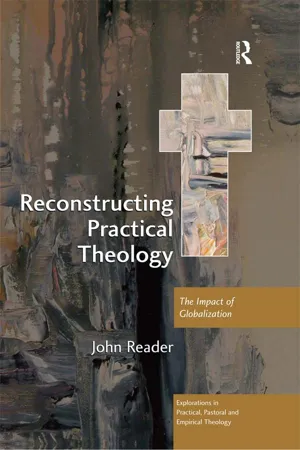
This book argues that the discipline of practical theology needs to be re-shaped in the light of the impact of various influences created through the encounter with globalization. Essential to this is an engagement with the insights of other disciplines, e.g. sociology, politics, economics and philosophy. The content and authority of the Christian tradition is being challenged by the blurred encounters with more fluid lifestyles, alternative spiritualities and indeed other faiths as mediated through information technology and the breakdown of attachments to all forms of institutional life. Traditional ways of 'belonging' and relating to places and structures are being eroded leaving the established patterns of ministry, worship, church organisation the province of an ageing population, while those who are now more inclined to search for 'communities of interest' avoid being drawn into the practices and structures of formal religion. What is the future for practical theology in this rapidly changing context? By examining the familiar concerns of the subject John Reader shows how it is in danger of operating with 'zombie categories' - still alive but only just - and presents the possibilities for a reflexive spirituality grounded in the Christian tradition as a way into the future.
Information
Chapter 1
A Changing World
Introduction
The objective of this book is to review and refine practical theology in the light of the contemporary context in which Christianity is operating. I will argue that one of the reasons why our responses are becoming inadequate is that we are using inappropriate and dated categories to understand and describe that context, and I will then offer alternatives to those drawing on other disciplines. Broadly speaking the best way of grasping these changes is under the heading of a family of concepts derived from the study of globalization. This is another of those terms that has now swept into academic discourse and suffers from over-exposure and under-theorization, so that will also be addressed at points in the argument.
A leading contemporary sociologist, Ulrich Beck, has coined the phrase ‘zombie categories’ as a way of pointing to the continued employment of concepts that no longer do justice to the world we experience and yet which are difficult to abandon because of tradition and also because they are not yet totally redundant (Beck and Beck-Gernsheim 2002: 203–206). Zombie categories are ‘the living dead’, the tried and familiar frameworks of interpretation that have served us well for many years and continue to haunt our thoughts and analyses, even though they are embedded in a world that is passing away before our eyes. Finding convincing replacements for them however is not easy as it requires changes of discourse and changes of perception. We are likely to resist such changes and rapidly resort to the tried, tested and familiar when the challenge becomes too uncomfortable. The areas to be addressed will be outlined shortly.
Can the wider claim that globalization and its related concepts have so changed the world in which we operate really be justified? Once again this question will receive more substantial attention throughout the book.
Leaving aside for a moment a direct study of the role of christianity and religions more generally within this changing configuration, here is a brief description from a recent text which claims to identify the hidden agenda beneath globalization. Dennis Smith argues that unless globalization changes direction within the near future the consequences will be a loss of freedoms and a damaging impact upon the struggle for human rights. In fact, ‘if we go on as we are, there is a high risk of a major world war occurring by mid-century. It all depends upon who wins the current political struggle’ (Smith 2006: 1).
This is not a book which indulges in sensationalist scaremongering or which foretells the end of civilization as we know it, but rather it engages in close and thoughtful historical and political analysis of current movements in globalization based on wider historical perspectives. Smith’s argument is that the crucial battle is not between the West and various terrorist activists, but within the West itself. On one side are the supporters of what he calls decent democracy, a system delivering dignity, freedom and fair treatment to all citizens and, on the other, the proponents of a liberated capitalism, pursuing narrowly economic objectives but enforced by certain state and commercial interests. The ‘logic of the market’ currently identified with the Washington consensus and the direction being forged by the USA internationally, will be ranged against the supporters of a humane form of cosmopolitanism based upon a human rights regime and wishing to extend the benefits of growth to all, not just the fortunate few.
Using the themes of humiliation, rejection and victimization, Smith presents the case that we are heading into an unstable political environment where the hegemony of the USA will increasingly come under challenge from other major economic and political power blocs. Hence the EU, the growing power of China and India, let alone a resurgent Russia and possibly even Brazil, will soon be vying for more dominant roles within the global economy. How will the USA respond to these challenges? Smith offers a disturbing scenario:
If urban citizens throughout the world are denied decent democracy, if they are humiliated by the logic of the global market, then they will be tempted to follow new Hitlers, promising the rewards of revenge. It has happened before. If it happens again, we will be on our way to a third world war involving the American state, terrified of humiliating decline, and its increasingly powerful global neighbours in Europe and Asia. (Smith 2006: 2)
Hopefully this is a worst-case scenario, although one can readily see how Smith reads this prediction out of the current situation. There are of course other global problems which he does not mention, notably fears of environmental disasters of various sorts and the possible struggle to command the scarce natural resources of oil, gas and water which may yet ‘fuel’ such global conflicts.
What has any of this got to do with religion, let alone practical theology? Religion is a powerful catalyst and source of ideas and motivation within these potential global conflicts. The USA and the George W. Bush administration is a case in point. The EU appears to be taking a much more secularist stance, but that in itself is creating tensions for both Christians and Muslims within its borders. Clearly the role of radical forms of Islam, let alone their influence in some of the most populous nations in the world, has to be taken into account within global politics. Whether it is for good or for evil – and it is probably both – religion is not going to stay off the global stage. I suggest that a practical theology that cannot grasp this dimension of its significance in world events is seriously deficient.
A Sustainable World?
Another major challenge that practical theology cannot afford to ignore comes from concerns about our relationship to the planet which we inhabit and, therefore, questions about the future of our species. The term ‘sustainability’ probably sums up this area of concern better than any other. We need to ponder whether or not sustainability is in any sense a Christian or theological concept, but, at the moment, it is so deeply embedded in the secular discourses with which we must engage that it is impossible to neglect it. Is our current way of life sustainable? If it is not, then any religious response is bound to be drawn into the consequences of such a conclusion. What will happen if we carry on as we are and, if the answer is that we are heading for environmental disaster, do we have the political will let alone the technical capacity to avert this?
If, again, this would appear to be a case of sensationalist scaremongering and of the more extreme suggestion that a politics of fear is being deliberately employed by Western governments, who are afraid of losing their grip over an apathetic or disillusioned populace, then one can do worse than attend to the findings of the Stern Report which was published in the autumn of 2006.
This report was commissioned by the UK government in order to present the economic case for environmental reform. Whether or not one agrees with it or is sympathetic to its general approach, the important thing is that such a report exists at all and that it will become an established part of the political and economic discourse of which we must take note.
The opening paragraphs of the executive summary provide a stark warning about what might lie ahead:
The scientific evidence is now overwhelming: climate change is a serious global threat, and it demands an urgent global response. This review has assessed a wide range of evidence on the impacts of climate change and on the economic costs, and has used a number of different techniques to assess costs and risks. From all of these perspectives, the evidence gathered by the Review leads to a simple conclusion: the benefits of strong and early action far outweigh the economic costs of not acting. (Stern 2006: vi)
Strong and decisive action needs to be taken now if the worst effects of this are to be avoided and access to the basic elements of life for people around the world, such as water, food production, health and the environment itself is to be guaranteed. The Stern Report estimated that hundreds of millions of people will suffer if global warming is allowed to increase unchecked. This, it is claimed, can now be measured in economic terms; the failure to act will be equivalent to losing at least 5 per cent of global GDP for each successive year, one can inflate this figure to 20 per cent by including a wider range of risks and impacts. However, the costs of acting now, which would mean reducing greenhouse emissions to avoid the worst impacts of climate change, can be limited to around 1 per cent of global GDP per year.
Now one can clearly argue about such figures and the bases for their calculation, and one could criticize the very exercise of reducing environmental issues to economics, but that is not the point for our purposes. A document of this nature would have been unthinkable a few years ago. The argument is that the world has changed and that there is a growing perception and belief that humanity faces a level of risk previously unheard of, so much so that even politically motivated economists are taking this seriously and that decisions will be made on the basis of reports such as this. It is as if there is shadow hanging over us and, even though we may choose to ignore it as we go about our daily lives, it is still there and beginning to dominate our thoughts and feelings about our current and future world. It is part of our subconscious and increasingly part of our conscious lives. It is an element of a changing context which any practical theology must acknowledge and to which it must give proper attention.
The other thing that must be emphasized is that this problem is global and demands a global response. Hence the report states:
Because climate change is a global problem, the response to it must be international. It must be based on a shared vision of long-term goals and agreement on frameworks that will accelerate action over the next decade, and it must build upon mutually reinforcing approaches at national, regional and international level. (Stern 2006: vi)
This reinforces Beck’s argument about zombie categories. To begin to see the world in a new way is essential to an adequate response to this type of global risk. Environmental dangers do not obey national border controls. The nation state is no longer the most effective political unit to tackle this threat. But nation states are what we still have, alongside a growing body of international organizations, both governmental and non-governmental. Mobilizing and organizing the latter in ways that still retain a democratic ethos is a major challenge. One can see that shifting from the zombie categories to new structures for thinking and acting is not going to be easy. What are practical theology’s zombie categories and how are we working to replace them with more appropriate ones? For the time being it is as if we have to learn to live in parallel worlds, the old, familiar and increasingly redundant living uncomfortably alongside the new, emerging and untested. This is not an easy place to be.
The Contours of Practical Theology
Before it is argued that practical theology is now beset by zombie categories that leave us in this strange interim location, we need to look more closely at the discipline as it is now and how it has developed in recent years. It would not overstate the case to say that this is a contested area where one encounters a wide variety of interpretations and views. What exactly falls within the remit of this subject and is there anything that might not count as practical theology?
One clear point of overlap is with what is known as pastoral theology and, without going into the details of this debate, it does need to be registered that attempts to draw a sharp distinction between the two appear somewhat fruitless. A recent standard textbook on the two subjects The Blackwell Reader in Pastoral and Practical Theology does not even try to separate them in its title but acknowledges the almost symbiotic relationship between the two (Woodward and Pattison 2000).
When it comes to defining practical theology the task becomes even more complex:
In principle, the scope of practical theology is almost infinite. Any issue that is of practical contemporary human and religious concern may become the focus for practical theological consideration. Often, the kinds of issues that most concern practical theologians are those that relate to or become problematic in the life of the church and the church’s ministry. (Woodward and Pattison 2000: 8)
It might seem then that one has a free hand in discussing just about anything that concerns church life. However, although this is a reasonable assessment of where things are now, it does need to be recognized that the discipline has had a sharper focus for most of its history. Here, for instance, is a description offered by one of the current established scholars in the field, Elaine Graham:
Within the single discipline of practical theology were grouped the following subdisciplines: homiletics (preaching); poimenics (pastoral care or the cure of souls); liturgics (public worship); jurisprudence (church government and discipline); and catechetics (education, usually of children). In principle it was understood that these various activities were indicative not just of the clerical or priestly office, but characteristic of the life and work of the whole church. (Graham 1996: 58)
If this gives a somewhat more confined area of study and appears to suggest that it is really about the application of theological insights and principles to the practice of church life and ministry, then this would be useful but unfortunately still misleading. The whole idea of an applied theology in which the real theologians do the hard thinking about the Christian tradition behind the scenes and then somehow pass it on to the front-line practitioners to work out what they are then supposed to do about it, simply reproduces that gap between theory and practice that has haunted practical theology from the beginning. Hence what one is now more likely to encounter are attempts to carve out and establish a distinctive territory for practical theology which has its own theoretical identity and integrity. So here is another example from one of the best known US scholars in the field who is concerned to ground practical theology in the sub-discipline of theological ethics.
I believe that it is impossible to be practical in the sense of ‘applied’ without sooner or later making clear the norms that guide one’s practice. In short, it is very difficult to draw a clear line between the moral and practical. So, for the purposes of this book, when I use the phrase ‘practical theology’, I am including Christian ethics or moral theology with a genuine concern not only to articulate norms but also to transform lives and institutions, to get down to specifics – to get practical. (Browning 2006: 57)
I am not about to dispute any of these statements, and it is important to show that the arguments I will present do stand broadly within a continuing discussion about the nature and scope of practical theology. I hope it is now clear that this is very much an open discussion being conducted at the highest level within the discipline and that there is room for legitimate debate and disagreement as to what exactly does fall within its remit. I will also show that it is a developing discipline, both in terms of its use of non-theological resources and in terms of its contact with regular church life and ministry.
Developments in Practical Theology
Part of the exercise of establishing practical theology as a discipline with its own identity is to point out that it has a lengthy and worthy heritage that can be traced back to the beginnings of the christian church. This also helps people to realize that the discipline has changed over time and will continue to do so. For a glimpse into this dimension of the subject I turn to a text on theological reflection (Graham, Walton and Ward 2005). Introducing the term ‘theological reflection’ into the discussion is important as it represents what has become a main focus for debate within practical theology.
Graham, Walton and Ward suggest that the development of practical theology can usefully be divided into six broad historical periods (2005: 2–3). The earliest of these which covers the first two centuries of Christianity is based upon caring for one another within the Christian community and is concerned to build up the body of christ. In the second phase an institutionalization of apostolic ministries is evident relating pastoral care to sacramental ministry. This coincided with the emergence of moral theology, a tradition that is still to be found within much Roman Catholic pastoral theology today.
It was the influence of the Enlightenment and the subsequent work of the Protestant theologian Schleiermacher which moved the subject onto another plane and its third stage of development. The idea of an applied theology began to take hold and the term practical theology appeared within the German academies during the eighteenth century. The fourth stage saw a rise in both professionalism and secularism at the start of the twentieth century, once again related to the role of the minister as a pastoral professional carrying out the tasks of ministry on behalf of the christian community.
This brings the account almost up to date. Over the last 50 years the introduction of ideas from the fields of psychology and other sources of therapeutic knowledge has been a major influence upon practical and pastoral theology. In other words, the study of the human person has understandably figured within the development of the subject. But even this has now partly been overtaken by what Graham, Walton and Ward term the hermeneutic model of pastoral engagement, hence the increased importance of theological reflection within the discipline. This represents a move away from the clerically dominated view of pastoral care and the consequent emphasis upon other ways in which the wider church engages with its social and political context. This helps us to understand that the scope of practical theology has been broadening over the last 100 years and that one of the critical questions is that of how it relates to, draws upon and possibly critiques the insights of non-theological disciplines that touch upon its traditional areas of concern. However, the main focus of practical theology is still that of pastoral ministry, whether exercised by clergy or laity, and ways in which this contributes to the vision of the kingdom of God in the world. The implied question is whether these are now becoming zombie categories that are running alongside much broader concerns that are starting to impinge upon Christian witness and ministry.
Before moving on to examine some recent definitions of the subject area it is worth noting Graham, Walton and Ward’s further description of the current types of theological reflection (2005: 12–13). These form the substance of their text and are valuable as a drawing together of a wide variety of theological approaches. The chapters cover: theology by heart – the use of personal experience, journaling and other such ‘living human documents’; speaking in parables and the use of Scripture gene...
Table of contents
- Cover
- Half Title
- Title Page
- Copyright Page
- Table of Contents
- 1 A Changing World
- 2 A Sense of Place
- 3 Pastoral Care and Globalization
- 4 Worship, Spirituality and Globalization
- 5 Reflexive Spirituality and Globalization
- 6 Families, Children and Globalization
- 7 Work and the New Economy
- 8 Practical Theology and Global Ethics
- Bibliography
- Index
Trusted by 375,005 students
Access to over 1.5 million titles for a fair monthly price.
Study more efficiently using our study tools.
Frequently asked questions
Yes, you can cancel anytime from the Subscription tab in your account settings on the Perlego website. Your subscription will stay active until the end of your current billing period. Learn how to cancel your subscription
No, books cannot be downloaded as external files, such as PDFs, for use outside of Perlego. However, you can download books within the Perlego app for offline reading on mobile or tablet. Learn how to download books offline
We are an online textbook subscription service, where you can get access to an entire online library for less than the price of a single book per month. With over 1.5 million books across 990+ topics, we’ve got you covered! Learn about our mission
Look out for the read-aloud symbol on your next book to see if you can listen to it. The read-aloud tool reads text aloud for you, highlighting the text as it is being read. You can pause it, speed it up and slow it down. Learn more about Read Aloud
Yes! You can use the Perlego app on both iOS and Android devices to read anytime, anywhere — even offline. Perfect for commutes or when you’re on the go.
Please note we cannot support devices running on iOS 13 and Android 7 or earlier. Learn more about using the app
Please note we cannot support devices running on iOS 13 and Android 7 or earlier. Learn more about using the app
Yes, you can access Reconstructing Practical Theology by John Reader in PDF and/or ePUB format, as well as other popular books in Theology & Religion & Christian Ministry. We have over 1.5 million books available in our catalogue for you to explore.