- 328 pages
- English
- ePUB (mobile friendly)
- Available on iOS & Android
eBook - ePub
About this book
Parametric cost estimating models are flexible tools which bring engineering, scientific and mathematical rigour to cost and schedule estimating, but great tools alone will not keep programs affordable. Tools must be applied as part of a credible process if estimates and analyses are to be accepted. Complex major projects involving engineering, hardware, software, service and IT, all suffer from two basic problems: the project sponsors often struggle to specify the project effectively, and project managers find themselves wrestling with unpredicted cost or schedule overruns. Everyone wants to be successful with the tools and solutions they use, so this book is a comprehensive collection of methods with proven success. The applications described by Dale Shermon and his co-authors have evolved over 30 years of cost engineering experience during which time they have been matured by the parametric community. Each chapter explores a different application of parametrics, based on real-life case examples, providing you with a detailed guide to the rationale and value of cost engineering in a different industry or program context. Systems Cost Engineering will help cost engineers, project and program directors, and the champions that support them, to understand and apply parametrics to ensure that their programs: * offer a credible analysis of alternative cost options * are never initiated with insufficient funding because of inaccurate estimates of cost or quantification of risks * are never diverted from their objective because of a lack of credible cost management * share and communicate knowledge of realistic and dynamic cost and productivity metrics amongst the program team * are never derailed by surprise cost overruns or schedule delays The information in this book will give projects sponsors and bid managers confidence in the business case that they are developing and enable them to communicate a clear and transparent picture of the risks, opportunities and benefits to stakeholders and project owners.
1
Introduction
Cost Engineering requires the fusion of three elements: processes, cost models and skilled people. When these three elements are combined efficiently, a capability is achieved that will profoundly influence the projects that an organization embarks upon. When these elements are realized in the organization, then cost estimating naturally leads to project control, which enables the development of corporate knowledge and the re-use of what has been learned in the cost estimates of the future.
Program Affordability Management (PAM) (see Figure 1.1) is a seamless union of these elements that results in what we call True Program Success. How do we know when we have achieved True Program Success? When we can confidently say, no program will ever:
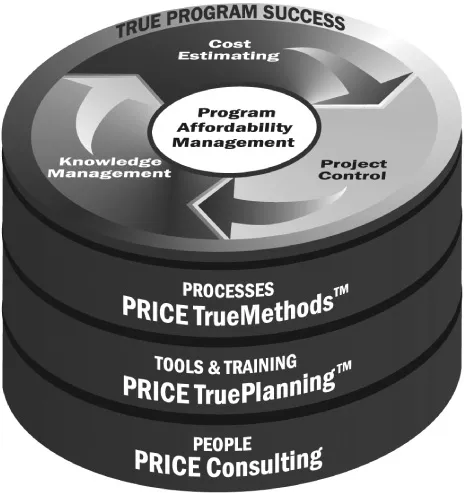
Figure 1.1 Program Affordability Management (PAM)
- be conceived without a credible analysis of alternatives;
- be initiated with insufficient funding because of inaccurate initial estimates and inaccurate quantification of the risks;
- be deterred from its mission because of lack of credible cost analysis within the program’s management;
- be deterred from its mission because of lack of integration between Earned Value Management and Cost Estimating and Analysis;
- be deterred from its mission because knowledge of cost and productivity metrics is not being shared among program teams and with other programs;
- be deterred from its mission because of surprise cost overruns and schedule delays.
Program Affordability is achieved through three elements of Cost Engineering:
- TrueMethods – which are best practices in Advanced Planning, Bid and Proposal Development, Supplier Assessment and Selection, and Project Cost Control. These are the processes which are applications of a cost model taught by experts and applied by the relevant staff.
- TruePlanning – which is a comprehensive cost analysis and knowledge management tool. It is a cost model framework which can be applied in numerous applications with the right training and experience.
- Parametric consultants – who are experts in building budgets, evaluating performance, identifying risks, analysing tradeoffs and continuously monitoring program value. They are able to customize standard processes and training, to suit the environment, with models that relate directly to the organization. Alternatively, they can mentor the relevant staff in the same tasks.
Purpose of this Book
The purpose of this book is to describe how to achieve applications of cost and schedule models within an organization. The applications described in the following chapters have evolved over many years, until they have become elements of the philosophy of Program Affordability Management (PAM).
Figure 1.2 shows the structure of the documentation which parametric cost model vendors provide. The Graphical User Interface (GUI) Guide details the software and its use in terms of file storage, retrieval and screen manipulation. The model references are used to describe the characteristics of those models: their inputs, outputs and functional relationships – what makes them tick.
This book is an overarching guide to the application of the individual cost models. Independently of the parametric model being used, its intention is to provide solutions to the cost estimating problems posed in businesses today; enabling a return on the investment for a parametric model.
Each of the following chapters tackles a different application of the parametric methodology of cost and schedule estimating. As such, it is independent of the specific cost model used.
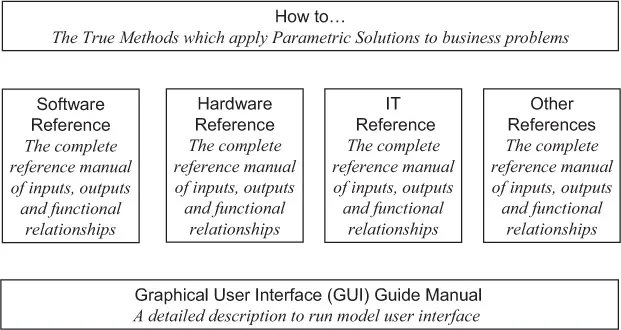
Figure 1.2 Example of documentation structure
Frequently the terms Cost Estimator, Cost Analyst, Parametrician, Cost Engineer, Cost Forecaster and others are used interchangeably. In some organizations these terms have very specific and defined meanings. In this book the term Cost Engineer will be consistently used to describe a trained person able to operate, interpret and calculate a parametrically generated estimate. This is not intended to exclude staff who do not have the title Cost Engineer, but is simply designed to make the book more consistent.
2
How to … Appreciate Parametrics
Why do so many large organizations around the world use parametrics? The reason is to provide speed in estimating the cost and schedule duration when little information exists (see Figure 2.1) regarding a project, proposed program, competitors product or suppliers equipment. During the early stages it is possible to influence the design decisions that are being made and thus reduce the cost of the technology being designed. Parametrics does not necessarily provide more accuracy; although it can contribute when combined with other methods, as we will see in later chapters.
Parametrics is a similar method of estimating to those used by any Cost Engineer who has constructed a spreadsheet model. When constructing a cost model the first step is to gather an international database of historical past projects. From this database, the Cost Drivers – those design and performance characteristics that influence the out-turn project costs, schedule and performance – can be observed. This enables the establishing of equations or algorithms which relate the Cost Drivers to the outputs. These are usually referred to as Cost Estimating Relationships or CERs.
The part of the process which distinguishes the commercial parametric model from the building of spreadsheet models is the final part – continuous calibration. This ensures that the commercial cost model is maintained. While spreadsheet models tend to be created for a project and then not re-used, commercial models are continuously used and need to be maintained. In parametrics, the algorithms or Cost Estimating Relationships are recycled, thus ensuring a return on investment for the time spent researching.
Figure 2.2 is an example of a simple parametric cost model. In the example, it was established that on average the door took 30 minutes to prepare and for this configuration it took 60 minutes to paint. The project characteristics are provided to go with this data: the area, number of layers of paint and the number of sides painted. As is clear to see, a simple equation can be produced to relate the independent variables (characteristics) to the dependent variable (time taken). The parametric model can be re-used for different scenarios and different projects.
This is a core equation. Keep in mind the fact that we do not take all the parameters which could impact the cost – such as the brush size, work regulation, skill of the painter and so on – into account. Commercial parametric cost models take many person years of cost research. They involve many cost estimating relationships and numerous Cost Drivers. Parametric cost models are conceived in the same manner as the simple door painting model, that is, built around a core equation. In the case of the PRICE Systems hardware model, the core equation is the weight and technology index.
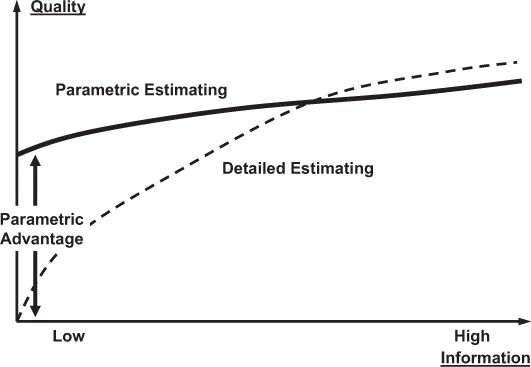
Figure 2.1 The advantage of parametrics
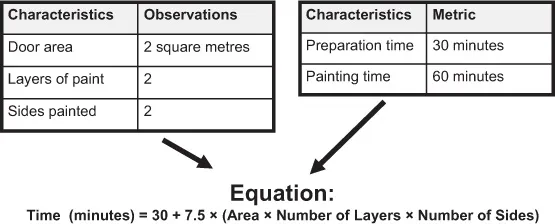
Figure 2.2 Parametric model example
Parametric vendors will employ a Chief Scientist and a cost research team. This team will be well versed in statistics, mathematics and cost research. They generate the parametric cost models which are communicated to the software programmers in the form of a White Paper. These White Papers are the documents which link the cost research to the software models. They enable commercial organizations, who supply cost models, to employ the best cost analyst for cost research and expert programmers for the software models, without the two roles complicating the two separate disciplines.
It is often said that if cost research could be provided in tablet form life would be simpler, however, for the time being software is the easiest way to communicate cost research.
Use of Parametrics throughout the Organization
Commercial parametric models have many applications (see Figure 2.3). At the top of the organization, they are able to solve problems for the decision-makers and senior management. At this level, senior managers can more quickly consider costs which influence the decision. Hence, bid or no-bid decisions can be made with a view to the cost. Furthermore, market strategy and business plans can be assessed alongside benchmarked productivity, competitor analysis and productivity tracking.
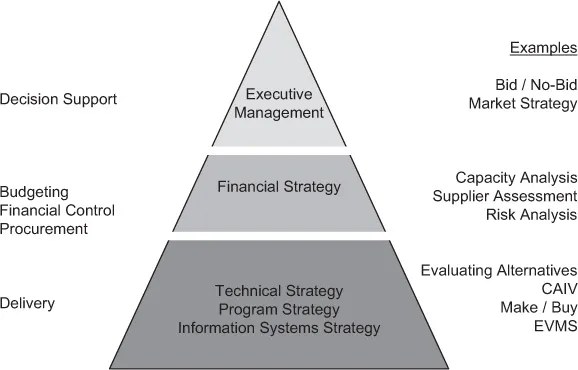
Figure 2.3 Enterprise applications
At the executive level, financial decisions can be accelerated with parametric estimates. Capacity planning will ensure best use of the available resources, supplier assessment employed to select the preferred supplier, and risk analysis used to consider the uncertainty in budgets and financial reporting.
At the operational level, parametrics can be deployed to deliver technology programs on the basis of the effective consideration of alternative options and the tracking of the program throughout its life with Cost as An Independent Variable (CAIV) and Earned Value Management (EVM) (through the integration of parametri...
Table of contents
- Cover Page
- Title Page
- Copyright Page
- Contents
- Acknowledgements
- List of Figures
- List of Tables
- Foreword
- Glossary
- 1 Introduction
- 2 How to … Appreciate Parametrics
- 3 How to … Estimate Using Parametrics
- 4 How to … Prepare Bids Faster with Fewer Resources
- 5 How to … Prepare a Focused Business Plan
- 6 How to … Validate Quotations from Suppliers
- 7 How to … Manage a Program Effectively
- 8 How to … Achieve Accuracy in Cost Engineering
- 9 How to … Accomplish Quality Assurance
- 10 How to … Estimate Through Life
- 11 How to … Estimate Technology Maturity
- 12 How to … Assess Software
- 13 How to … Analyse Risk and Uncertainty
- 14 How to … Influence Project Strategy
- 15 How to … Consider Technology Insertion
- 16 How to … Develop Cost-effective Alternatives
- 17 How to … Tackle the System of Systems Challenge
- 18 How to … Create Home-grown Parametric Models
- 19 How to … Successfully Conduct Life-Cycle Costing
- 20 How to … Accomplish Knowledge Retention
- 21 How to … Present the Results
- 22 How to … Adopt Parametrics
- 23 The History of Parametrics
- Index
Trusted by 375,005 students
Access to over 1.5 million titles for a fair monthly price.
Study more efficiently using our study tools.
Frequently asked questions
Yes, you can cancel anytime from the Subscription tab in your account settings on the Perlego website. Your subscription will stay active until the end of your current billing period. Learn how to cancel your subscription
No, books cannot be downloaded as external files, such as PDFs, for use outside of Perlego. However, you can download books within the Perlego app for offline reading on mobile or tablet. Learn how to download books offline
Perlego offers two plans: Essential and Complete
- Essential is ideal for learners and professionals who enjoy exploring a wide range of subjects. Access the Essential Library with 800,000+ trusted titles and best-sellers across business, personal growth, and the humanities. Includes unlimited reading time and Standard Read Aloud voice.
- Complete: Perfect for advanced learners and researchers needing full, unrestricted access. Unlock 1.5M+ books across hundreds of subjects, including academic and specialized titles. The Complete Plan also includes advanced features like Premium Read Aloud and Research Assistant.
We are an online textbook subscription service, where you can get access to an entire online library for less than the price of a single book per month. With over 1.5 million books across 990+ topics, we’ve got you covered! Learn about our mission
Look out for the read-aloud symbol on your next book to see if you can listen to it. The read-aloud tool reads text aloud for you, highlighting the text as it is being read. You can pause it, speed it up and slow it down. Learn more about Read Aloud
Yes! You can use the Perlego app on both iOS and Android devices to read anytime, anywhere — even offline. Perfect for commutes or when you’re on the go.
Please note we cannot support devices running on iOS 13 and Android 7 or earlier. Learn more about using the app
Please note we cannot support devices running on iOS 13 and Android 7 or earlier. Learn more about using the app
Yes, you can access Systems Cost Engineering by Dale Shermon in PDF and/or ePUB format, as well as other popular books in Business & Business generale. We have over 1.5 million books available in our catalogue for you to explore.