- 360 pages
- English
- ePUB (mobile friendly)
- Available on iOS & Android
eBook - ePub
About this book
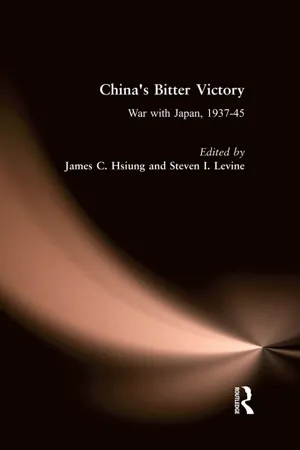
"China's Bitter Victory" is a comprehensive analysis of China's epochal war with Japan. Striving for a holistic understanding of China's wartime experience, the contributors examine developments in the Nationalist, communist, and Japanese-occupied areas of the country. More than just a history of battles and conferences, the book portrays the significant impact of the war on every dimension of Chinese life, including politics, the economy, culture, legal affairs, and science. For within the overriding struggle for national survival, the competition for political goals continued. China ultimately triumphed, but at a price of between 15 and 20 million lives and vast destruction of property and resources. And China's bitter victory brought new trials for the Chinese people in the form of civil war and revolution. This book tells the story of China during a crucial period pregnant with consequences not only for China but also for Asia and the world as well. Addressed to students, scholars, and general readers, the book aims to fill a gap in the existing literature on modern Chinese history and on World War II.
1
CHINA’S WARTIME DIPLOMACY
John W. Garver
MODERN Chinese nationalism arose from a sense of shame, born of the humiliation that the West and Japan inflicted upon China in the nineteenth and early twentieth centuries. Not content merely with defending China against further foreign aggression, patriotic Chinese wished to restore their country to a position of international prominence that they believed it deserved. This was the ultimate objective of China’s 1937–45 war against Japan, and, in particular, it was the goal of Nationalist China’s dominant leader, Chiang Kai-shek. Since the various powers in the 1930s saw Chiang Kai-shek as the ultimate authoritative representative of China, my analysis shall likewise focus on Chiang while making reference, as necessary, to others in the Nationalist hierarchy.1
Chinese Nationalism and the Powers
Of all the foreign powers with which he dealt, Chiang’s images of Japan and of the Soviet Union were the clearest. Deeply impressed by Japan’s emergence as a major military power, Chiang was also well informed about the numerous factions within Japan’s elite, and he hoped that those groups and individuals favoring an accommodation with the Republic of China (ROC) would ultimately take control in Japan. Even though China might have to make certain concessions in the process of reaching an accommodation with Japan, if Japan was prepared to respect China’s sovereignty, China would then be able to strengthen itself through partnership with its eastern neighbor. Chiang had not abandoned this hope when he led China into war in July 1937. Indeed, the decision for war and much of Chiang’s early wartime diplomacy must be seen as an effort to compel Japan to accept a reasonable accommodation with China. Much of Chiang’s diplomacy during the first year of the war sought to exploit Japanese intra-elite differences, but unfortunately the increasing sway of the militarists over the moderates defeated Chiang’s efforts at accommodation.2
Chiang was also quite impressed by the rapid growth of Soviet power, and convinced that Nationalist China should emulate the Leninist model of an amalgamated party, army, and government. However, his experience with Soviet and Comintern advisers in China during the 1920s made him extremely apprehensive of Soviet objectives in China. Believing that the Chinese Communists were agents of Soviet imperialism, Chiang saw the CCP’s efforts to make revolution as nothing less than a Soviet attempt to take over China. Moreover, as a traditionalist, Chiang was appalled by the Soviet-derived anti-Confucian doctrine of the CCP.3
To Chiang, Soviet Russia, like Japan, was an imperialist power that had carved out a sphere of influence in Sinkiang and Outer Mongolia. Yet because Moscow faced simultaneous threats from Japan and Germany, Chiang believed that the USSR was the best candidate for joining China in war against Japan or, short of that, for providing China with large-scale military and financial assistance. The perennial enmity between Russia and Japan had been exacerbated by Japan’s occupation of Manchuria in 1931, which triggered major increases in Soviet defense spending and a quadrupling of Soviet deployments in the Far East within a few years. To avoid conflict with Japan, in 1935 Moscow sold off its interests in the Manchurian railways. The conclusion in November 1936 of the German-Japanese anti-Comintern pact, however, which contained a secret codicil embodying a military alliance against the Soviet Union, turned Moscow toward China in search of a counterweight to Japan.
Shortly after Japan’s seizure of Manchuria, Nanking began improving relations with the Soviet Union, a movement that culminated in the December 1932 restoration of diplomatic ties. While Chiang’s envoys explored Soviet intentions during the mid-1930s, he remained extremely cautious about expanding relations any further, fearing that closer ties with Moscow might provoke rather than restrain Japan, and also alienate the Anglo-American powers while lending credence to Japan’s “anti-Communist” justifications of its China policies. Alignment with the Soviet Union would be an effective wartime measure, but as long as Chiang hoped to work out a peaceful accommodation with Japan, he kept the Soviet Union at arm’s length.
Several prominent KMT politicians did not share Chiang’s skepticism about Soviet motives. Sun Yat-sen’s widow, Soong Ch’ing-ling, and son, Sun Fo, party veteran Hsiao Li-tze, and ex-warlord Feng Yü-hsiang were among those who took a more sanguine view of Soviet intentions and of Sino-Soviet cooperation. Once war began, Chiang frequently turned to Sun Fo and Hsiao Li-tze to handle relations with Moscow.
Chiang had less firsthand experience with Britain and the United States. Britain had long been the nemesis of Chinese nationalism because of its imperialist past, and there was still little love lost between the British and the Chinese Nationalists. While the Nationalist elite included men such as Kuo Tai-ch’i, the ambassador to London, Foreign Minister Wang Chung-hui, and Ambassador V. K. Wellington Koo, who inclined toward Anglophilia, most Nationalist leaders suspected that Britain wished to keep China weak and divided. Both before and after July 1937, China’s leaders worried a lot about the possibility that London might strike a deal with Tokyo at China’s expense, and they sought means of preventing this. One reason why the Nationalists eagerly sought American action against Japan was that an activist U.S. policy was seen as a means to block the pro-Japan group in London.4
The Nationalists also realized that with one billion dollars invested in China—60 percent of all Western investment there—Britain had the most to lose by the establishment of Japanese hegemony over China. Consequently, China looked to Britain for support against mounting Japanese pressure. London did provide some support for China’s currency reform in 1935 and, after the Sino-Japanese War began, spearheaded the League of Nation’s condemnation of Japanese actions in China. Following the American lead, Britain granted financial assistance to China on half a dozen occasions between December 1938 and April 1941. But with its financial position precarious and its military power badly deteriorated, Britain’s global power was severely overextended. Germany’s growing power in Europe presented a more immediate threat to Britain than did Japanese actions in the Far East, so London had little stomach for confronting Tokyo.
The United States, too, was very wary of provoking a confrontation with Japan. U.S. military forces were extremely weak, while antimilitary sentiment in the country was very strong. U.S. trade with and loans to Japan far exceeded those to China. Although China looked to the United States for support, there was considerable uncertainty as to how substantive that support would be. Throughout the 1930s, the United States had limited itself to verbal condemnation of Japanese actions.5
At the time the war began, Chiang had had little experience with official Washington. Throughout the war, he relied heavily on his wife Soong Mei-ling and his brother-in-law T. V. Soong for advice regarding the United States. Both Soongs were Christians, had been educated in the United States, spoke fluent English, and understood American customs and thinking. Both also believed that the United States was the best partner for China.
Germany also figured prominently in China’s wartime diplomacy. After his break with the Soviets in 1927, Chiang had turned to Germany, still a pariah nation, for advice and support, which was eagerly extended. Germany’s inflation in the 1920s facilitated Sino-German ties by reducing the cost of German goods and education. Once the Nazis came to power, they imputed a new strategic significance to Germany’s links with China and supported the ROC as a link in a chain of anti-Communist states on the periphery of the USSR.
An ideological link with the New Germany also was forged. Many KMT leaders were impressed by the speed and effectiveness with which the Nazi regime reestablished Germany as a major power and believed that New China had much to learn from the “New Germany.” Such leaders included Minister of War Ho Ying-ch’in, secret service chief Tai Li, and the head of the central political training office, Ho Chung-huan. Others, such as Chu Chiu-hua and Ch’eng Tien-fong, were less enamored of National Socialist ideology but still admired the New Germany and saw it as a good economic partner.
The German role in China expanded rapidly in the 1930s. New factories were built with modern German machinery while Berlin also helped Nanking build up a small but significant munitions industry and modern army. By 1937 Chiang’s Central Army had an elite core of eighty thousand German-trained and German-armed men. Several hundred German advisers, including several top-level staff officers, served with Chiang’s forces. The most prominent of these advisers was General Alexander von Falkenhausen, whom Chiang trusted and respected.
Chiang’s Decision for War
Sometime early in 1937 Chiang Kai-shek decided that when the next major provocation occurred, China would not yield before Japanese pressure as it had done repeatedly since 1931. On the basis of past Japanese behavior, Chiang considered it highly likely that Tokyo and its aggressive and loosely leashed armies in China would respond to Chinese firmness by attempting to compel Chinese submission. A decision not to back down was a decision for war.
Chiang made this decision with the greatest reluctance, for he realized the extreme risks that war entailed both for China and for his own regime. Despite its progress in national defense, China’s military and industrial strength fell far short of Japan’s, and China needed more time before it could realistically hope to defeat Japanese forces. Confronting Japan prematurely in 1937 meant that China’s hopes for victory would depend ultimately not on its own efforts but on other powers. This was a risky business that put a premium on skillful Chinese diplomacy toward Germany, the United States, Britain, and the Soviet Union. If the other powers remained neutral, China might well be defeated.
A second major danger that made Chiang reluctant to go to war with Japan was his fear that the Soviet and Chinese Communists would seize the opportunity to communize China. From his experience during the first KMT-CCP united front in the 1920s, Chiang was profoundly skeptical of Communist intentions and pledges of unity. He suspected that the CCP was so enthusiastic about a war with Japan because they anticipated that such a war would create favorable conditions for the expansion of Communist power. Preoccupied with fighting Japan, the Nationalists would be less able to check the CCP. Moreover, the burdens imposed on the Chinese people were certain to be heavy, especially in a war of attrition. Chinese defeats in the initial stages were almost certain. Chiang feared that the Chinese Communists would seize on these circumstances to subvert his regime and to expand their own influence.
If the dangers were so great, why did Chiang finally opt for war? There were two linked reasons. First was the mounting force of nationalist passions within China. The Japanese advance into North China in the early 1930s challenged the Nationalist government’s legitimacy, deriving as it did from its claim to represent the “redemption” of China from the depths of “national humiliation.” By 1936–37, the Nationalist policy of yielding before Japanese pressure had become extremely unpopular, as manifested by the December 9 movement of 1935, the Sian Incident one year later, the anti-Japanese incidents that proliferated across China during the first half of 1937, and the increasing popularity of the CCP’s line of national unity against Japan. Chiang was well aware that these swelling patriotic sentiments undercut his policy of continuing to retreat before superior Japanese force.
Second, by late 1936, the growing power of the militarist faction in Japan and the failure of Chinese diplomats to achieve a “fundamental adjustment” in Sino-Japanese relations induced Chiang to abandon his earlier hope that more moderate forces might prevail in Tokyo. He came to believe that only when Japan realized it lacked the strength to force China into a status of dependency would Japanese leaders be willing to respect Chinese sovereignty. Only after Japan suffered a military rebuff at the hands of China and its allies would it come to its senses.
Regarding the Communist danger, Chiang may have believed that the severe setback suffered by the CCP with the loss of its Kiangsi-Hunan bases would critically hobble the Reds for some time. Chiang also hoped to use Moscow and the Comintern to rein in the CCP. Chinese Communist docility was to be part of the price Chiang demanded of Moscow for aligning China with the Soviet Union against Japan. Bowing to Chiang’s demand, Stalin tried to curb the CCP’s revolutionism, but Mao Tse-tung outfoxed both Chiang and Stalin.
Chiang saw the domestic and international factors as closely linked. Like all wars, the war against Japan was a gamble, but if Chiang threw the dice and won, then China’s status as well as Chiang’s own domestic political position would be immensely strengthened. His German adviser, Falkenhausen, pointed out to him that war and national unification might be closely linked in China as they had been in Germany. If Chiang led China to its first victorious international war in over a century, he would enjoy a much stronger hand against the regional warlords, opposition factions within the KMT, and the rebellious Communists. It could be a major step toward national unity. War with Japan was thus a high-risk, high-payoff game.
Chiang’s Strategy for Victory
Chiang went to war with both best-case and worst-case scenarios in mind. The best case was premised on the staying power of the German-trained units of the Central Army and on the willingness of Great Britain and the United States to intervene to protect their interests in China. It was commonly believed in China at this time that Japan’s economic vulnerabilities made it impossible for Tokyo to wage war for more than six months or perhaps a year. By then its meager reserves of gold and foreign currency would be exhausted, its markets in China disrupted by war and patriotic boycotts, and its access to British and American bank loans restricted. London and Washington, concerned about the negative impact of war upon their economic interests in China, would intervene to force a settlement on terms acceptable to China. Anglo-American military action would not be necessary; the mere threat to Japan’s trade with these powers and financial embargoes would soon bring Japan to its knees.
To reach this point, China’s best military units would have to be committed early in the fighting in order to demonstrate that this was a major war, and to raise the costs for both Japan and the other powers. With luck, the Central Army might even win a local victory over Japanese forces. But military defeat had its uses too. It might precipitate Anglo-American intervention to stave off such undesirable outcomes from the perspective of London and Washington as Chinese capitulation, Chinese alignment with the Soviet Union, or even Chinese entry into the Japanese-German anti-Comintern bloc.
Chiang’s worst-case scenario envisioned a protracted war of attrition. If the Anglo-American powers or the Soviet Union did not intervene, and if the Central Army’s crack units were overwhelmed by Japanese forces, the national government and its army would withdraw to the interior. China’s vast area, huge population, and relatively self-sufficient economy made it virtually impossible for Japan to defeat China. The deeper Japan intruded into China, the more patriotic resistance within China would grow and international opposition develop. As Japan’s economic situation deteriorated, one could expect the growth of opposition within Japan. The militarists might be ousted, and there might even be a full-scale revolution in Japan.
Chiang publicly outlined his strategy of attrition in December 1937, after the loss of the capital, Nanking, and the failure of the Anglo-American powers to intervene.
Appraising the outcome of hostilities, we are convinced that the present situation is favorable to China. The basis of China’s future success in prolonged resistance is not found in Nanking, nor in the big cities, but in villages all over China and in the fixed determination of the people. The time must come when Japan’s military strength will be completely exhausted, thus giving us ultimate victory.6
Chiang did not conceive of “victory” as meaning Japanese surrender, at least not until after Pearl Harbor. For the first four years of the war, “victory” for China meant that Tokyo acknowledged its inability to defeat China and agreed to respect China’s sovereignty, independence, and territorial integrity. Exactly what this meant in practice varied with the two countries’ fortunes of war.
What terms were acceptable to Chiang Kai-shek? In February 1938, Tung Tao-ning, head of the Japan desk of the Foreign Ministry and a member of Wang Ching-wei’s peace faction, secretly traveled to Tokyo with a proposal that would have restored the July 7, 1937, status quo ante and turned Manchuria into a Japanese “concession” (i.e., technically still a part of China). China would not pay indemnity and would itself be responsible for anti-Communist duties. In July 1938 Finance Minister H. H. Kung’s private secretary, Chao Fu-san, presen...
Table of contents
- Cover
- Half Title
- Title Page
- Copyright Page
- Dedication
- Table of Contents
- Preface
- Contributors
- Introduction
- 1 China’s Wartime Diplomacy
- 2 China’s Wartime State
- 3 Contending Political Forces during the War of Resistance
- 4 The Chinese Communist Movement
- 5 The CCP’s Foreign Policy of Opposition, 1937–1945
- 6 The Military Dimension, 1937–1941
- 7 The Military Dimension, 1942–1945
- 8 The Chinese War Economy
- 9 Science in Wartime China
- 10 Literature and Art of the War Period
- 11 Wartime Judicial Reform in China
- 12 The War and After: World Politics in Historical Context
- Bibliography
- Chronology
- Wade-Giles–Pinyin Conversion Table of Personal Names
- Index
Trusted by 375,005 students
Access to over 1.5 million titles for a fair monthly price.
Study more efficiently using our study tools.
Frequently asked questions
Yes, you can cancel anytime from the Subscription tab in your account settings on the Perlego website. Your subscription will stay active until the end of your current billing period. Learn how to cancel your subscription
No, books cannot be downloaded as external files, such as PDFs, for use outside of Perlego. However, you can download books within the Perlego app for offline reading on mobile or tablet. Learn how to download books offline
Perlego offers two plans: Essential and Complete
- Essential is ideal for learners and professionals who enjoy exploring a wide range of subjects. Access the Essential Library with 800,000+ trusted titles and best-sellers across business, personal growth, and the humanities. Includes unlimited reading time and Standard Read Aloud voice.
- Complete: Perfect for advanced learners and researchers needing full, unrestricted access. Unlock 1.5M+ books across hundreds of subjects, including academic and specialized titles. The Complete Plan also includes advanced features like Premium Read Aloud and Research Assistant.
We are an online textbook subscription service, where you can get access to an entire online library for less than the price of a single book per month. With over 1.5 million books across 990+ topics, we’ve got you covered! Learn about our mission
Look out for the read-aloud symbol on your next book to see if you can listen to it. The read-aloud tool reads text aloud for you, highlighting the text as it is being read. You can pause it, speed it up and slow it down. Learn more about Read Aloud
Yes! You can use the Perlego app on both iOS and Android devices to read anytime, anywhere — even offline. Perfect for commutes or when you’re on the go.
Please note we cannot support devices running on iOS 13 and Android 7 or earlier. Learn more about using the app
Please note we cannot support devices running on iOS 13 and Android 7 or earlier. Learn more about using the app
Yes, you can access China's Bitter Victory by James C. Hsiung,Steven I. Levine in PDF and/or ePUB format, as well as other popular books in History & Chinese History. We have over 1.5 million books available in our catalogue for you to explore.