Due to the increasing world population, energy consumption is steadily climbing, and there is a demand to provide solutions for sustainable and renewable energy production, such as wind turbines and photovoltaics. Power electronics are being used to interface renewable sources in order to maximize the energy yield, as well as smoothly integrate them within the grid. In many cases, power electronics are able to ensure a large amount of energy saving in pumps, compressors, and ventilation systems. This book explains the operations behind different renewable generation technologies in order to better prepare the reader for practical applications. Multiple chapters are included on the state-of-the-art and possible technology developments within the next 15 years. The book provides a comprehensive overview of the current renewable energy technology in terms of system configuration, power circuit usage, and control. It contains two design examples for small wind turbine system and PV power system, respectively, which are useful for real-life installation, as well as many computer simulation models.
eBook - ePub
Renewable Energy Devices and Systems with Simulations in MATLAB® and ANSYS®
- 402 pages
- English
- ePUB (mobile friendly)
- Available on iOS & Android
eBook - ePub
Renewable Energy Devices and Systems with Simulations in MATLAB® and ANSYS®
About this book
Information
1
Renewable Energy Systems: Technology Overview and Perspectives
CONTENTS
Abstract
1.1Introduction
1.2State of the Art
1.3Examples of Recent Research and Development
1.4Challenges and Future Trends
1.5Further Readings
References
Abstract
In this chapter, essential statistics demonstrating the increasing role of renewable energy generation are first discussed. A state-of-the-art review section covers the fundamentals of wind turbine and photovoltaic (PV) systems. Schematic diagrams illustrating the main components and system topologies are included. Also, the increasing role of power electronics is explained as an enabler for renewable energy integration and for future power systems and smart grids. Recent examples of research and development, including new devices and system installations for utility power plants and for residential and commercial applications, are provided. Fuel cells, solar thermal, wave generators, and energy storage systems are also briefly presented and illustrated. Challenges and future trends for the technologies in 2025 are summarized in a table for onshore and offshore wind energy; solar power, including PV and concentrating solar power; wave energy; fuel cells; and storage with batteries and hydrogen, respectively. Recommended further readings on topics of electric power engineering for renewable energy are included in the final section.
1.1Introduction
Sustainable energy supply remains to be a main requirement of modern society in order to respond to the increased energy demand caused by the larger consumption especially due to population growth. For a long time, the energy boom has been based on fossil fuels. Unfortunately, not only the supply of oil, coal, and natural gas is limited, but there exist also major pollution and environmental concerns associated with using the traditional energy sources and alternatives are important.
Renewable energy technologies are seen as some of the most important solutions for the future, and they need to be further developed in this century in order to take over most of the energy production. Many emerging technologies exist and they have different levels of maturity. The scale of implementation is not the same either. Most of the renewable technologies are dependent on weather conditions, and they are challenging in respect to the integration into the grid system. These issues need to be fully solved—how to make a power system that is able to cope with a very high penetration of renewables, which also involves the development of smart grid systems. Such systems may include microgrids and energy storage facilities, and, in many cases, they will combine the electric power system with other energy carriers like heating/cooling and gas as well as look at how to use transportation as a resource.
Figure 1.1 shows the worldwide energy demand in the past decades and also the estimated energy demand until 2030. As it can be observed, due to the continuous increase in gross domestic product, the overall energy demand is expected to increase by more than 50% by 2030 [1]. To achieve this primary goal, renewable energy will be an important part in the foreseeable future energy production (hydro, renewable and biomass, etc.).
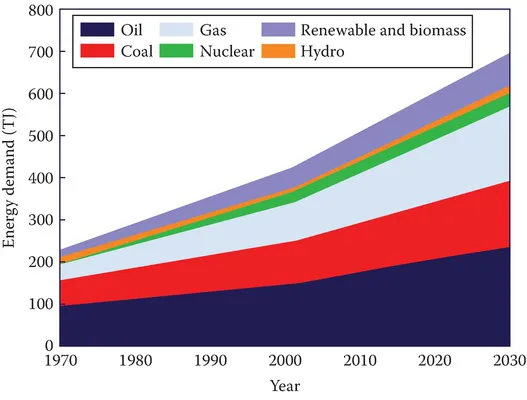
Figure 1.1 Worldwide energy dema...
Table of contents
- Cover
- Halftitle Page
- Title Page
- Copyright Page
- Contents
- Preface
- Editors
- Contributors
- Chapter 1 Renewable Energy Systems: Technology Overview and Perspectives
- Chapter 2 Solar Power Sources: PV, Concentrated PV, and Concentrated Solar Power
- Chapter 3 Overview of Single-Phase Grid-Connected Photovoltaic Systems
- Chapter 4 Three-Phase Photovoltaic Systems: Structures, Topologies, and Control
- Chapter 5 Overview of Maximum Power Point Tracking Techniques for Photovoltaic Energy Production Systems
- Chapter 6 Design of Residential Photovoltaic Systems
- Chapter 7 Small Wind Energy Systems
- Chapter 8 Power Electronics and Controls for Large Wind Turbines and Wind Farms
- Chapter 9 Electric Generators and their Control for Large Wind Turbines
- Chapter 10 Design Considerations for Wind Turbine Systems
- Chapter 11 Marine and Hydrokinetic Power Generation and Power Plants
- Chapter 12 Power Conversion and Control for Fuel Cell Systems in Transportation and Stationary Power Generation
- Chapter 13 Batteries and Ultracapacitors for Electric Power Systems with Renewable Energy Sources
- Chapter 14 Microgrid for High-Surety Power: Architectures, Controls, Protection, and Demonstration
- Index
Trusted by 375,005 students
Access to over 1.5 million titles for a fair monthly price.
Study more efficiently using our study tools.
Frequently asked questions
Yes, you can cancel anytime from the Subscription tab in your account settings on the Perlego website. Your subscription will stay active until the end of your current billing period. Learn how to cancel your subscription
No, books cannot be downloaded as external files, such as PDFs, for use outside of Perlego. However, you can download books within the Perlego app for offline reading on mobile or tablet. Learn how to download books offline
Perlego offers two plans: Essential and Complete
- Essential is ideal for learners and professionals who enjoy exploring a wide range of subjects. Access the Essential Library with 800,000+ trusted titles and best-sellers across business, personal growth, and the humanities. Includes unlimited reading time and Standard Read Aloud voice.
- Complete: Perfect for advanced learners and researchers needing full, unrestricted access. Unlock 1.5M+ books across hundreds of subjects, including academic and specialized titles. The Complete Plan also includes advanced features like Premium Read Aloud and Research Assistant.
We are an online textbook subscription service, where you can get access to an entire online library for less than the price of a single book per month. With over 1.5 million books across 990+ topics, we’ve got you covered! Learn about our mission
Look out for the read-aloud symbol on your next book to see if you can listen to it. The read-aloud tool reads text aloud for you, highlighting the text as it is being read. You can pause it, speed it up and slow it down. Learn more about Read Aloud
Yes! You can use the Perlego app on both iOS and Android devices to read anytime, anywhere — even offline. Perfect for commutes or when you’re on the go.
Please note we cannot support devices running on iOS 13 and Android 7 or earlier. Learn more about using the app
Please note we cannot support devices running on iOS 13 and Android 7 or earlier. Learn more about using the app
Yes, you can access Renewable Energy Devices and Systems with Simulations in MATLAB® and ANSYS® by Frede Blaabjerg, Dan M. Ionel, Frede Blaabjerg,Dan M. Ionel in PDF and/or ePUB format, as well as other popular books in Technology & Engineering & Energy. We have over 1.5 million books available in our catalogue for you to explore.