Intermediate Welsh
eBook - ePub

Intermediate Welsh

A Grammar and Workbook

  1. 184 pages
  2. English
  3. ePUB (mobile friendly)
  4. Available on iOS & Android
eBook - ePub

Intermediate Welsh

A Grammar and Workbook

About this book

Intermediate Welsh: A Grammar and Workbook is designed for learners who have achieved basic proficiency and wish to proceed to more complex language. It presents a broad range of grammatical topics, illustrated by examples, which serve as models for the varied exercises that follow. The emphasis throughout is on colloquial spoken Welsh used by modern-day native speakers. Features include:

  • a clear, accessible format;
  • many useful language examples;
  • jargon-free grammar explanations;
  • sample drills and exercises;
  • a full key to the exercises.

This new edition has been redesigned for greater clarity and further examples have been updated.

Trusted by 375,005 students

Access to over 1 million titles for a fair monthly price.

Study more efficiently using our study tools.

Unit 1

Uned un

Inflected future
Regulars

In Basic Welsh (Unit 24) we saw how the stem of the verb is used when we need to add endings; the imperative (command form) ending -wch, for example, is added not to talu (verb-noun) to give *taluwch, but to the stem tal- to give talwch! ‘pay!’ Then for the preterite (Basic Welsh, Unit 25) there is a special set of endings covering all persons – so tales i ‘I paid’, talodd e ‘he paid’, etc.
Another set of personal endings in Welsh conveys the idea of the future. Let’s look at the endings first:
Singular
Plural
1
-a i
-wn ni
2
-i di
-wch chi
3
-ith e/hi
-an nhw
Notice again that we have included the following pronoun in each case, as in Modern Welsh the endings never appear on their own except in yes/no answers. You may have noticed also that the second person singular pronoun is not ti but di in the future.
So the inflected future of talu will be:
Singular
Plural
1
tala i I will pay
talwn ni we will pay
2
tali di you will pay
talwch chi you will pay
3
talith e/hi he/she will pay
talan nhw they will pay
General principles for inflected verbs (Basic Welsh, Unit 26) apply; so, for example, tala i, fe °dala i, °dala i all mean ‘I’ll pay’. Notice the very common expression °Wela i di/chi ‘I’ll see you’ (i.e. ‘goodbye’).
You will have realized by now that we saw another way of doing the future in Basic Welsh (Unit 18), using bydda i etc. (future of bod) + yn + VN. Are they the same? No – and they are not interchangeable; if they were, what would be the point of having both systems? But they do overlap in function. It is hard to see any substantial difference, for example, between Pryd bydd e’n ffonio? and Pryd ffonith e? ‘When will he phone?’ On the other hand, the inflected future is definitely preferred in certain circumstances, and we will have a look at some of these in the next unit.

Exercise 1.1

Turn these long futures into short futures:
Example:
Bydda i’n talu
Tala i
  1. 1 Fyddi di’n agor y siop yfory?
  2. 2 Fe fydda i’n gweld ti wythnos nesa.
  3. 3 Byddwn ni’n helpu chi.
  4. 4 Bydd y lleill yn aros fan hyn.
  5. 5 Fyddwch chi’n cyrraedd mewn pryd?
  6. 6 Fydd Fred yn cymryd coffi?
  7. 7 Fe fydd Sioned a Medi’n trafod y broblem.
  8. 8 Fyddi di’n cymryd rhagor?
  9. 9 Fe fydd Suzie’n bwydo’r anifeiliaid wedyn.
  10. 10 Fyddan nhw ddim yn arwyddo’r ddogfen.

Exercise 1.2

Translate into Welsh using the short future – use Mi° for affirmative (AFF) sentences:
  1. 1 I’ll help you (chi).
  2. 2 We’ll see you (chi) tomorrow.
  3. 3 When will these plants flower?
  4. 4 Bert will stay here.
  5. 5 They’ll phone tomorrow.
  6. 6 We won’t see them again.
  7. 7 Sioned will tell him this afternoon.
  8. 8 Will they write to us?
  9. 9 Will he buy enough?
  10. 10 They won’t drink.
  11. 11 I’ll collect everything.
  12. 12 You (chi) ’ll speak first.
  13. 13 Who will open the door?
  14. 14 We’ll build a new house here.
  15. 15 The water will run out here.
  16. 16 Will they arrange everything?
  17. 17 I’ll keep these for you (ti).
  18. 18 Will they tell us?
  19. 19 Sioned will give him a present.
  20. 20 I’ll call round later on.

Exercise 1.3

Turn these short futures into long futures:
Example:
Ffonith e
Bydd e’n ffonio
  1. 1 Enillan nhw’r gêm?
  2. 2 Ffonith Eleri heno?
  3. 3 Parith y gynhadledd am wythnos.
  4. 4 Arhosan nhw ddim.
  5. 5 Ateba i mo’r cwestiwn ’na.
  6. 6 Rhodda i ddeg punt iddo.
  7. 7 Chysga i ddim efo’r holl sŵn ’ma.
  8. 8 Mi drefnwn ni bopeth.
  9. 9 Helpa i chi mewn munud.
  10. 10 Pharith yr argyfwng ’ma ddim yn hir.
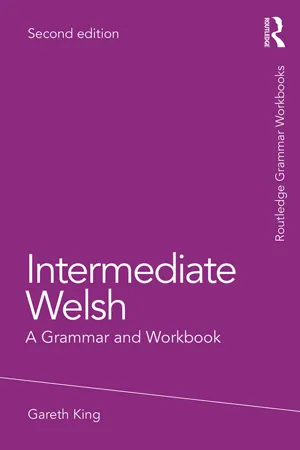
Table of contents

  1. Cover
  2. Title
  3. Copyright
  4. Dedication
  5. Contents
  6. Introduction
  7. 1 Inflected future: regulars
  8. 2 Inflected future: irregulars
  9. 3 Galla i°/medra i° ‘I can’, etc.
  10. 4 Byth and erioed ‘never/ever’
  11. 5 Comparison of adjectives I: comparative
  12. 6 Comparison of adjectives II: superlative; equative
  13. 7 Comparison of adjectives III: irregulars
  14. 8 ‘Time’; ordinal numerals
  15. 9 Aspect distinctions with VNs: newydd°, ar° and heb° with VNs
  16. 10 Alternative preterite formations
  17. 11 Subordinate clauses I
  18. 12 Subordinate clauses II
  19. 13 Subordinate clauses III
  20. 14 Relative clauses I
  21. 15 Relative clauses II
  22. 16 Conditional of bod; conditional of other verbs
  23. 17 Conditional sentences I: open conditions
  24. 18 Conditional sentences II: closed conditions
  25. 19 Other unreality verbs: gallwn i°/medrwn i°, dylwn i°, leiciwn i°/hoffwn i°
  26. 20 Unreality verbs with wedi: ‘should have …’, ‘could have …’, ‘might have …’, etc.
  27. 21 Colloquial passive construction with cael
  28. 22 Stative passives with wedi and heb°
  29. 23 Formal/media (or short) passive in -ir and -wyd
  30. 24 More conjugated prepositions
  31. 25 Compound prepositions
  32. 26 Miscellaneous pronouns I
  33. 27 Miscellaneous pronouns II
  34. 28 Gwybod ‘know’; sa i, so ti, etc. (neg)
  35. 29 Summary of SM
  36. 30 Conjunctions I
  37. 31 Conjunctions II
  38. 32 Focus I: principles
  39. 33 Focus II: VNs, bod
  40. 34 Focus III: mai and taw
  41. 35 Summary of sy
  42. 36 Mutation of verb-forms in more formal styles
  43. 37 Literary Welsh verbs I: the tense system of Literary Welsh
  44. 38 Literary Welsh verbs II: forms of bod
  45. 39 Literary Welsh verbs III: irregulars; subjunctive forms
  46. 40 Literary Welsh verbs IV: autonomous/impersonal forms
  47. Key to exercises
  48. Glossary of technical terms
  49. Vocabularies

Frequently asked questions

Yes, you can cancel anytime from the Subscription tab in your account settings on the Perlego website. Your subscription will stay active until the end of your current billing period. Learn how to cancel your subscription
No, books cannot be downloaded as external files, such as PDFs, for use outside of Perlego. However, you can download books within the Perlego app for offline reading on mobile or tablet. Learn how to download books offline
Perlego offers two plans: Essential and Complete
  • Essential is ideal for learners and professionals who enjoy exploring a wide range of subjects. Access the Essential Library with 800,000+ trusted titles and best-sellers across business, personal growth, and the humanities. Includes unlimited reading time and Standard Read Aloud voice.
  • Complete: Perfect for advanced learners and researchers needing full, unrestricted access. Unlock 1.4M+ books across hundreds of subjects, including academic and specialized titles. The Complete Plan also includes advanced features like Premium Read Aloud and Research Assistant.
Both plans are available with monthly, semester, or annual billing cycles.
We are an online textbook subscription service, where you can get access to an entire online library for less than the price of a single book per month. With over 1 million books across 990+ topics, we’ve got you covered! Learn about our mission
Look out for the read-aloud symbol on your next book to see if you can listen to it. The read-aloud tool reads text aloud for you, highlighting the text as it is being read. You can pause it, speed it up and slow it down. Learn more about Read Aloud
Yes! You can use the Perlego app on both iOS and Android devices to read anytime, anywhere — even offline. Perfect for commutes or when you’re on the go.
Please note we cannot support devices running on iOS 13 and Android 7 or earlier. Learn more about using the app
Yes, you can access Intermediate Welsh by Gareth King in PDF and/or ePUB format, as well as other popular books in Languages & Linguistics & Languages. We have over one million books available in our catalogue for you to explore.