- 200 pages
- English
- ePUB (mobile friendly)
- Available on iOS & Android
eBook - ePub
About this book
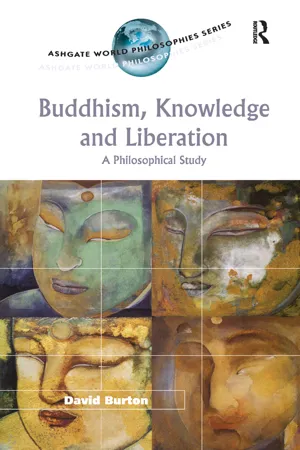
Buddhism is essentially a teaching about liberation - from suffering, ignorance, selfishness and continued rebirth. Knowledge of 'the way things really are' is thought by many Buddhists to be vital in bringing about this emancipation. This book is a philosophical study of the notion of liberating knowledge as it occurs in a range of Buddhist sources. Buddhism, Knowledge and Liberation assesses the common Buddhist idea that knowledge of the three characteristics of existence (impermanence, not-self and suffering) is the key to liberation. It argues that this claim must be seen in the context of the Buddhist path and training as a whole. Detailed attention is also given to anti-realist, sceptical and mystical strands within the Buddhist tradition, all of which make distinctive claims about liberating knowledge and the nature of reality. David Burton seeks to uncover various problematic assumptions which underpin the Buddhist worldview. Sensitive to the wide diversity of philosophical perspectives and interpretations that Buddhism has engendered, this book makes a serious contribution to critical and philosophically aware engagement with Buddhist thought. Written in an accessible style, it will be of value to those interested in Buddhist Studies and broader issues in comparative philosophy and religion.
Information
CHAPTER ONE
First Thoughts on Knowledge and Liberation
Religious traditions commonly offer an account of what they consider to be the human spiritual predicament. Buddhism is no exception. It generally says that the root difficulty faced by human beings is suffering (duḥkha) which is caused by the appropriative, selfish desire of craving (tṛṣṇā). And Buddhists often say that craving is itself rooted in ignorance (avidyā). Our craving is fuelled by lack of understanding. This is not any ignorance, however. Craving is not caused by unawareness that Little Rock is the capital city of Arkansas or of how to make soufflés, for instance. On the contrary, it is ignorance of ‘how things really are’ that is thought to produce craving and hence suffering.
Like many other religions, Buddhism not only gives an analysis of the human spiritual predicament but also offers a solution. Indeed, the principal concern of Buddhism is to provide an answer to the problem of suffering. Buddhist texts often describe the Buddha metaphorically as the ‘Great Physician’. Buddhism is fundamentally about providing a cure for a disease. However, the disease of suffering is not an ordinary, physical sickness and the cure is not potions or ointments. As suffering is thought to be caused by ignorance of ‘how things really are’, the cure for suffering is said to be the removal of this cause. Buddhism is thus intensely engaged with eradicating this ignorance which, it thinks, lies at the heart of our spiritual malady.
The opposite of ignorance is knowledge or understanding. Ignorance is not knowing or not understanding. For instance, if I do not know or understand that Julius Caesar was a Roman emperor then I am ignorant about this fact. My ignorance is dispelled when I achieve knowledge or understanding that Julius Caesar was a Roman emperor. Similarly, the ignorance of ‘how things really are’ is eradicated by knowledge or understanding of the true nature of things.
Buddhism often maintains, therefore, that the cessation of suffering requires knowledge (jñāna) or understanding (prajñā, sometimes translated as ‘insight’ or even ‘wisdom’) of ‘how things really are’. The Buddhist claim is that liberating knowledge has the true nature of things as its special content. This knowledge is considered to be the cure that will cut off suffering. Hence, the people who have transcended craving and suffering are said to have achieved Awakening (bodhi) and are Awakened (buddha), indicating that they have ‘woken up’ to the true nature of reality. Buddhism is thus, in many of its forms, a gnostic soteriology in so far as it identifies knowledge, or gnosis, as a necessary condition for liberation.
This is a characteristic which it shares with a variety of other Indian philosophical and religious traditions, such as Advaita Vedānta, Sāṃkhya, Nyāya-Vaiśeṣika, Jainism and others. However, there is an important difference. These non-Buddhist systems claim that liberation (mokṣa) results from insight into an eternal essence, soul or abiding self, variously called the ātman, puruṣa or jīva. For instance, Advaita Vedānta says that people attain liberation when they achieve the understanding that the essential, eternal self (ātman) is identical with the one, non-dual Absolute reality (brahman). Sāṃkhya describes liberation as occurring when individual, eternal consciousnesses (puruṣa) achieve isolation or separation (kaivalya) from the material world (prakṛti) by means of insight into their real nature. Nyāya-Vaiśeṣika agrees that the individual souls or essential selves (ātman) can break free from the material world by means of such knowledge. Jains also speak of the need to understand that the individual and eternal soul (jīva) is distinct from the material world, including the body, by which it is trapped. The belief in such an eternal, spiritual essence of the person has been a feature of much popular Indian religiosity.
By contrast, we will see that the Buddhist liberating knowledge does not involve insight into the true nature of the eternal soul or self, but rather the understanding that no such entity exists. The insight into not-self (anātman) is basic to Buddhist soteriology. A prevalent Buddhist formulation of ‘how things really are’ declares that all conditioned things are (1) impermanent, (2) suffering and (3) devoid of self. These are called the ‘three characteristics of existence’. The Awakened Buddhists are those who stop craving because they understand that everything is impermanent, that no thing has an eternal essence, and that suffering occurs because we crave for and get attached to such impermanent, essenceless phenomena. This book is a philosophical exploration of this Buddhist liberating knowledge of ‘how things really are’.
A brief synopsis
Chapter 2 examines in detail these three characteristics of existence. In addition, the chapter explores the nature of craving and why it is thought to cause suffering. Also, it discusses the Buddhist idea that one’s craving is rooted in ignorance of the three characteristics and that the solution to the problem of craving, and hence suffering, involves knowledge of impermanence, suffering and not-self. The chapter also uncovers a number of debatable philosophical claims that underlie the Buddhist analysis.
Chapter 3 discusses the apparent conundrum that many people seem to understand the three characteristics and yet still crave and suffer. If this knowledge is supposed to be liberating, how is it that such people have not put an end to their craving and suffering? Various solutions to this problem are critically examined, all of which distinguish Unawakened people’s deficient understanding of the three characteristics from the Awakened people’s thorough knowledge of them. According to Buddhism, only the thorough knowledge is sufficient to remove craving and suffering.
For instance, the Awakened people’s knowledge might be depicted as knowledge by acquaintance, whereas Unawakened people have a merely propositional knowledge or knowledge by description. Or else Unawakened people, though in some cases apparently believing that things are impermanent, selfless and cause suffering when craved, might be said to have an unconscious belief to the contrary. Finally, the Awakened people’s knowledge of the three characteristics might be characterized by meditative reflection and constant attentiveness, which is absent from the Unawakened people’s more distracted and reflectively shallow understanding.
Chapter 4 evaluates two ideas that seem to underpin the Buddhist account of liberating knowledge. First, there is the moral belief that suffering ought to be overcome. Buddhism appears to claim that thorough knowledge of the three characteristics entails the moral judgement that one should not crave impermanent, selfless things because this craving will cause suffering. The way the world is has implications for how we should act. In short, Buddhism seems to derive an ‘ought’ from an ‘is’ in a way that is problematic from the perspective of a moral relativist. That is, Buddhism seems not to make a fact-value distinction, regarding ‘the way things really are’ as including what might be called ‘moral facts’. Second, the Buddhist account of liberating knowledge appears sometimes to imply that knowledge alone can compel one to change one’s behaviour. If one has the thorough knowledge that one ought not to crave, then one gives up craving once and for all. Is it really the case, however, that knowledge alone, even thorough knowledge, will necessarily stop one from doing what one knows one ought not to do and not doing what one knows one should do?
In reply to this question, I argue that for many Buddhists it is not in fact the case that knowledge by itself brings about liberation. While Buddhists do contend that craving is rooted in ignorance they also say that ignorance is sustained by craving. They are mutually supporting phenomena. It is thus inaccurate to see Buddhism as only concerned with replacing ignorance with knowledge. On the contrary, liberating knowledge needs to be viewed in the context of the Buddhist path as a whole, which emphasizes the cultivation of one’s entire character, which includes correct behavioural habits and emotional attitudes as much as the intellect. The cognitive and non-cognitive aspects of the practitioner’s personality are to be developed in tandem. Liberating knowledge is the outcome of a comprehensive training that stresses not only development of one’s understanding but also diligence in moral observance. One stops craving and becomes unselfish and non-appropriative because of ethical endeavour in conjunction with knowledge.
In Chapter 5, the focus is on a variety of ‘anti-realist’ Buddhist understandings of the not-self idea, according to which having no self means not just that entities are dependently originating and have no permanent essence but also that these entities are unreal or fabricated. Particular attention is given to the Madhyamaka notion of emptiness (śūnyatā), which can be interpreted to mean that all things are conceptual constructions. Other forms of Buddhist anti-realism, found in the Sautrāntika, Sarvāstivāda and Yogācāra traditions, are also discussed. I consider the Buddhist anti-realists’ claim that liberating knowledge includes the perception of the merely fabricated nature of things. However, I argue that there are some serious philosophical problems with Buddhist anti-realism, especially in its Madhyamaka form where it seems particularly extreme.
Chapter 6 considers the very different interpretation that Buddhism is a form of scepticism, and that, far from seeking knowledge of ‘how things really are’, some Buddhist texts seem to encourage the practitioner to realize that such knowledge is impossible, and that hankering after it is a form of craving. The unfabricated ‘things in themselves’ are always hidden from view. They are unknowable, being veiled by the interpretive activity of the mind. Entities as experienced are fabricated by the mind, which always construes them in terms of its own concepts of space, time, causality and so forth.
Special consideration is given to a reading of Madhyamaka Buddhism – different from the anti-realist interpretation presented in Chapter 5 – according to which the Mādhyamikas are advocating such a sceptical variety of Buddhism. It is also possible, I suggest, to construe the early Buddhism of the Theravāda scriptures as promoting a sceptical soteriology. I argue that it is a debatable point whether these Buddhists, understood as sceptics, are right to be so pessimistic about the prospects for knowledge. I propose an alternative and more optimistic Buddhist theory of knowledge that is a type of moderate epistemological realism.
Buddhist sources not uncommonly refer to the true nature of things as ineffable. Chapter 7 is a critical study of this idea and identifies a variety of ways in which it might be understood. I focus particularly on the idea of the inexpressible knowledge of an ineffable reality as it occurs in some Yogācāra and Madhyamaka sources. I consider the possibility that these philosophies might be best construed as forms of ‘mystical scepticism’, where the ineffable ‘things in themselves’ are unknowable only for Unawakened people. By contrast, the Awakened people can strip away the veil of fabrications which conceals reality and attain an inexpressible insight into these ‘things in themselves’. The common Buddhist notion that nirvāṇa and the Awakened person’s knowledge of it are ineffable is also explored. I suggest that for many Buddhists liberating knowledge is not only of the three characteristics of existence, but also of a sacred reality which transcends words and the spatio-temporal world of impermanent, dependently originating things. In addition, some important philosophical objections to the Buddhist idea of such a mystical gnosis are considered.
In the conclusion, Chapter 8, I discuss the relationship between liberating knowledge and two other key Buddhist virtues, namely, compassion and faith. Furthermore, I consider the possibility that most human beings are unlikely, even with considerable effort, to transcend completely their moral and cognitive imperfections. They are not able entirely to cut off behavioural and intellectual faults and I argue that Buddhism has often accepted this to be the case. Buddhist liberation or spiritual awakening, understood as the transcendence of all craving and ignorance about ‘how things really are’, might thus be considered a virtually unattainable ‘regulative ideal’ that teaches and reminds Buddhists that values such as wisdom, compassion and non-attachment are to be cherished and cultivated even if they cannot usually be perfected.
The diversity of Buddhism
Buddhism is a vast and multi-faceted phenomenon. Damien Keown (1996, pp. 1–3) uses the famous Indian story, related by the Buddha at Udāna 69 f., of the elephant and the blind men to explain the dangers of partial understanding of Buddhism. According to this tale, a king divides his blind subjects into groups and they are taken to an elephant and asked to feel it. Each group of blind men grasps only one part of the animal – the trunk, the tail, the head, the foot and so on – and take this to be the character of the entire elephant. Similarly, Keown says, there has been a tendency to grasp one aspect of Buddhism and incorrectly take it to be the whole. Thus, one needs to be aware not only of misapprehensions but also of partial characterizations.
In addition, it should not be assumed that there is one fundamental ‘Buddhism’ that underlies all of the manifestations. Instead, some scholars have suggested that we might take Buddhism to be an ‘umbrella concept’ that refers to a family of distinct though interrelated religious phenomena. Buddhism might not be simply one animal after all. It might be argued that to seek to identify some essence shared by all or, at least, most forms of Buddhism is thus misguided.
Whether or not there is a common core to the various forms of Buddhism is a moot point and a debate which I do not wish to explore further here. However, it seems fair to say that these diverse Buddhisms, with or without a shared essence, often have strong conceptual connections with and resemblances to one another. They are not utterly distinct and often have overlapping terminology, values and assumptions.
One basic assumption shared by many, though certainly not all, forms of Buddhism is that knowledge of the true nature of things is vital for achieving liberation from suffering. However, as this study will show, it is not necessarily the case that the various forms of Buddhism which make this assumption agree about the precise content or nature of this knowledge. Many Buddhists would contend that knowledge of ‘how things really are’ is required for liberation, but there is considerable divergence about how this knowledge is to be characterized. One of the tasks of this book will be to demonstrate some of this diversity.
I will not endeavour to investigate Buddhism as a whole, which is surely a nearly impossible task. On the contrary, I will be highly selective. This is due in part to the limitations of my knowledge and partly a result of my specific interests. My hope is that the ideas expressed in this volume will provide some basis for further creative philosophizing by thinkers whose understanding of Buddhism and philosophical acumen complement and/or exceed my own. My ideas rely heavily on early Buddhism, as recorded in the Theravāda scriptures, on certain philosophical developments within Indian non-Mahāyāna and Mahāyāna Buddhism as well as on some Tibetan Buddhist notions. My emphasis is on Indian, Tibetan and Theravāda Buddhism, with only occasional references to the East Asian traditions and some developments in contemporary Buddhism.
Admittedly, there are types of Buddhism – for example, its Pure Land and Vajrayāna forms – in which devotion to a salvific Buddha or Bodhisattva, rather than liberating knowledge, has a primary role. My concern here, however, is with types of Buddhism that stress knowledge and liberation rather than devotion and salvation in the quest to transcend suffering. This is certainly not to imply that the forms of Buddhism that stress salvific devotion are less authentic, inferior or less worthy of study than the gnostic Buddhism on which I concentrate.
Nor is it to suggest that the gnostic Buddhist’s liberating strategy is exclusively concerned with knowledge. Far from it, the Buddhist liberating knowledge is often presented as an outcome of a ‘path’ that includes ethical conduct, faith and meditation as essential components. It will be one of my contentions in the present study, especially in Chapter 4, that the liberating knowledge that eradicates suffering cannot be understood in isolation from the entire Buddhist training which is its context and of which it is the fruition.
The philosophical study of Buddhism
The approach taken in this book will perhaps be frustrating to the historically or anthropologically minded reader, interested mainly in the detailed social and intellectual context of Buddhist ideas to which I refer, and to the philologist intent on unravelling the linguistic complexities of ancient Buddhist texts. Though I make substantial use of such texts, and am not oblivious to their historical and social context, my primary aim is to engage in philosophical reflection upon the Buddhist soteriology. Buddhist ideas as expressed in the various traditions thus function as a touchstone for philosophizing. By ‘philosophizing’ here I mean thinking in a critically aware manner about fundamental issues and concepts in Buddhist thought such as the nature of reality and the knowledge of it, why knowledge of reality is thought to lead to liberation, how one ought to conduct one’s life and so forth. My intention is not to stick slavishly to the reports of Buddhists writings about these matters but rather to offer a creative continuation of Buddhist philosophy, exploring possible meanings and implications of the texts. And one of the principal themes of this study will be that Buddhist written sources often contain a measure – sometimes a considerable amount – of ambiguity, so that a range of interpretations is often possible.
I am not here functioning as a mere expositor of traditional Buddhism, still less as an apologist. My intention in part is to uncover apparently questionable assumptions underlying the Buddhist worldview. However, my statement that they are ‘questionable’ is not meant to imply that they are necessarily wrong. Rather, my claim, somewhat more modest and less contentious, is that they are not necessarily right. There are various ways in which these Buddhist ideas can be reasonably challenged and their veracity doubted.
My assessment of Buddhist thoughts about knowledge and liberation does not, of course, take place from a neutral standpoint...
Table of contents
- Cover
- Half Title
- Title Page
- Copyright Page
- Table of Contents
- Preface
- 1 First Thoughts on Knowledge and Liberation
- 2 Impermanence, Not-self and Suffering
- 3 Thorough Knowledge Versus Deficient Understanding
- 4 Moral Knowledge and the Buddhist Path
- 5 Buddhist Anti-realism
- 6 Buddhist Scepticism
- 7 Mysticism and Ineffability
- 8 Compassion, Faith and Human Fallibility
- Bibliography
- Index
Trusted by 375,005 students
Access to over 1.5 million titles for a fair monthly price.
Study more efficiently using our study tools.
Frequently asked questions
Yes, you can cancel anytime from the Subscription tab in your account settings on the Perlego website. Your subscription will stay active until the end of your current billing period. Learn how to cancel your subscription
No, books cannot be downloaded as external files, such as PDFs, for use outside of Perlego. However, you can download books within the Perlego app for offline reading on mobile or tablet. Learn how to download books offline
Perlego offers two plans: Essential and Complete
- Essential is ideal for learners and professionals who enjoy exploring a wide range of subjects. Access the Essential Library with 800,000+ trusted titles and best-sellers across business, personal growth, and the humanities. Includes unlimited reading time and Standard Read Aloud voice.
- Complete: Perfect for advanced learners and researchers needing full, unrestricted access. Unlock 1.5M+ books across hundreds of subjects, including academic and specialized titles. The Complete Plan also includes advanced features like Premium Read Aloud and Research Assistant.
We are an online textbook subscription service, where you can get access to an entire online library for less than the price of a single book per month. With over 1.5 million books across 990+ topics, we’ve got you covered! Learn about our mission
Look out for the read-aloud symbol on your next book to see if you can listen to it. The read-aloud tool reads text aloud for you, highlighting the text as it is being read. You can pause it, speed it up and slow it down. Learn more about Read Aloud
Yes! You can use the Perlego app on both iOS and Android devices to read anytime, anywhere — even offline. Perfect for commutes or when you’re on the go.
Please note we cannot support devices running on iOS 13 and Android 7 or earlier. Learn more about using the app
Please note we cannot support devices running on iOS 13 and Android 7 or earlier. Learn more about using the app
Yes, you can access Buddhism, Knowledge and Liberation by David Burton in PDF and/or ePUB format, as well as other popular books in Philosophy & Eastern Philosophy. We have over 1.5 million books available in our catalogue for you to explore.