- 110 pages
- English
- ePUB (mobile friendly)
- Available on iOS & Android
eBook - ePub
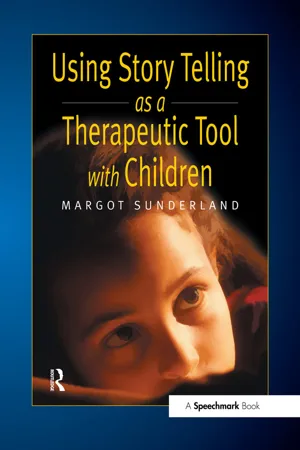
Using Story Telling as a Therapeutic Tool with Children
About this book
This practical handbook begins with the philosophy and psychology underpinning the therapeutic value of story telling. It shows how to use story telling as a therapeutic tool with children and how to make an effective response when a child tells a story to you. It is an essential accompaniment to the "Helping Children with Feelings" series and covers issues such as: Why story telling is such a good way of helping children with their feelings? What resources you may need in a story-telling session? How to construct your own therapeutic story for a child? What to do when children tell stories to you? Things to do and say when working with a child's story.
Information
CHAPTER 1
The Therapeutic Value of Story
Why story is such a good way of helping children with their feelings
Being human inevitably means times of having some too difficult and too intense feelings. Some of these feelings can be so confusing, disturbing or painful that they are very hard to manage, let alone think clearly about, or work through. Yet, like food, such feelings need to be properly digested. If they are not, they can live on to haunt us in some way. They can spoil our relationships or interfere with our being able to function properly. They can bring too much unhappiness. This is because the energetic charge of these too difficult or too strong feelings does not just go away. Instead it gets bottled up inside, and as with all bottled up emotional energy, the problem is that it then leaks out in neurotic symptoms, body symptoms, or destructive behaviour.
This ‘bottling up’ then ‘leaking out’ can be even more extreme with children. Children do not have sophisticated coping strategies for dealing with their intense or too difficult feelings. They do not have the inner resources for thinking them through, or for regulating their levels of emotional arousal. We have endless examples of the painful consequences of this: bullying, aggressive behaviour, learning difficulties, bed-wetting, soiling, separation anxiety, problems with concentrating, uncontrollable behaviour, hyperactivity, obsessions, phobias, sleeping problems, nightmares, eating problems or a regular state of fear, anxiety or unhappiness. Any of these can develop unless children have help with managing and understanding their more troubling feelings.
So if children need help with their feelings, can’t we just talk to them more about them? Herein lies the problem! Children do not talk naturally or easily about their troubling feelings, other than the odd ‘Not fair!’ or expressing anger with a furious ‘No!’, or by sulking, screaming or throwing something. Also, the few feeling words that children often choose, such as ‘I’m bored’, ‘Cross’, ‘Fed up’, or ‘It’s not fair,’ tend to lead to a very restricted level of understanding from the adults to whom these words are being said. Very often these words misrepresent. Too often they are simply inaccurate. A child, for example, can spend years labelling his feelings with ‘I’m bored’, ‘I’m cross,’ mistaking these too limited reports for the truth, not realising that, as De Zulueta puts it so well, ‘Experience lived is not the same as experience verbally represented’ (1993, p131). Think also of the adult’s frequent question to the troubled child, ‘What’s wrong?’, and how the child often does not reply, cannot reply, in the language in which he is being asked to speak. Or he replies with a cursory ‘Nothing’s wrong’ or ‘I’m OK’, which all too often shuts the door to help. Someone believes him, rather than thinking, ‘Maybe he just hasn’t the words to speak about how he is very much not OK.’ Nor do young children talk to their little friends about their feelings.
The central argument in this book is that everyday language is not the natural language of feeling for children. Their natural language of feeling is that of image and metaphor, as in stories and dreams.
Toby, aged five
Mummy: ‘Now, Toby, I want to try to explain to you about Daddy leaving.’
Toby: ‘Look at that truck, Mummy!’
When she tries again later, Toby wants to show her the spider at the bottom of the toilet.
They are just talking in different languages – which the psychoanalyst Ferenczi (1931) calls a ‘confusion of tongues’.
Sally, aged six
Sally is sitting in a café with her mother, who is talking ten-to-the-dozen to a friend about her anger towards her ex-husband. Sally is making circles in the sugar and getting her dolly to talk to the little pots of jam, which she is pretending are the homes of magic glow-worms. The adults are in the realm of thinking and feeling, and little Sally is in the realm of imagining and feeling. And so, when Mummy turns to Sally and says, ‘Now look, Sally, we’ve got to talk about how you’ve been biting Sophie’, Mummy gets nowhere. She is not speaking in Sally’s language of feeling. Rather, she is using her own language.
Because of this language problem, many children fail to get the help they so desperately need with their emotional problems and troubled feelings. Furthermore, the adult trying to get through to a child with everyday language, regularly fails to reach the child in a way that shows that she really knows, or really understands. Rather, the child will tend to get distracted or feel lectured at.
So, if you want to speak to troubled children or have them speak to you, you are far more likely to be successful if you do it through ‘their’ language – the language of image, metaphor or story. Let us now look again at Sally and her mother:
Mummy: ‘Now I want to explain to you why biting Sophie is wrong.’
Sally: ‘Look at that little jam-pot, Mummy, it’s got all yukky yuck on the side!’
Mummy: ‘No, this is serious, Sally. Now listen to me [holds Sally’s arm firmly], when you bite, it hurts…’
Sally: ‘I’m having a big red balloon for my birthday, and one on my cake too!’
Mummy (persevering): ‘So do you understand, Sally?’
Sally says nothing, nods half-heartedly, but when Mummy lets her go, she continues in her fantasy world of magic glow-worm homes.
Next day, Sally bites Sophie.
Sally says nothing, nods half-heartedly, but when Mummy lets her go, she continues in her fantasy world of magic glow-worm homes.
Next day, Sally bites Sophie.
Sally’s mother failed to connect with Sally in this interaction, for three important reasons:
- ● She is talking to Sally in the wrong language.
- ● She has not tried to understand why Sally bites Sophie.
- ● She has not given Sally another way of managing the feelings that made her bite Sophie in the first place.
This is where a story can get straight to the heart of the matter. It does so by addressing each of these three areas, as we shall see.
Using story recognises the limitations of talking about feelings to children in everyday language. Stories can speak to children on a deeper and far more immediate level than literal, everyday language. Talking about feelings in everyday language can mean going round and round in circles. This is because everyday language is a language of thinking, whereas speaking through a story, or playing out what you want to say with dolls or puppets, or through clay, a painting or in a sandbox scene, means you are using a language of imagining. This is the child’s natural language.
For a child, everyday words and common feeling labels are often sensorially too dry. He is likely to experience them as dead little words. They are too flat, too reductionist, too cognitive to engage him. They are often also just not strong enough for the intensity of his, as yet undefended, way of being in the world. They fail to marry up with the sheer force of feeling he experiences from time to time. In the imaginative world in which he lives, which is so full of colour, magic, image, action, bright light and so on, dull little feeling words cannot hope to capture his emotionally charged, imaginative experiences. For a child, common feeling labels such as ‘cross’, ‘sad’ or ‘scared’ do little more than report feelings.
Furthermore, common feeling labels tend to ‘flatten’ what the child is experiencing into something which he is not. Think of trying to describe a beautiful daffodil in literal words, for example. This makes it far less of a daffodil. It is stripped of its essence; its sensuality; its complexities, and the directness with which it affects us:
The soul wants imaginative responses that move it, delight it, deepen it. (Hillman, 1983, p38)
The earth is not flat and neither is reality. Reality is continuous, multiple, simultaneous, complex, abundant and partly invisible. The imagination alone can fathom this and it reveals its fathomings.
(Winterson, 1995, p151)
In contrast, stories told by adults to children, or children telling stories to adults through play or painting, can speak about feelings with amazing richness. In fact, the mind naturally speaks about emotional issues through story, as we see in dreams. In dreams, image and metaphor are the mind’s chosen way of processing powerful feelings in our past or present, as well as our fears or hopes for the future. A story is simply like having a dream while being awake.
Take, for example, Tessa (aged 5), who regularly has major temper tantrums on the floor in the supermarket. Afterwards, Tessa is in a very frightened state because of the intensity of feeling inside her. She often has nightmares about monsters that same night. The adult response of ‘You seem very cross’ says far too little about what and how Tessa is actually feeling. It fails to convey the full qualitative and energetic aspects of her tantrum experience. The word ‘cross’ is too vague, too generalised. It is a dead word. As Hillman says, it is ‘a terrible impoverishment of the actual experience’ (Hillman, 1983, p44). But tell ‘temper-tantruming’ Tessa a story about floods or avalanches, or a fire that rips through everything, and you will probably find you get through to her and convey to her that you understand something of what she has been going through. Or ask Tessa to tell you a story, paint a picture or make something in clay, and you are asking her to speak about her vitally lived experience.
In fact, as well as children, many adults get stuck in the cul-de-sacs of convenient feeling labels to describe their own feelings. Toned-down feeling words, or very oblique or minimising references to intense emotional states or experiences, are also arguably part of our repressed culture as a whole, as expressed here in part of a poem by Jacqueline Brown:
Even words were counterfeit – ‘a visit from your Auntie’, ‘a number two’, ‘hanky-panky’ and ‘passed away’ were cheap plastic versions of blood, shit, sex and death that might shatter and cut.
We were force-fed the fake for so long it was hard to recognise the real when we finally met it (‘Imitation’, 1996, p46)
In short, parent-child, teacher-child or counsellor-child communications about feelings when only everyday language is used, are likely to be impoverished. The conversation will tend to lack depth of expression and understanding on both sides. It will have none of the subtleties, the complexities about felt life from a communication spoken in the realm of the imagination. If literal words were completely adequate in expressing what we human beings feel, there would be no need for art or music or theatre or poetry. But of course they are not. The following are examples of cases where everyday language failed to reach a troubled child, and where story got through.
Charlie, aged six
When Charlie was five, his father moved out to live with his new partner abroad. It was a sudden parting, because the marriage was in an awful state and Charlie’s parents thought it would be damaging to Charlie if they were to stay together any longer. Charlie loved his Daddy intensely. But when his Daddy moved out, Charlie just got on with his life. He did not cry, and seemed to refer to his father only in a matter-of-fact way. However, his school work deteriorated dramatically, and teachers often found him just staring out of the window. His mother and other relatives tried endlessly to get Charlie to talk about Daddy leaving. They failed. When they said to Charlie how they could imagine how sad and cross he was, Charlie just got on with polishing his bike, or playing with his Ninja Turtles. These adults’ words seemed to have very little impact on Charlie.
The problem was, Charlie’s mother and her relatives were using the wrong language. They did not realise that Charlie needed to deal with his feelings through image, story and metaphor, and was in fact already doing so:
- ● Most nights Charlie dreamt of being with Daddy, and then suddenly along came a giant sheep and kidnapped Daddy. In other dream scenarios Daddy would die in a car crash on his way to see Charlie.
- ● Most days, Charlie said to his mother, ‘Can we have that story again tonight? The one about the little bear that gets stuck in the black hole until everything turns awful, and he can’t see the sun any more?’
- ● Most days, Charlie asked, ‘Can we watch the film Titanic again?’. And when there was no time to watch Titanic again, or his mother said ‘No’, as she was getting sick of watching it, Charlie said, ‘Well, can we just watch that bit when the couple lose hands with each other and get separated?’
In short, Charlie’s mind was saying, ‘Look, I need to deal with this trauma, but I need to deal with it through image, metaphor and story’. (A dream, of course, is also a made-up story.) It was via story that Charlie was busy processing his feelings about his Daddy leaving. His mother’s attempts at connection were sincere and genuine, such as ‘I think you are probably very sad about Daddy moving out’, but they simply labelled Charlie’s feelings. Her words failed to speak...
Table of contents
- Cover
- Half Title
- Title
- Copyright
- Dedication
- Contents
- List of figures
- Introduction
- Chapter 1 The Therapeutic Value of Story
- Chapter 2 How to Use Storytelling as a Therapeutic Tool with Children
- Chapter 3 How to Make an Effective Response when a Child Tells a Story to You
- Bibliography
- Index
Trusted by 375,005 students
Access to over 1.5 million titles for a fair monthly price.
Study more efficiently using our study tools.
Frequently asked questions
Yes, you can cancel anytime from the Subscription tab in your account settings on the Perlego website. Your subscription will stay active until the end of your current billing period. Learn how to cancel your subscription
No, books cannot be downloaded as external files, such as PDFs, for use outside of Perlego. However, you can download books within the Perlego app for offline reading on mobile or tablet. Learn how to download books offline
Perlego offers two plans: Essential and Complete
- Essential is ideal for learners and professionals who enjoy exploring a wide range of subjects. Access the Essential Library with 800,000+ trusted titles and best-sellers across business, personal growth, and the humanities. Includes unlimited reading time and Standard Read Aloud voice.
- Complete: Perfect for advanced learners and researchers needing full, unrestricted access. Unlock 1.5M+ books across hundreds of subjects, including academic and specialized titles. The Complete Plan also includes advanced features like Premium Read Aloud and Research Assistant.
We are an online textbook subscription service, where you can get access to an entire online library for less than the price of a single book per month. With over 1.5 million books across 990+ topics, we’ve got you covered! Learn about our mission
Look out for the read-aloud symbol on your next book to see if you can listen to it. The read-aloud tool reads text aloud for you, highlighting the text as it is being read. You can pause it, speed it up and slow it down. Learn more about Read Aloud
Yes! You can use the Perlego app on both iOS and Android devices to read anytime, anywhere — even offline. Perfect for commutes or when you’re on the go.
Please note we cannot support devices running on iOS 13 and Android 7 or earlier. Learn more about using the app
Please note we cannot support devices running on iOS 13 and Android 7 or earlier. Learn more about using the app
Yes, you can access Using Story Telling as a Therapeutic Tool with Children by Margot Sunderland in PDF and/or ePUB format, as well as other popular books in Psychology & Education General. We have over 1.5 million books available in our catalogue for you to explore.