- 152 pages
- English
- ePUB (mobile friendly)
- Available on iOS & Android
eBook - ePub
About this book
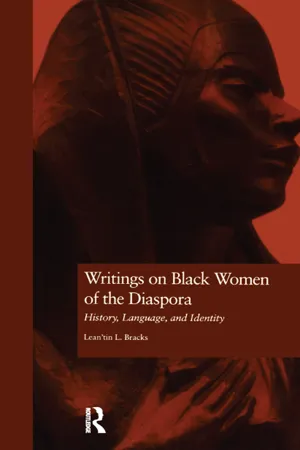
Toni Morrison, Alice Walker, Paule Marshall, and Mary Prince represent the best of African American women writers who draw on the tortuous legacy of their people as a source for their art, revealing and defining themselves as they create compelling narratives that illuminate their roots, their heritage, and their unique culture. The themes that suffuse their writing are family, community, strong women, cultural memory, oral history, and slavery. By analyzing the works of these four remarkable writers, the study shows how today's black woman can take control of her destiny by coming to grips with an obscured and distorted past. These original essays articulate the way in which historical awareness, sensitivity to language, and an understanding of stereotypes can empower enduring artistic visions in a world that is largely indifferent to marginal voices.
Information
CHAPTER 1
Literary Quilting
History, Language, and Identity in Women’s Diasporic Texts
Literary quilting is a term I use to help conceptualize how history, language, and image/identity are important frameworks for understanding the way texts by women writers of the African diaspora can be stitched into our lives. Early on in my reading of the texts chosen for this study, I tried to describe how meaningful they were through the lenses of historical context, complexities in language use, and the development of an empowered identity for the protagonists that is specifically female and specifically black. The following words occurred to me:
Speak to me in the language of my people so that I may hear and understand with my all-too-famous grin, while my heart sops up the truths. Those who hear and do not understand, know not who I am nor from where I have come.
I found myself no longer merely a spectator as I had been for the bulk of my reading experience, for when I contextualized this literature with a gendered Afrocentric framework, the stories came alive with meaning for today’s black women who are in their communities living, loving, growing, changing, and seeking control of their circumstances in empowering ways. Those characters who evolve toward a greater sense of themselves in the four texts I have selected carry important messages for contemporary women of the diaspora and demonstrate that self-identity directly results from either honoring African-rooted ancestral legacies or ignoring them. I see a clear link among Toni Morrison, Alice Walker, Paule Marshall, and Mary Prince in that all draw on these African-rooted legacies for their strength, showing today’s reader a path toward self-affirmation in a racist, sexist world that demeans, distorts, or minimizes black women’s power.
Mary Prince begins this study because the dynamics of slavery in the Caribbean, which allowed for stronger cultural influences from Africa, enabled her to survive extreme powerlessness. She stands, therefore, as a stunning model of black female strength, and her narrative demonstrates the crucial role played by African legacies in creating that strength. Since women in many locations of the Caribbean during slavery were quite assertive in their verbal and legal protests against the subjugation of their race as well as being more directly connected with African traditions, Mary Prince’s narrative gives us a female speaker who is keenly in touch with her own worth as a human being as well as examples of successful female resistance to oppression. Furthermore Mary Prince’s voice, an important part of the historical record of our collective movement toward freedom, serves as an antecedent to black women who sought to define themselves in the nineteenth century while setting the tone for our subsequent passage to Emancipation, Reconstruction, and the modern era.
These points are well illustrated in The History of Mary Prince, A West Indian Slave, Related by Herself (1831), where we see a slave woman so strengthened by family and community that she voices her validity in the face of her captors’ attempts to erase her. Mary’s cultural and family influences, revealed through exploring Mary’s personal history, redefine her out of the isolated position of a pitiful victim of slavery, bolstered by Christianization and the protection of her white supporters, into a woman who clearly recognizes that her own freedom is intricately tied to that of all slaves and that it is in her power to achieve it. The ability to see herself as part of a world free from subjugation was made possible by knowledge gained from newly arrived slaves, the availability of information about successful slave revolts such as that of Toussaint L’Ouverture in Santo Domingo, and the stories of women warriors who participated in revolts in the Caribbean as formidable fighters and tacticians. This historical perspective on Mary Prince’s life makes it conceivable that she was a long-time participant in the fight for freedom before her narrative was presented.
Although much of her narrative obscures this rebellious context due to her deferential self-presentation, Mary Prince’s assertiveness comes out clearly at various key points in the account of her growth from child to woman. We see a strong sense of her own agency develop, for instance, after she escapes a beating from her master by running to her parents’ home, even though she is aware that the consequences of such defiance could be severe. Later on, she takes an even more remarkable stance when she stops her master from beating his own daughter as well as herself. These acts present us with a slave who is far from humble or intimidated or in need of rescue by a white benefactor. This narrative, when we examine it carefully as a record of the empowered development of Mary Prince, reveals an individual who was strong both in character and purpose and who well understood the limits of her own enslavement. It is true that our view of Mary Prince is somewhat flat and one-dimensional, but we should not let this obscure the clear agency behind her narrative strategy. Although Mary speaks passionately about her family, for instance, we learn little from her narrative about the writer as daughter, wife, and mother. This knowledge of Mary as an individual was silenced no doubt by her white publisher, Thomas Pringle, but we need to recognize that Mary did not want necessarily to reveal such personal information to a white audience. She had a much larger plan of freedom in her rhetoric that subsumed a statement of individual identity.
Although slave narratives were controlled by white publishers and abolitionists with their own agendas, texts like those of Mary Prince were effective vehicles for self-expression as we see in her case, but other forms of written history distorted more completely the viewpoint of black women. As W.E.B. Du Bois pointed out, the suppression of all but white-controlled accounts of history erased the perspectives of African American subjects and made recovery of black cultural memory crucial for balancing the record:
in text-books, in popular culture, and in historiography itself, white supremacy in the present remained secure as long as historical memories were controlled or suppressed.1
Through the reclamation of Mary Prince’s voice, we can better conceptualize the personification of Sethe, the focal character in Beloved, as a woman of courage and conviction who battles her way through the Reconstruction era and who emerges from Toni Morrison’s quilting of Margaret Garner’s story into historical memories of the black community. We can also, through reading Mary Prince, contextualize the struggles of Celie from Alice Walker’s The Color Purple in seizing opportunities for empowering herself in the decades after Reconstruction. Alice Walker, like Morrison, fills some important gaps in African American history and addresses painful silences by bringing us to the early twentieth century when stereotypes of the black woman continued to devalue and misrepresent her worth. Paule Marshall in Praisesong for the Widow, finally, brings us full circle back to the Caribbean location that nurtured Mary Prince. She broadens the scope of cultural reclamation engaged in by Morrison and Walker as she moves from the United States to the island of Carriacou, Grenada, and metaphorically to mother Africa where all join together in a physical and emotional reclamation of the diasporic unity that can still exist. Marshall also moves us forward to the post-World War II period where we see the same issues of survival and identity for black women represented in the earlier eras. Avey Johnson, like the other protagonists discussed here, must step out from under a veil of invisibility in order to experience the freedom that is legally, but not psychologically, hers.
Although very different in setting, tone, time period, and narrative style, these texts share the central themes on which I focus in this study. Each looks to African roots for identity and power, for instance, whether the protagonist be legally enslaved or psychologically imprisoned. Each also deconstructs ongoing stereotypes of black women. Just as Mary Prince confronted and rejected the definition of herself as a slave, so do Sethe and Celie turn from images that dehumanize their acts of survival while Avey must turn away from internalized stereotypes of her race. Similar stereotypes were confronted in the characterizations of black middle-class females of earlier works by African American women who also sought to debunk these misconceptions, but I want to emphasize that these images continue to affect black women negatively despite the civil rights legislation and other advances that have been made in contemporary times. Morrison, Walker, and Marshall, no less than Mary Prince, must redefine what it means to be a black woman by focusing on a female protagonist who seeks to liberate herself from the baggage of stereotypes inherited from the past and evolve toward an identity rooted in African cultural influences.
All three contemporary writers focus on the key adjustments to Emancipation made by their grandmothers’ generation, and I have chosen them in order to emphasize the ongoing importance of slavery’s legacy of survival as well as pain to women writers of the diaspora today. History for them is not dead and buried but a living, palpable component of contemporary life which can be repressed, but at one’s peril. African American writers of the past also brought the history of slavery into their imaginative landscapes, but today’s narratives, in my view, are more psychologically complex and more consciously oriented toward a female perspective due to the previous literary generation’s enormous obstacles.2 Previous women writers had to break through serious barriers to their artistic expression, impediments that inhibited, to some extent, their full examination of slavery’s impact on women.
A major impediment for previous women writers was the difficulty of finding historical perspectives other than those of white historians. The crucial recovery work by black and feminist scholars since the 1960s has provided today’s writers the historical context they need to reconstruct an authentic Afrocentric framework for their characters. In effect, it became necessary to first free silenced voices of the present before the past could be effectively tackled. Then too, the blatantly racist stereotyping by the dominant culture viciously caricatured black vernacular and the rural or working-class population. To counter these stereotypes, most early writers such as Nella Larsen concentrated on the middle-class mulatto woman as protagonists. Although this generation could make the black female character focal, its treatment of race, class and gender was necessarily limited, and only a small portion of the black population was represented.3 In addition, the black experience as a general rule in earlier texts was rendered so as to affect the white reading audience while conveying a more expanded sense of what it meant to be black in America. As necessary as this was for the removal of misconceptions regarding blacks, it did not fully address the deeper realities of black people’s lives that affected their interaction with America and each other.
Today’s writers are able to handle more comfortably and in greater depth characters who are neither middle class nor formally educated, and they are less concerned with reaching a white audience than with strengthening a black one. This altered social/political context allows black women writers to liberate the female voice by using colloquial dialect without so many of the problems faced by earlier writers such as Jessie Fauset or Zora Neale Hurston. Bolstered by a degree of social power unavailable to their early twentieth-century counterparts, Morrison, Walker, and Marshall can include vernacular speech without engaging in the debates which surrounded it earlier, primarily during the Harlem Renaissance. Furthermore, being able to focus on a black audience due to changes in the publishing industry, they can root their narratives more firmly in the political perspectives that benefit their characters.
Through a female protagonist who evolves from victim to self-defined agent, a complex narrative voice moving freely through the vernacular, and conscious retrieval of African cadences, then, the black contemporary woman writer seeks to make audible lost voices, both present and past. She further explores the pernicious legacy of slavery preserved within the historical memories of African American people while expanding what we retain about our African past. Quilting survival lessons passed on from Mary Prince to Sethe to Celie to Avey to us as readers provide guidance into our futures as black women brought in chains to a white-dominated and appropriated land.
To explain my critical framework in more detail, I take up in the following sections the issues I see as central to an empowered reading of diasporic literature by women. One of the first principles that I encountered in my examination of these four texts, an idea that fundamentally shaped my understanding of them, is that the history of slavery permeates their individualized narratives. It is this reality with which these writers must deal in order to examine truthfully the lives of their female characters. Without being aware of that history, we as readers will not grasp what these writers are about nor will we understand their characters. Furthermore, it is crucial that we recognize that this history of subjugation has been written by those who positioned themselves as record keepers, namely those who benefited from slavery. As Claude Levi-Strauss says: “historical facts are no more given than any other. It is the historian, or the agent of history, who constitutes them.”4 People of the African diaspora, while being victimized by these systems, were denied the inclusion of their perspective in the chronicling of their suppression. Black women writers, therefore, must first reclaim the perspective of their people and give a voice to the long-silenced experiences of the past, which is especially true for contemporary writers who now have the benefit of Afrocentric historical scholarship.
Nowhere is this reclamation more necessary than in the slave narrative, which is not just a record of subjugation and restraint but a source of redefinition in the way we view slavery’s impact. Although the slave narratives were a conscious effort to end the evils of slavery, it is important to recognize that they were specific constructs of which persons, behaviors, and degrees of individual expression were thought of as deserving to be heard. This selection process inherently distorts our view of slaves, but although experiences of one slave often were used problematically as representative of the entire group, it is possible to liberate to some degree the repressed voices of others for whom the slave spoke. In addition, the complexities of the individual voice, although weighed down by stereotypes that devalued the capabilities of blacks in general, remained firmly intact.
Toni Morrison makes rememory or reconstruction of a distorted historical moment central to her novel Beloved, which is based on an account of a slave, Margaret Garner, who killed her child in 1856. Historical events as presented in the newspaper article Morrison recovered are not unlike the version of history as presented in Mary Prince’s narrative, forboth recount atrocities of slavery while suppressing the voice of the individual. However, unlike Mary Prince’s story, which managed to convey her perspective on slavery, the voice of Margaret Garner is almost entirely missing as the white reporter relays only those aspects of Garner’s life that are consistent with his white audience’s preconceptions. While it is noted that her preacher mother-in-law, for instance, understood the pain that led Garner to infanticide as an escape for her children, the only time Garner herself is quoted is to address the question of her sanity.
These selected parts of the reporter’s conversation with Garner say nothing of who her master was and what her actual suffering entailed, nor do they shed light on how she and other slaves so brutalized by slavery got through such an existence. Most importantly the article does not address the contradictions inherent in the value of life for a slave, which was on one hand conceptualized by Christian masters as a precious gift from God, while on the other it was devalued by slavery and brutal acts of the very people who professed to believe in that same God. Garner’s complex act of infanticide is only known through the white prism of the reporter P.S. Bassett who piously tells us: “As I listen to the facts, and witness the agony depicted in her countenance, I could not but exclaim, Oh, how terrible is irresponsible power, when exercised over intelligent beings!”5
The meaning of surviving and confronting an existence of subjugation from the perspective of Margaret...
Table of contents
- Cover
- Half Title
- Title Page
- Copyright Page
- Dedication
- Table of Contents
- Series Editors’ Foreword
- Preface
- Chapter 1 Literary Quilting: History, Language, and Identity in Women’s Diasporic Texts
- Chapter 2 The History of Mary Prince, A West Indian Slave, Related by Herself: History, Ancestry, and Identity
- Chapter 3 Toni Morrison’s Beloved: Evolving Identities from Slavery to Freedom
- Chapter 4 Alice Walker’s The Color Purple: Racism, Sexism, and Kinship in the Process of Self-Actualization
- Chapter 5 Paule Marshall’s Praisesongfor the Widow: Afro-Caribbean Rituals of Power, Place, and Identity
- Bibliography
- Index
Trusted by 375,005 students
Access to over 1.5 million titles for a fair monthly price.
Study more efficiently using our study tools.
Frequently asked questions
Yes, you can cancel anytime from the Subscription tab in your account settings on the Perlego website. Your subscription will stay active until the end of your current billing period. Learn how to cancel your subscription
No, books cannot be downloaded as external files, such as PDFs, for use outside of Perlego. However, you can download books within the Perlego app for offline reading on mobile or tablet. Learn how to download books offline
Perlego offers two plans: Essential and Complete
- Essential is ideal for learners and professionals who enjoy exploring a wide range of subjects. Access the Essential Library with 800,000+ trusted titles and best-sellers across business, personal growth, and the humanities. Includes unlimited reading time and Standard Read Aloud voice.
- Complete: Perfect for advanced learners and researchers needing full, unrestricted access. Unlock 1.5M+ books across hundreds of subjects, including academic and specialized titles. The Complete Plan also includes advanced features like Premium Read Aloud and Research Assistant.
We are an online textbook subscription service, where you can get access to an entire online library for less than the price of a single book per month. With over 1.5 million books across 990+ topics, we’ve got you covered! Learn about our mission
Look out for the read-aloud symbol on your next book to see if you can listen to it. The read-aloud tool reads text aloud for you, highlighting the text as it is being read. You can pause it, speed it up and slow it down. Learn more about Read Aloud
Yes! You can use the Perlego app on both iOS and Android devices to read anytime, anywhere — even offline. Perfect for commutes or when you’re on the go.
Please note we cannot support devices running on iOS 13 and Android 7 or earlier. Learn more about using the app
Please note we cannot support devices running on iOS 13 and Android 7 or earlier. Learn more about using the app
Yes, you can access Writings on Black Women of the Diaspora by Lean'tin Bracks in PDF and/or ePUB format, as well as other popular books in Literature & World History. We have over 1.5 million books available in our catalogue for you to explore.