- 722 pages
- English
- ePUB (mobile friendly)
- Available on iOS & Android
eBook - ePub
About this book
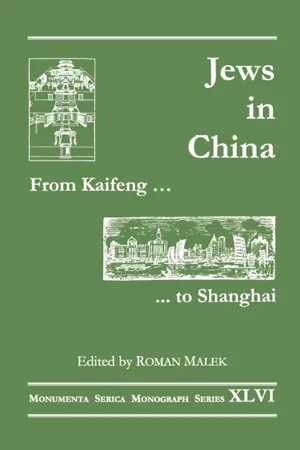
The collection presents the proceedings of the international colloquium held in Sankt Augustin in 1997 and additional materials. The articles are written in English, German or Chinese (with English abstracts). The volume includes a general index with glossary.
… to Shanghai

HISTORY OF THE JEWS IN INNER MONGOLIA, LIAONING, BEIJING, TIANJIN, AND QINGDAO (1911–1949)

Contents
Introduction | ||
I. | Inner Mongolia | |
1. | Hailar | |
2. | Manchouli | |
3. | Jews in Hulun Buir and other places in Inner Mongolia | |
4. | Summary | |
II. | Liaoning | |
1. | Dalian | |
2. | Mukden | |
3. | Summary | |
III. | Beijing | |
IV. | Tianjin | |
1. | Summary | |
V. | Qingdao | |
Summary | ||
English Abstract | ||


History of the Jews in Inner Mongolia, Liaoning, Bering, Tianjin and Qingdao (1911–1949) (Summary)
Introductory remark
The present paper deals with the history of Jews in Inner Mongolia (mainly in Hailar and Manchuli), Liaoning (mainly in Dalian/Port Arthur and Fengtian/Mukden [present-day Shenyang]), Beijing, Tianjin and Qingdao. Beijing was the only one of these seven cities that did not have its own Jewish religious institutions and a Jewish community.
1. Inner Mongolia
Because of the scarcity of historical records very little is known about the modern history of Jews in Inner Mongolia.
The first Jews to come to Inner Mongolia were soldiers of the Russian Tsarist army, followed by Russian Jews working on the construction of the Chinese Eastern Railroad since 1897. The Jewish settlements concentrated in Hailar and Manchuli. Owing to their economic success, the Jews in these cites had established their own places of worship.
In the years of the Republic, the fur trade in the Northeast and the North of China was controlled by Jewish merchants. During this time, there were also European Jews coming to Inner Mongolia for research, e.g., the Hungarian Jew Aurel Stein (1862–1943), who in 1914 made some important discoveries of Tangut archaeological relics at Ejina.
With the outbreak of the October Revolution, the Soviet Union sent revolutionaries to Inner Mongolia. Among them there were a number of Jews, e.g. the diplomat Joffee who came to China in 1922 as an authorized representative, his successor as Soviet ambassador to China Karakhan in 1923 and in the same year Borodin who was sent to China as representative of the Comintern and political advisor to Sun Yatsen.
The fact that a rather high percentage of the Russians who came to Inner Mongolia and to other places in China were Jewish can be explained by the persecutions the Jews had suffered in Russia especially during the Tsarist period. Jews also played a major role in archaeological research in China and especially in Mongolian studies. Quite a few of the western missionaries in Inner Mongolia, especially among the Protestants, were of Jewish origin.
1. Hailar: Jewish places of worship were set up in Hailar and Manchuli in 1910 and 1912, respectively. There are records about elections to a meeting of the Jewish association in the 1930s. Representatives from Hailar took part in the Far Eastern Conference of Jewish Communities held in Harbin in 1937 and 1939. According to a report of the Manchurian railway, there were 130 Jews in Hailar (including Manchuli) in 1940.
2. Manchouli: According to a report of the Secret Service of Manchouli of August 1922, among the foreign businesses in Manchouli there was a tabacco company owned by a Jew of British origin and three other Jewish shops. A report from 1934 of the education ministery of Manchukuo says that there was a Jewish private school run by the Association of Overseas Jews (established in 1926). The school was situated at the railway station of Manchouli: It had four school-days a week, included four grades and counted 80 students and five teachers.
There a reports about Russian Jews having lived in Manchouli who, after returning to the Soviet Union, were suspected of being Japanese spies and therefore sentenced to death.
The flood of Jewish refugees from Europe, beginning from July 1940, crossed the border in Manchouli, making their way to Harbin. A special comittee of the Far Eastern Conference of Jewish Communities in Harbin was dispatched to Manchouli to greet them.
3. Jews in Hulun Buir and other places in Inner Mongolia: From the beginning of this century, there were some Jewish companies in Hulun Buir. At that time Jewish merchants controlled parts of the economy of Hulun Buir, such as the foreign trade and forestry. After Hulun Buir was invaded by the Japanese army, most of the Jews left, but some of the Jewish merchants were compelled to cooperate with the Japanese merchants.
Summary
1. Beginning with the construction of the Chinese Eastern Railroad from Manchuli to Hailar in 1897, Russian Jews settled as traders along this route, Jewish merchants making up for 60% percent of the Russian trade. The route from Manchuli to Hailar was to become a major gateway for Jews to China.
2. At the beginning of this century, the Jewish settlers decided to reside in Manchuli and Hailar permanently. They not only made important contributions to the development of the two cities, but also established Jewish communites, places of worship and Jewish schools.
3. Forming a part of the Russian people, the Jews had rather complicated relations with the White Russians. Although they had strong ties with their Russian homeland, being engaged in free trade they mistrusted socialism. After the October Revolution a majority of them did not adopt the Soviet nationality. Most of them became stateless, some became citizens of Lithunia or Latvia. After the founding of Manchukuo, a Bureau of Affairs for Overseas Russians was established. Like the stateless Russians, the Jews of Russian origin were not allowed to leave Manchukuo. After the defeat of Japan most of these Jews migrated to the south, preparing to leave for Europe, the United States, Australia or Israel. Only if they had no other choice, they returned to the Soviet Union.
4. The Jews residing along the route from Manchuli to Hailar were directed towards the Jewish community in Harbin that held in a central position politically and economically. They did not have any economic or other relations with the regions south of Hulun Buir or even further southwest in Inner Mongolia because of geographical reasons.
2. Liaoning
1. Dalian
The first Jews coming to Dalian/Lushun were Russian soldiers. Among them was Joseph Trumpeldor (1880–1921) who was captivated in the war between Russia and Japan (1904–1905) and who became the first Jewish officer to be decorated by the Tsar for his bravery. The Jewish youth organizations, also in China, were named after this active Zionist.
Later on, most of the Jews settling in Dalian were merchants. They held close economic ties with Jewish companies in Harbin, a number of them actually being branch enterprises of Harbin firms.
According to different records, the Jewish association in Dalian had 58 members in 1929 and 180 in 1940.
Summing up, most of the Jews in Dalian were of Russian origin. Politically, economically and in religious affairs they were subordinated to the Jewish community in Harbin, although they had their own community and places of worship (if no regular synagogue). The history of their community ended with the departure of the Jews before and after liberation.
2. Mukden
The Jews in Mukden were also mostly of Russian origin, their community being smaller than the one in Dalian. The first Far Eastern Conference of Jewish Communities held in Harbin in December 1937 very probably promoted the formation of their community.
I came to Shenyang 1996 to look for the site of the Jewish community. I inquired some elderly inhabitants about the former residences of the White Russians and fortunately I was able to find the site of the Shenyang Jewish community. It is a two-storeyed building, with the Star of David engraved on its outer wall.
Summary
The Jews in Liaoning were mostly of Russian origin and had come to China with the construction of the Chinese Eastern Railroad at the turn of the century. They did not experience any discrimination in Liaoning, in fact, the local population could not tell them apart from other Westerners. In terms of community activities (shetuan huodong) they followed the Harbin Jews. Harbin was a transitory stop for most of the Russian Jews coming to China.
3. Beijing
Contrary to other Chinese cities with Jewish residents like Shanghai, Harbin or Tianjin, Beijing never had a Jewish community (shetuan) nor a synagogue, the reason for this being the lack of a foreign concession and of a wealthy class of merchants that could have financially supported the religious institutions.
A number of European Jews who settled in Beijing had converted to Christianity earlier, e.g., the Protestant missionary Samuel Isaac Joseph Schereschewsky (1831–1906).
Some Jewish scholars taught at Beijing universities during the Anti-Japanese War, e.g. the German-born Rudolf Loewenthal (1904–1996) who also published on the Kaifeng Jews and covered the topic of “The Jewish Press in China” in his The Religious Periodical Press in China (1940).
According to a report of the Manchurian railway from August 1938 the Jews in Beijing numbered 120, ca. 40 of them being French, 30 British, 20 American or stateless and 10 Soviet.
Among the Jews who settled permanently in Beijing after liberation and became Chinese citizens is Sidney Shapiro who published a volume of articles by Chinese scholars on the Kaifeng Jews in an English translation [Jews in Old China. Studies by Chinese Scholars (New York 1984)]. There are also some descendants of Kaifeng Jews living in Beijing, like my colleague Zhao Xiangru, a retired researcher at the Institute of Ethnic Minorities of the Academy of Social Sciences.
4. Tianjin
In the 1860s and 1870s, the first Jews from Russia began to settle in Tian...
Table of contents
- Cover
- Half Title
- Title Page
- Copyright Page
- Table of Contents
- Intercultural encounters: From Kaifeng … to Shanghai. Jews in China. An Introduction
- From Kaifeng …
- … to Shanghai
- Europe, China and “the Jewish Paradox”
- General Index with Glossary
Trusted by 375,005 students
Access to over 1.5 million titles for a fair monthly price.
Study more efficiently using our study tools.
Frequently asked questions
Yes, you can cancel anytime from the Subscription tab in your account settings on the Perlego website. Your subscription will stay active until the end of your current billing period. Learn how to cancel your subscription
No, books cannot be downloaded as external files, such as PDFs, for use outside of Perlego. However, you can download books within the Perlego app for offline reading on mobile or tablet. Learn how to download books offline
Perlego offers two plans: Essential and Complete
- Essential is ideal for learners and professionals who enjoy exploring a wide range of subjects. Access the Essential Library with 800,000+ trusted titles and best-sellers across business, personal growth, and the humanities. Includes unlimited reading time and Standard Read Aloud voice.
- Complete: Perfect for advanced learners and researchers needing full, unrestricted access. Unlock 1.5M+ books across hundreds of subjects, including academic and specialized titles. The Complete Plan also includes advanced features like Premium Read Aloud and Research Assistant.
We are an online textbook subscription service, where you can get access to an entire online library for less than the price of a single book per month. With over 1.5 million books across 990+ topics, we’ve got you covered! Learn about our mission
Look out for the read-aloud symbol on your next book to see if you can listen to it. The read-aloud tool reads text aloud for you, highlighting the text as it is being read. You can pause it, speed it up and slow it down. Learn more about Read Aloud
Yes! You can use the Perlego app on both iOS and Android devices to read anytime, anywhere — even offline. Perfect for commutes or when you’re on the go.
Please note we cannot support devices running on iOS 13 and Android 7 or earlier. Learn more about using the app
Please note we cannot support devices running on iOS 13 and Android 7 or earlier. Learn more about using the app
Yes, you can access From Kaifeng to Shanghai by Roman Malek in PDF and/or ePUB format, as well as other popular books in History & Chinese History. We have over 1.5 million books available in our catalogue for you to explore.