- 180 pages
- English
- ePUB (mobile friendly)
- Available on iOS & Android
eBook - ePub
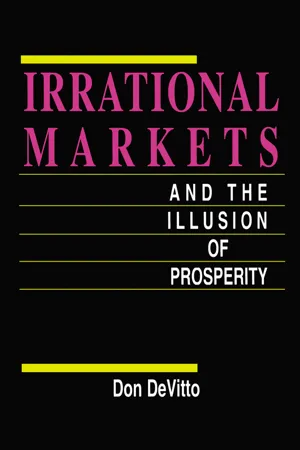
Irrational Markets and the Illusion of Prosperity
About this book
Irrational exuberance - the now-famous utterance of Alan Greenspan, referred to the seemingly unending upward spiral of the stock market. Of course, as every investor knows, the stock market plummeted after this comment was made, only to recover and exceed every known record over the next year. Nothing, it appears, could keep this market down: not inflationary pressures, concerns over the Asian economic crisis, lack of earnings in many companies, nor elevated stock prices. Nothing, it seems, could stop investors in their passion for bidding up prices of stocks, especially technology and telecommunications. But beware: Irrational Markets warns that Americans are living in an economic dreamland, and that the long bull market and low unemployment levels have only masked a disturbing economic reality - in short, we're in for a rude awakening. Based on extensive research, this provocative book is sobering reading for any current or would be investor.
CHAPTER
1
INFLATION AND STOCK PRICES
Americans today have more money at risk in the stock market, in both absolute and relative terms, than ever before. What truly sets this market apart from all other bull markets is the unprecedented level of participation by middle class Americans. The prior great bull markets of this century (the 1920s, 1950s and the 1960s) did attract money from smaller investors via mutual funds, but due to the explosive growth of 40IK retirement plans, middle class Americans have exposed themselves to the benefits, and the risks, of the market as never before. Additionally, the advent of trading over the Internet has for the first time brought Wall Street into the home of the average American. Online trading is growing at a phenomenal pace, attracting hordes of new investors and speculators.
Most Americans make a strong connection between the stock market and the economy. The tremendous bull market of the 1990s seems to affirm the strength of our capitalistic system and validate the tremendous technological achievements of the past decade. Indeed, throughout history the stock market has usually been a relatively accurate barometer of the health of the economy.
Unfortunately, there have also been periods when excessive optimism and speculation caused the stock market to rise far beyond rational levels. When this occurs, the stock market poses a dangerous risk to the real economy. This happened in the U.S. in the late 1920s, contributing to the crash of 1929 and the subsequent depression years of the 1930s. Japan experienced a similar situation in the late 1980s, leading to a market collapse in the nineties, and a severe recession that continues still.
The question we thus must ask is whether today’s stock market is an accurate reflection of a strong economy or an unhealthy symptom of excessive speculation.
My fear is that we are again witnessing a period of dangerous overvaluation in the stock market. Its ramifications reach far beyond Wall Street. The record level of public participation in today’s market has positive and negative implications. It is a wonderful phenomenon when stocks rise, apparently spreading wealth throughout the nation. Inevitably, though, the tide will turn and stocks will recede from these overvalued levels. When this occurs the financial and emotional pain will resound throughout this nation, affecting Americans at all income levels.
The striking parallels between today and the 1920s begin with the trends in inflation and interest rates. There have been only two periods of secular (long-term) decline in interest rates in this century (see figure 1-1). The first period began in earnest in 1921 and ended about 19 years later with the beginning of World War II. The second period began in 1982 and continues today. While most economists and market analysts are happy to point out the positive impact of low inflation upon our economy, they reluctantly discuss the negative ramifications of deflation (falling prices) for our stock market and our economy.
Analysts supporting today’s elevated stock market refer often to the low inflation and interest rate era of the 1950s and 1960s. They conveniently ignore what can happen when disinflation turns into deflation, as it did in the 1930s (see figure 1-2). No doubt this omission is partly due to the fact that bearish analysts tend to have a short leash on Wall Street. After all pessimism is bad for business. No one likes a bearish analyst during a roaring bull market.
Figure 1-1 US Government Bond Yields, 1900–1998

Source: Global Financial Data
Figure 1-2 Three Year Moving Average of Inflation (Consumer Price Index)

Source: Global Financial Data
What’s the connection between interest rates and the stock market? It generally is accepted that two major factors affect stock prices: earnings and interest rates. Clearly, rising earnings tend to support higher stock prices and falling earnings generally depress stock prices. However, interest rates affect the market inversely. As interest rates rise, the market is negatively impacted: First, stocks have more competition for investors’ dollars from bonds as well as other assets. As interest rates on bonds rise, stocks become less attractive to investors, so money flows away from stocks and into bonds. Also higher rates tend to depress sectors of the economy that are dependent on lending rates, such as housing and autos.
Obviously, these are important sectors. As they begin to weaken, earnings may suffer across a wide spectrum of the economy. The opposite effect occurs when rates begin to fall. Hence, stock prices tend to rise when rates are falling and fall when rates are rising. This basic concept lies at the heart of securities (stock) analysis and can be a useful tool in understanding stock price movements.
However, this general relationship between interest rates and stock prices doesn’t always hold true. There have been long periods during this century when interest rates seemed to have little impact on the stock market. For instance, during the 1930s interest rates fell quite dramatically, yet the stock market was unable to overcome the impact of falling earnings. This same scenario played itself out during the 1990s in Japan, where deflation led to a collapse in corporate earnings as well as the market even though interest rates were dropping steadily.
Because deflation is such a rare beast, most analysts don’t even factor it into their forecasts. They assume that earnings will rise eternally, with only very short interruptions brought about by intermittent economic contractions (recessions). These analysts would like us to believe that today’s bull market has much in common with the low-interest-rate era of the 1950s and 1960s—but little in common with the low-interest-rate era of the 1920s. Few, if any, facts support this assumption. Furthermore, this overly optimistic appraisal of today’s market is both shallow and potentially very misleading.
In the years preceding 1920 in the United States there was a significant rise in debt due to the costs of financing World War 1. As is often the case, this rise in debt was accompanied by higher inflation and interest rates. After the war the trend began to reverse itself. It was precisely this reversal that ignited the great bull market of the 1920s. Inflation and interest rates dropped steadily throughout the 1920s and the stock market soared (see figure 1-3).
Figure 1-3 Dow Jones Industrial Average, 1914–1998

Source: Global Financial Data
The years preceding 1982 witnessed a similar sharp rise in debt and inflation. Beginning with the Vietnam War and spurred by the oil embargo of the 1970s, we began to see a sharp rise in inflation and interest rates.
Persistent price hikes led people to take inflation for granted and encouraged them to take on more debt. After all, it makes sense to borrow if you believe your dollar will be worth less in the future and you expect borrowing costs to rise. By 1979 the Federal Reserve Board (the Fed) realized that inflation was ruining the economy. Paul Volcker, head of the Fed, decided that inflation had to be brought under control.
The Fed initiated a severe monetary tightening that drastically raised short-term interest rates. It worked! By late 1982 inflationary expectations began to fall, and with them so did long-term interest rates. Once again, just as we witnessed in 1921, the stock market leapt forward. So began the greatest bull market we have ever seen. And herein lies the crucial difference between today’s bull market and the bull market of the 1950s. Though rates in the 1950s and 1960s remained relatively low by recent standards, they rose throughout the period (see figure 1-1).
The higher stock prices and price/earnings (P/E) ratios of the 1950s were due to greatly increased confidence in earnings growth after the war-plagued 1940s and the depression years of the 1930s. Interest rates played no role in the bull market of the 1950s and 1960s. On the other hand, the fuel for today’s bull market, as in the 1920s, is clearly the dramatic fall in long-term interest rates. Now, as in the twenties, the impetus for falling rates is the constant downward pressure on prices in our economy.
Financial markets and the popular press view this disinflation (prices rising at lower rates) very positively. However, are we in control of this deflationary process? This is the crucial question. Can we stabilize inflation at very low levels and maintain moderate economic growth, creating the nirvana economy that seems to be priced into our stock market today? Or is disinflation simply the inevitable prelude to deflation, bringing with it global economic chaos, as it did in the 1930s?
The economic and financial parallels between today’s economy and that of the 1920s are difficult to ignore (though many are succeeding in doing just that). The stock market, interest rates, and inflation rates are all following a very similar path to that taken in the late 1920s. While many may scoff at this notion, the risks are real. The 1997–1998 economic crisis that moved rapidly from Asia to Russia and Brazil gives us a clear warning that deflation is a disease that can spread very quickly. While the world economy seems to have stabilized for the time being, Japan and China are still fighting deflation. At this point no one knows whether these deflationary pressures can be isolated before they spread to our shores.
The potential for outright deflation exists for the first time in 60 years. To ignore this risk is to invite disaster.
CHAPTER
2
DEFLATION
Until recently, the topic of deflation had received little attention in the financial press. This is not surprising; we haven’t encountered it since the 1930s.
While deflation is typically thought of in purely economic terms, it also has a psychological aspect to it. Webster’s defines deflation as “a decrease in the amount of currency in a country.” No doubt, the monetary aspects of deflation are important. However to view deflation in a strictly monetary sense is insufficient.
In simple terms, deflation is a state of falling prices. This state may arise due to a lack of currency or money, a lack of demand for goods, or an excess of supply. Usually, it’s a combination of all these factors.
What’s critical to understand is that while the central bank of a country can to some extent control the supply of currency, governments have little control over the demand for goods, especially in today’s consumer-driven economies. The implication of this is that once a state of deflation emerges, it can become difficult, if not impossible, for a government to reverse the trend. This is where the psychology of the consumer is so important. If consumers are reluctant to spend, the impact of government policy, whether fiscal or monetary, is muted.
Figure 2-1 U.S. Government Federal Net Outlays

Source: Economagic.com
The U.S. economy of the 1930s and Japan’s economy of the 1990s underscore the critical importance of consumer psychology: In both cases, governments used stimulative monetary and fiscal policies in an attempt to increase the demand for goods. In both cases, they largely failed. In the 1930s, America put its faith in fiscal policy to stimulate the moribund economy (see Figure 2-1). Government spending grew dramatically as a result of President Roosevelt’s New Deal. In spite of this massive effort, the unemployment rate in 1939, nearly 10 years after the onset of the depression, remained stubbornly high at 17 percent. When the depression started long-term interest rates were already quite low (below 4 percent) and they continued to move lower throughout the depression years, bottoming out at about 2 percent in 1939. Short-term rates were actually negative for a time. Such was the dismal state of demand in America. Ultimately it was the beginning of World War II that finally brought America out of depression.
In the 1990s, Japan relied mostly on monetary policy to stimulate its economy. The Japanese Central Bank lowered short-term rates steadily from 1991 through 1996 (see Figure 2-2). From 1989 to 1998 interest rates on longer-term (10-year) government bonds dropped from around 7 percent to well under 1 percent. In late 1998, the rate on six-month Japanese T-Bills dropped to a negative .004 percent, revealing yet another parallel with our experience of the 1930s. This is the first time rates in Japan have ever been negative. Yet, in spite of this huge decline in rates, the Japanese economy remains mired in economic stagnation.
Why wasn’t the Japanese government more aggressive on the fiscal (government spending) side du...
Table of contents
- Cover
- Title Page
- Copyright Page
- Table of Contents
- ACKNOWLEDGMENT
- PREFACE
- CHAPTER 1—INFLATION AND STOCK PRICES
- CHAPTER 2—DEFLATION
- CHAPTER 3—SPECULATION AND MANIAS
- CHAPTER 4—OVERVALUATION
- CHAPTER 5—DEBT AND SAVINGS
- CHAPTER 6—DISTURBING SIGNS
- CHAPTER 7—THE INTERNET
- CHAPTER 8—DEFLATION AND YOUR INVESTMENTS
- CHAPTER 9—BURSTING THE BUBBLE
- CHAPTER 10—CONCLUSION
- APPENDIX—BULL AND BEAR CYCLES OF THE TWENTIETH CENTURY
- INDEX
Trusted by 375,005 students
Access to over 1.5 million titles for a fair monthly price.
Study more efficiently using our study tools.
Frequently asked questions
Yes, you can cancel anytime from the Subscription tab in your account settings on the Perlego website. Your subscription will stay active until the end of your current billing period. Learn how to cancel your subscription
No, books cannot be downloaded as external files, such as PDFs, for use outside of Perlego. However, you can download books within the Perlego app for offline reading on mobile or tablet. Learn how to download books offline
Perlego offers two plans: Essential and Complete
- Essential is ideal for learners and professionals who enjoy exploring a wide range of subjects. Access the Essential Library with 800,000+ trusted titles and best-sellers across business, personal growth, and the humanities. Includes unlimited reading time and Standard Read Aloud voice.
- Complete: Perfect for advanced learners and researchers needing full, unrestricted access. Unlock 1.5M+ books across hundreds of subjects, including academic and specialized titles. The Complete Plan also includes advanced features like Premium Read Aloud and Research Assistant.
We are an online textbook subscription service, where you can get access to an entire online library for less than the price of a single book per month. With over 1.5 million books across 990+ topics, we’ve got you covered! Learn about our mission
Look out for the read-aloud symbol on your next book to see if you can listen to it. The read-aloud tool reads text aloud for you, highlighting the text as it is being read. You can pause it, speed it up and slow it down. Learn more about Read Aloud
Yes! You can use the Perlego app on both iOS and Android devices to read anytime, anywhere — even offline. Perfect for commutes or when you’re on the go.
Please note we cannot support devices running on iOS 13 and Android 7 or earlier. Learn more about using the app
Please note we cannot support devices running on iOS 13 and Android 7 or earlier. Learn more about using the app
Yes, you can access Irrational Markets and the Illusion of Prosperity by Don DeVitto in PDF and/or ePUB format, as well as other popular books in Business & Business General. We have over 1.5 million books available in our catalogue for you to explore.