- 256 pages
- English
- ePUB (mobile friendly)
- Available on iOS & Android
eBook - ePub
War, Peace and Terror in the Middle East
About this book
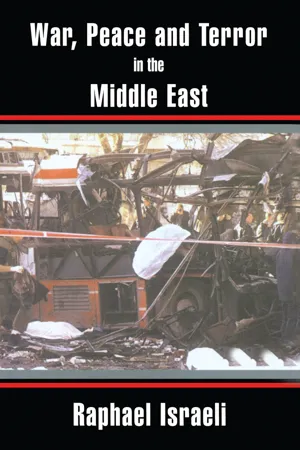
A collection of articles about the fateful issues of war and peace in the Middle East, especially the evasive brands of war - terrorism and incitement.
Horrific words of incitement, followed by atrocious acts of terror, have occurred during the past few years. These have significantly eroded hope in the peace process that had been initiated by Sadat and Begin a quarter-century ago (1977).
All efforts to duplicate that feat between Israel and Palestinians have ended in frustration so far, and it now seems that a tremendous amount of ground-work will have to be done before a new peace venture.
This volume focuses on these themes and brings to bear both the benefit of the hindsight gained since the articles were published, and the insight that the current world crisis, occasioned by the terrorism and broadsides against Western culture that al-Qai'da and its allies have launched.
Information
Part 1
Commitments, Ideologies and Incitement
1. Arafat’s Peace*
When town after town on the West Bank and Gaza passed into Palestinian Authority (PA) hands following the Oslo II Agreement (1995) that was designed to facilitate the transition from Israeli occupation to Palestinian self-rule, Yasser Arafat, president of the PA, began to manifest some surprising traits in his statesmanship. Most notable for someone viewed as a secular leader is his profound Islamic commitment, which harks back to his membership in the Muslim Brethren in Egypt during his formative years. The issue of Islam is of particular interest, due to Arafat’s attempts to juggle between new-found pragmatism as a statesman (who has, to all appearances, chosen the road of political settlement with Israel, at least prior to the resumption of the Intifada in the fall of 2000), and his innate propensity for doctrinal and vindictive rhetoric. Arafat must strike a balance between his proclaimed obligation to compromise – requiring him to set aside some of his long-held Islamic convictions which had helped him mobilize Palestinian public opinion behind him – and his need to placate his most dangerous opposition, namely, Hamas1 and the Islamic Jihad (holy war), which refuse to shed the very same convictions Arafat once held, continuing instead to embrace and profess them openly.
This essay will examine whether Arafat is in fact bound by one particular set of principles (with the other being merely tactical rhetoric), and whether he espouses any particular ideology only when it appears to him at a particular time to best reflect his and his people’s interest. In other words, is there a way to read between the lines of his ambiguous rhetoric and statements to gauge ‘the real Arafat’? Can one predict Palestine Liberation Organization (PLO) and Palestinian policies based on Arafat’s patently unclear messages laced with double meanings?
The Double-Talk of Redemption
True to his personal rhetorical tradition, Arafat pursued his Islamic discourse with eagerly receptive audiences when he oversaw the process of retrieving from Israel the West Bank towns of Jenin, Tulkarem, Qalqilya, Bethlehem and Ramallah in late 1995 and early 1996. In the process another town, Nablus, the hub of Palestinian nationalism in the West Bank, became the focus of an anti-Israeli explosion of sentiment associated with Arafat’s rhetoric of redemption. After all, ‘Nablus oblige’, one might say.
The abandonment by Israel of Palestinian cities to Arafat’s fledgling rule was traumatic to both parties, though it had something equally redemptive about it: it gave vent to all the tensions that had accumulated during 28 years of Israel’s unwelcome domination. It created at the same time an ambiance of uncertainty, borne of the quasi-messianic expectation that Palestinian rule would inaugurate a new era of justice and plenty, coupled with the realization that existing social, political, and economic difficulties might seriously hamper this exciting experiment. One thing was certain: the historical scope and import of these momentous events. To rise to the occasion, Arafat had to cater to the predominant mood of excitement and hope by injecting into his speeches in practically all those cities the same redemptory themes: liberty, independence, Jerusalem as the capital, the continuation of jihad, struggle to victory.
Most of these themes are imbued with Islamic symbols and history. They are shrouded in an aura of myth, especially when Arafat himself posed, or came to be seen, as the Messiah-redeemer or Mahdi who would inaugurate this new era. Indeed, in every case, when traveling to the cities in question, Palestinian crowds awaiting him clamored cries of ecstasy upon seeing his helicopter approaching to land. Loudspeakers announced the coming of the chairman, and urged the masses to ‘swear allegiance’ to the president. In Bethlehem, where Arafat’s inaugural visit coincided with Christmas celebrations, the entire landing ceremony, reviewing of the guard of honor, and world-wide broadcast of Christmas, were all announced over the Voice of Palestine radio and television stations as if they were all part of one great sequence.
Arafat’s oratory in general leaves much to be desired. However, his habit of using repetitious phrases, easily-remembered slogans, a colloquial style of speech and popular imagery do touch deep chords in the souls of his audiences; he succeeds in creating an intimate discourse with them. He always addresses the masses that encounter him in personal terms, such as ‘Brothers’, ‘Sisters’, ‘Beloved members of the family’, ‘Members of my tribe’, etc.2 Once he has introduced himself to his audience, he invariably invokes Jerusalem as a powerful unifying and mobilizing symbol. In every case, he lists each of the towns and villages so far ‘liberated’, and vows to ‘march into Jerusalem’ or to ‘pray in Jerusalem’ at the end of the peace process. He refers to Jerusalem as ‘al-Quds a-Sharif’ (Jerusalem the Noble), or ‘al-Quds al-’arabiyya’ (Arab Jerusalem), the former signifying ‘all of Jerusalem’ in Arab and Arafat’s parlance, the latter designating East Jerusalem (the part of the city claimed by the Palestinians as their capital). Arafat also invokes the sacredness of the land. In Bethlehem, Arafat referred to ‘our blessed land’ that witnessed the birth of ‘our Palestinian Messiah, Blessed be His Memory’. Thus, Arafat connects ‘his’ Palestine to the ‘blessed land’ with its messianic message, and then widens the scope of his Islamic commitment to Palestine to embrace Christianity as well, for the Christian Arabs of Palestine are as Palestinian as its Muslims, since Christ Himself was Palestinian. This ecumenical message, which makes Islam and Christianity (to the exclusion of Judaism) the twin divine revelations of Palestine, legitimizes Arafat as the curator and protector of the Holy Places of both faiths. It turns the PLO and its head into the representative and partner of world Christianity, as well as world Islam in Holy Jerusalem. Thus Arafat tries to portray himself as a better, and more universally accepted, ruler of the city than the Israelis.
Nothing epitomized this new garb donned by Arafat better than the well-publicized and widely reported visit by his wife Suha (a former Christian who converted to Islam as a prerequisite to their marriage) to the Church of Nativity with her newborn daughter, as if to proclaim that his Islam and her Christianity were happily wed together and jointly perpetuated in the persona of little Zahwa. Of course, Arafat would not admit to this union of the two great religions on unequal terms: his wife had to convert, after all, while he did not. Their daughter is Muslim, not Christian, because she was born of a Muslim father. But his beau geste of extending his loving care to Christianity in Palestine immediately attracted the interpretation that he coveted and had probably intended: the Greek-Orthodox Patriarch of Jerusalem declared to a delighted Arafat on that occasion, ‘Here is the successor of Sophronius welcoming the successor of ‘Umar ibn al-Khattab.’ No one present or watching on television could miss the parallel. Reference was made, of course, to the submission of the Byzantine Patriach of Jerusalem, Sophronius, in AD 638 to the second Caliph of Islam, ‘Umar ibn al-Khattab (634–644), who conquered Jerusalem for Islam and put an end to many centuries of Christian rule. Until the Crusaders established in 1099 the Christian kingdom of Jerusalem, the city was to remain, uninterruptedly, part and parcel of Dar al Islam, the universal Pax Islamica. This modern-day declaration of the patriarch was so melodious to Arafat’s ear that he ordered all his media to publish it in their headlines. The public learned of his command only when an ill-advised and independent-minded journalist (the night editor of the daily Al-Quds, Mahir al-’Alami) refused to comply, and soon found himself arrested and interrogated in the dark basements of Jibril Rajub’s security apparatus in Jericho.3 Arafat’s eagerness to widely publicize the patriarch’s sycophancy did not stem from his intention to humiliate the latter, nor only because he was pleased by the flattering comparison with the Great Caliph ‘Umar, but because such a statement confirmed his newly acquired, glamorous image as the new ‘liberator’ of Jerusalem.
Thus, Arafat was placed as the latest link in the chain of great Islamic liberators, which to date includes ‘Umar as well as Saladin, who recaptured Jerusalem in 1187 and put an end to Crusader rule there. If one bears in mind the oft-made comparison in Arab and Islamic circles between the medieval Crusader State and contemporary Israel, one necessarily comes to the conclusion that exactly as ‘Umar had occupied Jerusalem by peaceful means (namely, the surrender of the Christians), and Saladin by force (by the conquest of the city and the eviction or massacre of its inhabitants), so will Arafat now repeat that feat either by accepting the surrender of at least East Jerusalem by the Israelis, or by pressing his call for jihad in order to retrieve all of it. Many Palestinian circles (especially Muslim fundamentalists4) take delight in this parallel and are quick to draw conclusions from it. ‘Umar and Saladin had been accepted as the legitimate rulers of Jerusalem following the oath of allegiance (bay’a) accorded them by the crowds. Now, as the loudspeakers were enjoining the populace to deliver the oath of allegiance to the president, the parallel became neat, complete, and inescapable. History had come full circle.
This outpouring of religiosity and Islamic symbolism by Arafat is consistent not only with his many speeches from Johannesburg to Gaza, in which Jerusalem, jihad and other Islamic symbols have been repeatedly invoked, but also with Palestinian nationalist antecedents where Islam has played a prominent role. Indeed, since the 1920s, the Palestinian national movement has been headed by a religious leader, the Mufti of Jerusalem, Haj Amin al-Husseini (similar to Makarios, Archbishop of the Greek-Orthodox in Cyprus, or Bishop Muzurewa in Rhodesia). As such, it relied upon religious themes to shape the opposition to British rule and to Zionism. Moreover, in the 1930s, Izz a-Din al-Qassam, a Syrian Muslim who settled in Haifa, undertook extensive religious, political and educational activities in northern Palestine that soon lent prominence to his leadership. He then founded a militant group, the Black Hand, as an instrument of armed struggle against both British imperialism and Jewish Zionism. Al-Qassam called openly for jihad against both until the British killed him in battle in 1935.
During the Palestinian Revolt (1936-39), the Muslim Brethren, based in Egypt, established a number of lodges in Palestine that in later years grew into a fully-fledged network of the Brotherhood. The Muslim Brothers’ activities later developed into a two-pronged activism (like al-Qassam’s antecedent): struggle against British occupation and the Zionist menace. The 1948 War between Israel and the Arabs split the Palestinian–Arab population into an Israeli-ruled minority and a Jordanian-governed and Egyptian-governed majority on the West Bank and in Gaza respectively, where the Muslim Brothers continued to swell their ranks in spite of their frequent clashes with the authorities there. The occupation by Israel of the West Bank and Gaza in the 1967 War again brought the entire Palestinian population west of the Jordan River under Israeli rule. Paradoxically, the Muslim movements could thrive under Israeli rule, since it allowed them leeway in their overt activities so long as they did not contravene the law.
Conversely, Israel’s penetration into the social, political and economic realms of life of Palestinians contributed to the destruction of the last vestiges of their old hierarchies and loyalties, and hastened their modernization, much to the outrage (and detriment) of Muslim fundamentalists who sensed that Israel was undermining their traditional Islamic society and turning it away from Islam. The seeds of a renewed open conflict between the fundamentalists and the Israelis were thus sown in the already fertile ground of the anti-Israeli sentiment prepared by the PLO and Palestinian nationalists who had also rejected Israeli rule over them for secular reasons. Hence, the eruption during the Intifada of Hamas, which was galvanized into a zealous Islamic group (by definition) encompassing most Islamic fundamentalist currents of the day. It is worth noting, however, that latter-day fundamentalist groups did not monopolize these elements of Islam. Even mainstream Palestinian nationalism, like most local forms of Arab nationalism, have made use of Islam to characterize enemies, to imply modes of action against them, and to define the nature of the Palestinian community and its struggle, thus linking key religious and secular concepts.5
For example, jihad is linked with the armed struggle of the PLO – the commitment to fight imperialism linked with the fight against Zionism (itself considered to be an extension of imperialism). Both concepts are joined together in a contemporary rendition of the first historical armed entry of the West into the Muslim world since the Crusaders. When the PLO refers to its casualties as shahada (martyrs), and to its guerrillas as fedayeen (self-sacrificers), it implies the redemption (in the Muslim sense of the concept) to be won from dying for one’s homeland.6 Similarly, the modern struggle against Jews, Zionists and Israelis (terms often used interchangeably) harks back to the old Muslim–Jewish enmity during the time of the Prophet. Thus, when Arafat made the pilgr...
Table of contents
- Cover
- Half Title
- Title Page
- Copyright Page
- Dedication
- Table of Contents
- List of Illustrations
- Foreword
- Introduction
- Part 1: Commitments, Ideologies and Incitement
- Part 2: War and Terror in Action
- Part 3: Peace and Its Demise
- Bibliography
- Index
Trusted by 375,005 students
Access to over 1.5 million titles for a fair monthly price.
Study more efficiently using our study tools.
Frequently asked questions
Yes, you can cancel anytime from the Subscription tab in your account settings on the Perlego website. Your subscription will stay active until the end of your current billing period. Learn how to cancel your subscription
No, books cannot be downloaded as external files, such as PDFs, for use outside of Perlego. However, you can download books within the Perlego app for offline reading on mobile or tablet. Learn how to download books offline
Perlego offers two plans: Essential and Complete
- Essential is ideal for learners and professionals who enjoy exploring a wide range of subjects. Access the Essential Library with 800,000+ trusted titles and best-sellers across business, personal growth, and the humanities. Includes unlimited reading time and Standard Read Aloud voice.
- Complete: Perfect for advanced learners and researchers needing full, unrestricted access. Unlock 1.5M+ books across hundreds of subjects, including academic and specialized titles. The Complete Plan also includes advanced features like Premium Read Aloud and Research Assistant.
We are an online textbook subscription service, where you can get access to an entire online library for less than the price of a single book per month. With over 1.5 million books across 990+ topics, we’ve got you covered! Learn about our mission
Look out for the read-aloud symbol on your next book to see if you can listen to it. The read-aloud tool reads text aloud for you, highlighting the text as it is being read. You can pause it, speed it up and slow it down. Learn more about Read Aloud
Yes! You can use the Perlego app on both iOS and Android devices to read anytime, anywhere — even offline. Perfect for commutes or when you’re on the go.
Please note we cannot support devices running on iOS 13 and Android 7 or earlier. Learn more about using the app
Please note we cannot support devices running on iOS 13 and Android 7 or earlier. Learn more about using the app
Yes, you can access War, Peace and Terror in the Middle East by Raphael Israeli in PDF and/or ePUB format, as well as other popular books in Politics & International Relations & Middle Eastern Politics. We have over 1.5 million books available in our catalogue for you to explore.