- 336 pages
- English
- ePUB (mobile friendly)
- Available on iOS & Android
eBook - ePub
About this book
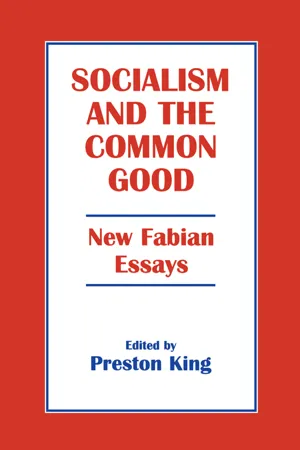
In this collection, contributors discuss a central theme which is both theoretical and practical - the role of the state in achieving social justice in modern market systems from a socialist perspective. They reject the cult of choice and of rational egoism.
Information
Part One:
Principles and Constituencies
1
Socialism and the common good
It is striking how little reaction there has been in social democratic circles and parties to the sudden and, as far as I know, barely predicted, collapse of European communism and the Soviet Union. I am not referring so much to the pathetic failure of the British Labour Party to adjust its ‘defence’ or foreign policy to these momentous changes – it was only too typical of the Labour leadership to embrace nuclear weapons at exactly the historical moment which made them irrelevant – as to the lack of discussion about the meaning and implications of these historic events.
What this reflects, I suspect, is the belief or assumption that social democracy has nothing in common, politically or intellectually, with communism; or at least the determination that it should not appear to have anything in common with communism. The claim that ‘what happens in Eastern Europe’ – even when it is good news – ‘has nothing to do with us’ is one more way of distancing social democracy from communism and Marxism; and that has, of course, been a prime concern of social democrats since 1917, and especially since 1945. Thus the Italian socialist and social democratic parties always cooperated in operating the first rule of post-Fascist Italian politics, which is that the Italian Communist Party (PCI) should never be allowed to form part of a government, despite being for more than 40 years the country’s second largest party. Better a coalition with the Christian Democrats than the Communists, no matter how moderate and constitutional the latter became.
Historically and intellectually, all this is mere pretence and pretension. All forms of socialism, even the most moderate and diluted, owe a debt to Marx and Marxism whether they like it or not.
Historically the split between revolutionaries and reformers represented the partition of a single stream, and it is one which has never in fact been complete or absolute. I would be happy to support these assertions if it was thought necessary; but one need only look at the tone and style of Fabian Essays of 1889 to see how different were relations then between these gradualists and their revolutionary contemporaries such as William Morris, compared with the hostile and dogmatic feuding that developed in the period after 1917.
More important for my purposes is to note the de facto degree of mutual dependence which existed between social democracy and communism. On the one hand social democracy could be perceived as reassuringly moderate – a sensible middle way, avoiding both the excesses of modern capitalism as epitomised in the decay and violence of urban America, as well as the bureaucratised authoritarianism and inefficiency of communist regimes and economies. On the other hand, communism acted as a magnet, pulling the whole spectrum of politics to the Left, and compelling reformist parties in the capitalist world to devise policies which, they hoped, would undermine the appeal of communism by echoing its good points and abjuring its bad ones. It was also the case that the international role of the Soviet Union acted as a usually unacknowledged restraint upon the foreign interventions of the United States – so it was so much easier for the United States to make war on Iraq once it was sure that the Soviet Union would not obstruct such an enterprise. Now this pole of attraction and source of restraint has vanished, leaving the poor world dangerously exposed to American threats and interventions – as in Somalia – and leaving social democracy more isolated and vulnerable than it has been for many decades.
The insecurity of the Left within the capitalist democracies has been compounded by the coincidental revival of militant and merciless capitalism which dominated the 1980s in much of the West, and which has now been taken up with enthusiasm in the ex-communist countries of Eastern Europe, where the very word ‘socialism’ is likely to carry deeply negative overtones for a good many years to come.
None of this is meant to imply that the social and economic and political order which has now disintegrated into rubble was an embodiment of socialism, as it always suited the Right to assert. But it was a tribute to the power of the Cold War ethos that most of the Western Left was afraid to admit that those societies had any socialist virtues at all, or that the Soviet Union played any positive role in international politics. But now these things can be admitted, and are, in some quite surprising quarters;1 and we can see that the collapse of communist authoritarianism, welcome as this was in itself, has not turned out to be an unmixed blessing, nor a prelude to unmixed blessings either.
Intellectually its impact in the Western world has been dreadful. We have been told yet again that ‘Marxism is dead’ by all kinds of people who had never willingly conceded that it was alive. And the corollary of this is the claim that ‘we are all liberals now’, and even that liberal capitalist democracy is the final political and economic goal to which all human history has been leading. The revival of liberal economics from the mid-1970s onwards has now been compounded by the proclaimed victory of capitalism over communism, or liberal democracy over socialist dictatorship. Given all that, given the particularly acute problems of the British Labour Party, which many people have argued, perhaps correctly, for more than a decade, is in long-term decline; given the general tendency of social democracy to forget if not openly renounce its original objectives and drift rightwards towards a would-be comfortable accommodation with capitalism – given all this, is it any wonder that social democrats are no longer clear in their own minds what socialism actually is or means, and are apt, or prefer, to think about it in the terms of established liberalism? It was surely entirely typical of these developments that when Neil Kinnock was asked why there was no mention of socialism in Labour’s 1992 election manifesto, he replied by saying that everything in it was based on our fundamental socialist belief in the liberty of the individual (or words to that effect).
That belief or value is, of course, the central value of liberalism, not socialism; and it would have been perfectly possible for both Ashdown and Major to invoke it as central to their conception of liberalism or conservatism. In other words, it tells us nothing about what is distinctive about socialism, as opposed to what it may have in common with other ideologies. It is true that the ‘New Liberalism’, from T. H. Green onwards, did revise and enlarge the concept of freedom, and indeed the philosophy and agenda of liberalism, in ways which pushed liberalism towards socialism; so that there is, as Roy Hattersley showed in Choose Freedom, a way of thinking about freedom which does then distinguish socialism from traditional, conventional liberalism, which still views state or public action with some suspicion, still tends to think of freedom as ‘the silence of the laws’ or as ‘an area of non-interference’.
But even allowing for all this, a socialism which elevates freedom or liberty to the position of its supreme or central value is conceding too much to liberalism. For, however sophisticated the conception of freedom that is employed, what it implies is that the central political aim is to increase the autonomy of the individual, and that no other goal is as important as, let alone more important than, this. This raises a whole range of questions – about both the desirability and feasibility of ever-growing individual autonomy and, at another level, about the very concept of the individual which, as Iain Hampsher-Monk points out in his essay, is called in question by a variety of ways of thinking about people and society, some at least of which would seem to be much closer to socialist thinking than the liberal individualism which underpins the preoccupation with personal freedom or autonomy.
One of the most obviously debatable assumptions inherent in John Stuart Mill’s attempt to combine liberalism with utilitarianism is the assumption that freedom and happiness, or if not happiness then some kind of profound personal sense of fulfilment, go together, both for the individual and for society as a whole. Freedom is the precondition of progress; but the autonomous person also derives deep satisfaction from the fact that she or he is autonomous, in control of his or her own life. Now these are both empirical propositions in principle – which is not to say that we could ever finally prove them to be clearly true or false, of course. I think we can safely admit that both propositions have a lot of truth in them. But neither is as self-evidently true as Mill seems to have thought. All the relationships we enter into, and especially family relationships, carry with them obligations, commitments, ties, which entail very considerable losses in freedom and autonomy in all kinds of very obvious ways. Why then do we involve ourselves in them if not because we know that such relationships, although they often bring pain and misery, are also the source of the deepest and most durable happiness and personal security? Autonomy, self-direction, freedom make a strong appeal to those, especially perhaps young people and many women, who feel themselves to be trapped or cramped within established institutions, communities or networks which do not allow them the scope to ‘be themselves’. But consider, on the other hand, the plight of both the very young and the very old in the more anonymous urban environments. Consider the old-age pensioner living alone in rented accommodation which has a generally transient population. He or she would probably appreciate a good deal less autonomy and freedom because in this situation they are effectively synonyms for emptiness, social isolation and neglect.
Of course one can construct counter-examples – of the gay man or lesbian who escapes from the censorious intolerance of family and village or small town to the relative freedom of the same big city which is so harshly indifferent to the lonely pensioner. I am not, of course, denying the value of freedom and autonomy. I am saying that they are not in themselves an adequate prescription for personal happiness or even self-realisation, and socialists cannot afford to believe that they are. Socialism cannot afford to lose sight of those other dimensions of the good society to which it was classically committed, and which its founders and creators well understood.
Nor can socialism be built upon the foundations of individualism, whether ontological or ethical. The concept of the individual is neither neutral nor banal. The idea that it is a kind of obvious truth was well expressed by that classic liberal writer, E. M. Forster:
… as for individualism – there seems no way of getting off this, even if one wanted to. The dictator-hero can grind down his citizens till they are all alike but he cannot melt them into a single man … they are obliged to be born separately, and to die separately … The memory of birth and the expectation of death always lurk within the human being, making him separate from his fellows …
But about three hundred years earlier John Donne put quite a different construction upon death. Because it is the one destination to which we all travel, it reminds us of our common fate, not our separateness:
that privat and retirid man, that thought himselfe his owne for ever, and never came forth, must in his dust of the grave bee published and … bee mingled with the dust of every high way …2
I think I am right in saying that the ancient Greeks had no word corresponding to ‘individual’, and that the privacy which is of such importance to modern liberalism did not seem to them to be an important or privileged condition. It was in fact one of deprivation, as Hannah Arendt pointed out, indicated by the word itself. The word ‘idiot’ signified a purely private person, and it was the public sphere which was the area of freedom.3 And we need only turn to the opening pages of Aristotle’s Politics to see that what we think of as essentially a rather too fanciful, if not actually sinister, metaphor – that of the body politic and its members – is for him a perfect image of the relation between the single human person (or man) and the community of polis to which he belongs. You could not be a human being outside society. You would have to be either sub- or super-human, either a beast or a god.
Bentham disliked this metaphor intensely – rightly from his own point of view. ‘The community is a fictitious body, composed of the individual persons who are considered as constituting as it were its members.’ Note the ‘fictitious’ and ‘as it were’. This is not an image that Bentham wishes to endorse in any way. ‘The interest of the community then is, what? – the sum of the interests of the several members who compose it … Individual interests are the only real interests.’ When Mrs Thatcher announced that ‘There is no such thing as society. There are only individuals and their families’, she was, apart from the revealingly inconsistent reference to ‘the family’, closer to Benthamite or liberal atomism (of the methodological individualist kind preached by Hayek, Popper, Berlin and others) than she was to traditional conservatism, as represented by Burke: ‘Individuals pass like shadows, but the commonwealth is fixed and stable.’
Liberal individualism thus does not represent a universal perception of the relations between persons and society, as so many of its advocates fondly imagine or assume. On the contrary, it is, if anything, the historical exception to the general rule which sees men and women as essentially social beings, caught up in the web of relationships and institutions which compose a society, and unavoidably dependent upon social interaction for their very existence as human beings. Socialism and communism, as the very terms suggest, belong to that family of ideologies. And they were in origin an attempt to create a modern, post-industrial vision of community which would not only replace nostalgia for the hierarchial pre-industrial society praised and upheld by Burke and the conservatives, but also provide an alternative to the miserably atomised and conflict-ridden conglomerations which capitalism was producing in place of the old feudal order.
I do not myself see how socialism can convert its basic view of the world into one which embodies or reflects essentially the liberal individualist perspective without ceasing to be socialism. This may not worry practical politicians, but it ought to worry socialist philosophers. And, in fact, it ought to worry the politicians as well, because the gap between philosophical fundamentals and the attraction of public support is not the gulf which they, in their more antiintellectual moods, may suppose it to be.
There is, I think, plenty of evidence, perhaps including the result of the British 1992 election, to suggest that the public do respond to parties which clearly stand for something basic and big. They want a clear image of a party, and that means knowing what values or principles a party stands for. For example, take Crosland’s view that the core of socialism is ‘equality’: socialism is about equality. That may not be an adequte definition of socialism, and it may not be one with which everyone will agree. But it has two virtues. One is that it is simple and easily grasped and remembered. The other is that it is distinctive. No liberal or conservative leader is likely to copy it. Indeed conservatives are more likely to proclaim their perennial belief in inequality. The point of this digression is a simple one: a party needs a clear and distinctive set of values in order to command popular support and allegiance. Philosophy and political effectiveness are not so far apart as might be supposed.
So individualism, and a consequent stress on personal freedom and free choice, do not offer anything distinctive for the Labour Party or the Left, and the temptation to embrace them, just because they became the stock-in-trade of the Right-dominated 1980s, should have been, and ought still to be, firmly resisted. To fight on this terrain is to fight on the enemy’s ground.
I would like to add a word here against the current cult of choice, which is obviously seen and presented as the embodiment of increased personal freedom. This is, at first glance, difficult to do. To deny choice seems to be arrogant and authoritarian. And perhaps in one version of the ideal world, one of abundance and unlimited resources – a world which looks less and less possible for ecological reasons if no others – there could be choice right across the spectrum of human needs and desires. But in practical terms the pursuit of choice is in many areas not only delusory, but actively damaging. Parents ought to have a choice of schools to which to send their children, it is suggested. Fine, if this was a choice between different educational patterns and philosophies offered by equally good, well-funded and well-supported schools. But that is not the way it is, or will be. Choice of schools means choice between markedly better and worse schools within the state system, or between the state system and private schools for those who can afford the latter. Choice then enhances the benefits and advantages already available to the rich and privileged, leaving the...
Table of contents
- Cover
- Half Title
- Title Page
- Copyright Page
- Contents
- List of contributors
- Preface
- Introduction
- PART ONE: PRINCIPLES AND CONSTITUENCIES
- PART TWO: COLLECTIVISM AND MARKETS
- PART THREE: THE POVERTY OF EGOISM
- PART FOUR: THE ENRICHMENT OF IDENTITIES
- Index
Trusted by 375,005 students
Access to over 1.5 million titles for a fair monthly price.
Study more efficiently using our study tools.
Frequently asked questions
Yes, you can cancel anytime from the Subscription tab in your account settings on the Perlego website. Your subscription will stay active until the end of your current billing period. Learn how to cancel your subscription
No, books cannot be downloaded as external files, such as PDFs, for use outside of Perlego. However, you can download books within the Perlego app for offline reading on mobile or tablet. Learn how to download books offline
Perlego offers two plans: Essential and Complete
- Essential is ideal for learners and professionals who enjoy exploring a wide range of subjects. Access the Essential Library with 800,000+ trusted titles and best-sellers across business, personal growth, and the humanities. Includes unlimited reading time and Standard Read Aloud voice.
- Complete: Perfect for advanced learners and researchers needing full, unrestricted access. Unlock 1.5M+ books across hundreds of subjects, including academic and specialized titles. The Complete Plan also includes advanced features like Premium Read Aloud and Research Assistant.
We are an online textbook subscription service, where you can get access to an entire online library for less than the price of a single book per month. With over 1.5 million books across 990+ topics, we’ve got you covered! Learn about our mission
Look out for the read-aloud symbol on your next book to see if you can listen to it. The read-aloud tool reads text aloud for you, highlighting the text as it is being read. You can pause it, speed it up and slow it down. Learn more about Read Aloud
Yes! You can use the Perlego app on both iOS and Android devices to read anytime, anywhere — even offline. Perfect for commutes or when you’re on the go.
Please note we cannot support devices running on iOS 13 and Android 7 or earlier. Learn more about using the app
Please note we cannot support devices running on iOS 13 and Android 7 or earlier. Learn more about using the app
Yes, you can access Socialism and the Common Good by Professor Preston King,Preston King in PDF and/or ePUB format, as well as other popular books in Politics & International Relations & Political Philosophy. We have over 1.5 million books available in our catalogue for you to explore.