- 456 pages
- English
- ePUB (mobile friendly)
- Available on iOS & Android
eBook - ePub
Catalysys and Surface Science
About this book
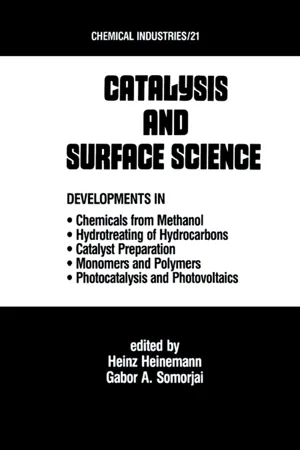
The most comprehensive and up-to-date survey of five industrially important areas ofcatalysis, Catalysis and Surface Science focuses on chemicals from methanol ... hydrotreatingof hydrocarbons . . . catalyst preparation ... monomers and polymers ... andphotocatalysis and photovoltaics.In each of these significant topics, this useful collection of articles traces state-of-the-artdevelopments in fundamental science ... in current exploratory and applied research ...and in current technology. It outlines future trends in catalytic research and technology,and gathers together and synthesizes-into one, single, handy reference-the informationcontained in voluminous, widely scattered articles, books, and patents. As added referencefeatures, this authoritative source provides a wealth of illustrations, including photographs,charts, tables, and line drawings .. . plus useful, detailed bibliographies for further research.Written by 32 leading authorities on all aspects of catalysis, Catalysis and Surface Scienceis essential reading for chemical, industrial process, petrochemical, and electronicengineers, as well as industrial, polymer, and materials chemists. It is also a useful text forgraduate students in chemistry and chemical engineering.
Studies with High Activity Catalysts for Olefin Polymerization
UNIPOL Systems Department Union Carbide Corporation Bound Brook, New Jersey
I. | INTRODUCTION | |
II. | TYPES OF HIGH ACTIVITY CATALYSTS | |
III. | PREPARATIVE METHODS TO HIGH ACTIVITY CATALYSTS | |
A. | Chemical Anchoring to Surface of Substrate | |
B. | Formation of Bimetallic Complexes | |
C. | Insertion into Defects of Substrate | |
D. | Formation of High Surface Area Sponges | |
E. | Formation of Solid Solutions by Cocrystallization | |
IV. | ACTIVE SITE CONCENTRATIONS | |
V. | LIGAND EFFECTS ON CATALYTIC BEHAVIOR | |
VI. | FACTORS IN CONTROL OF MOLECULAR WEIGHT DISTRIBUTION | |
VII. | STEREOREGULARITY AND PROPYLENE POLYMERIZATION CATALYSTS | |
VIII. | CATALYST CHARACTERIZATION STUDIES | |
IX. | EFFECTS OF CATALYST MORPHOLOGY ON POLYMER MORPHOLOGY | |
X. | MECHANISM OF OLEFIN POLYMERIZATION | |
XI. | CATALYSIS AND THE POLYETHYLENE REVOLUTION | |
XII. | CONCLUDING REMARKS REFERENCES | |
I. INTRODUCTION
Catalysis continues to play a vital role in polymerization of such olefins as ethylene and propylene. A voluminous patent and scientific literature describing transition metal catalysts for olefin polymerization has emerged since the original discoveries by Ziegler, Natta, and other workers [1, 2, 3, 4, 5, 6], Significant progress in polymerization catalysis has been made in the last 15 years, particularly with the development of methods to increase the efficiency of transition metal catalysts in olefin polymerization. Success in this area has provided the basis of simplified, less costly plant operations which do not require removal of residual catalyst from the polymer [3, 4, 5, 6, 7, 8, 9].
Although much attention has been directed toward improvements in catalyst productivity, there has been and continues to be much active research on other important features of olefin polymerization. The specific nature of the catalyst has an important effect on polymer molecular weight, polymer molecular weight distribution, copolymerization kinetics, and degree of stereoregularity. Moreover, the size, shape, and porosity (morphology) of the catalyst particle play an important role in regulating the morphology of the resultant polymer [6, 7, 8, 9]. Many modern day industrial catalysts show attractive behavior in most or all of the areas described above.
While significant technological advances based on new and improved catalysts have been made since the original discoveries, there is still a widely held view that understanding of these catalysts is meager and empirical. It is true that olefin catalytic processes are not generally understood in a detailed mechanistic sense. One cannot predict a priori the behavior of a particular catalyst composition or the specific characteristics of the polymer produced by the catalyst. Nevertheless, significant progress has been made through studies with a wide variety of high activity catalysts. Certain general requirements have been identified to be critical in polymerization. This paper reviews segments of current catalyst research activities in olefin polymerization and discusses some current perspectives in these research areas.
II. TYPES OF HIGH ACTIVITY CATALYSTS
Developments toward higher activity (≥200 kg polymer/g Ti versus 1-5 kg polymer/g Ti) Ziegler-Natta catalysts have been based in large part on reactions of specific magnesium, titanium, and aluminum compounds [2, 3, 6, 10]. Some of the early impetus in this area was provided by catalysts, chemically anchored on Mg(OH)Cl supports [11]. Other studies concentrated on the use of MgCl2 as a substrate [12, 13, 14]. Grinding of MgCl2, and treatment with TiCl4, provided one route to a higher surface area substrate of magnesium and titanium. Some developments focused on reaction products of magnesium alkyls and titanium compounds [15]. Other workers described the advantages of preparing trimetallic sponges by the addition of certain aluminum compounds to a magnesium substrate which had been treated with a titanium compound [16]. Catalysts based on reaction of magnesium alkoxides with transition metal compounds have also received attention [17]. Chemical complexes consisting of magnesium and titanium compounds with electron donors also serve to catalyze olefin polymerization [18].
Attractive, high activity catalysts for propylene polymerization have been described. Patents to Montedison/Mitsui discuss catalysts comprising an aluminum alkyl compound with an electron donor such as ethylbenzoate, and a solid matrix containing the reaction products of halogenated magnesium comp...
Table of contents
- Cover
- Half Title
- Title Page
- Copyright Page
- Table of Contents
- Preface
- Contributors
- CHEMICALS FROM METHANOL
- HYDROTREATING OF HYDROCARBONS
- CATALYST PREPARATION
- MONOMERS AND POLYMERS
- PHOTOCATALYSIS AND PHOTOVOLTAICS
- Index
Trusted by 375,005 students
Access to over 1.5 million titles for a fair monthly price.
Study more efficiently using our study tools.
Frequently asked questions
Yes, you can cancel anytime from the Subscription tab in your account settings on the Perlego website. Your subscription will stay active until the end of your current billing period. Learn how to cancel your subscription
No, books cannot be downloaded as external files, such as PDFs, for use outside of Perlego. However, you can download books within the Perlego app for offline reading on mobile or tablet. Learn how to download books offline
Perlego offers two plans: Essential and Complete
- Essential is ideal for learners and professionals who enjoy exploring a wide range of subjects. Access the Essential Library with 800,000+ trusted titles and best-sellers across business, personal growth, and the humanities. Includes unlimited reading time and Standard Read Aloud voice.
- Complete: Perfect for advanced learners and researchers needing full, unrestricted access. Unlock 1.5M+ books across hundreds of subjects, including academic and specialized titles. The Complete Plan also includes advanced features like Premium Read Aloud and Research Assistant.
We are an online textbook subscription service, where you can get access to an entire online library for less than the price of a single book per month. With over 1.5 million books across 990+ topics, we’ve got you covered! Learn about our mission
Look out for the read-aloud symbol on your next book to see if you can listen to it. The read-aloud tool reads text aloud for you, highlighting the text as it is being read. You can pause it, speed it up and slow it down. Learn more about Read Aloud
Yes! You can use the Perlego app on both iOS and Android devices to read anytime, anywhere — even offline. Perfect for commutes or when you’re on the go.
Please note we cannot support devices running on iOS 13 and Android 7 or earlier. Learn more about using the app
Please note we cannot support devices running on iOS 13 and Android 7 or earlier. Learn more about using the app
Yes, you can access Catalysys and Surface Science by Heinz Heinemann,Gabor A. Somorjai in PDF and/or ePUB format, as well as other popular books in Physical Sciences & Chemistry. We have over 1.5 million books available in our catalogue for you to explore.