eBook - ePub
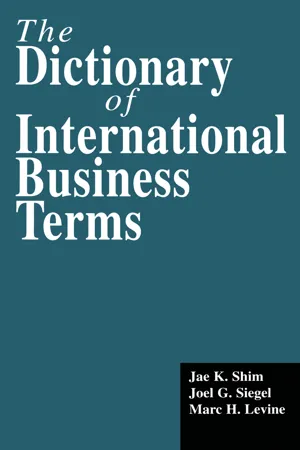
The Dictionary of International Business Terms
- 400 pages
- English
- ePUB (mobile friendly)
- Available on iOS & Android
eBook - ePub
The Dictionary of International Business Terms
About this book
The diversity and complexity associated with the increasing globalization and integration of economies require a familiarity with information technology and terminologies associated with international business. The Dictionary of International Business Terms will be valuable to students and professionals in all areas of business who need to keep abreast of this rapidly changing environment. Over 2,000 terms are defined with examples, charts and illustrations. Additional key areas covered include: global accounting and taxation; exports and imports; global trade, law, and regulations; international organizations; international finance, banking, and investments; economic and business strategies; and management of multinational corporations.
Information
Edition
1Subtopic
Business GeneralA
ABANDONMENT The intentional desertion of property by a owning or leasing entity without making provision for transferring the ownership or use to another. For example, a multinational company may divest itself of a segment of its business by abandonment. The measurement date of such a transaction is the day that the operations of the abandoned segment cease. The abandonment of the property by an owner or leasing entity does not negate any liability or responsibility that the entity may have relating to it. The property generally reverts back to the prior owner.
ABROGATION The abolishment, repeal, or annulment of an agreement or act. Insurance can be taken out to cover damages resulting from a nullifying or breach of a contract between a multinational company and foreign companies or a foreign government. Such coverage may include the expropriation of property overseas.
ABSOLUTE ADVANTAGE Ability to produce a good with fewer resources per unit or at a lower cost than that of a country's trading partners. It contrasts with COMPARATIVE ADVANTAGE in that the exporting country holds an absolute superiority in the availability and cost of certain products.
ABSOLUTE QUOTA A ceiling placed by a government on the number of general or specific imported products from one or more countries for a designated time period. For example, if the quota is 100,000 imported cars from Japan for 19X9, once that level is reached no additional imported cars will be allowed for that year. The objective of this policy might be to protect domestic industries.
ABSORPTION COSTING Under this costing method (also called full costing), all manufacturing costs (variable and fixed) that are incurred in the production process are considered inventory costs of the unit manufactured and become cost of goods sold when the unit is sold. Variable costs are those costs that fluctuate in direct proportion to production volume. They consist of direct materials, direct labor, and variable factory overhead (e.g., factory supplies). Fixed costs, on the other hand, remain constant as production volume changes. They consist of fixed factory overhead (e.g., factory rent). For external financial reporting, absorption costing must be followed for inventory valuation (disclosure) purposes in order to satisfy GENERALLY ACCEPTED ACCOUNTING PRINCIPLES. A special, modified form of absorption costing is allowed for tax purposes. In a variable costing system (direct costing method), only variable costs of the production process are charged to the product as inventory costs. Variable costing is used extensively for internal managerial reporting purposes in such areas as budget preparation, decision making and cost control. However, it is neither acceptable for external financial reports nor tax purposes. See also MANUFACTURING COST.
ABSORPTION OF CHARGES 1. The process of paying or "absorbing" charges that are assessed by others. For example, in shipping terms, a FREE ON BOARD shipping point means that the seller/shipper of goods is not responsible for shipping costs. Rather, the purchaser is responsible for all costs of shipment initiating from the seller's place of business. If a common CARRIER requires that the seller/shipper pay the cost of delivery to the purchaser in advance, then the purchaser must absorb these charges and pay the seller/shipper for them as part of the purchase price of the goods. 2. Payment or absorption by a common CARRIER of related freight costs such as storage costs, wharfage, etc., on a shipment.
ABUSES Economic injuries intentionally perpetrated by one company over another as a result of a trade agreement or arrangement. For example, abuses may occur if a company sells its products with differing contractual stipulations for the purpose of putting one purchasing company at a trading disadvantage to that of another. Other examples include selling goods to countries at unfair, highly inflated selling prices, limiting production for the purpose of artificially inflating prices, limiting competition so that monopolistic conditions exist for purposes of price control, producing at substandard quality, etc. See also PRICE CONTROLS.
ACCELERATED TARIFF ELIMINATION An agreement between two or more countries to hasten the lowering of a TARIFF or tariffs between them. This may include an attempt to eliminate any tariff. The objective is to promote INTERNATIONAL TRADE.
ACCELERATION CLAUSE A contractual or agreed provision that upon the occurrence of a stipulated act or event, the multinational company's vested interest in a property will be earlier. An example is when an obligation owed to the company becomes immediately payable in full because of the debtor's nonpayment of an installment payment or some other violation of the agreement.
ACCEPTANCE 1. A binding contract effected when one party to a business arrangement accepts the offer of the other. Acceptance may be implied or partial, oral or written, depending on the nature of the offer. 2. A drawee's promise to pay either a TIME DRAFT or sight draft. Typically, the acceptor signs his/her name after writing "accepted" on the bill along with the date. An acceptance of a bill in effect makes it a PROMISSORY NOTE; the acceptor is the maker and the drawer is the endorser. See BANKERS ACCEPTANCE.
ACCEPTANCE ADVICE In INTERNATIONAL TRADE, a confirmation between banks that consummation of a transaction has occurred. Typically, in the transference of funds between banks, acceptance advice is sent by the bank that has received funds to the bank that has sent the funds confirming the amount of collection, the account for which the collection was made, miscellaneous fees, charges, etc., relating to the transaction.
ACCEPTANCE FACILITY A credit line received from a financial institution such as a bank to finance a company's export or import of products or services. The bank may require and want to hold documentation of title to the goods such as a warehouse receipt.
ACCEPTANCE FINANCING A means used by exporters in INTERNATIONAL TRADE for the purpose of arranging financing, i.e., EXPORT FINANCING. For example, if an exporter needs short-term capital, the exporter will offer a draft for payment in advance of its specified date of MATURITY. When a bank accepts the draft, the exporter receives the discounted value of the draft (the discount rate may be the current bank rate or may be a rate based on the term of the draft and the risk associated with repayment). By accepting the draft through endorsement, the accepting bank guarantees payment of the draft.
ACCESSION The act of becoming a participant in a multinational agreement or treaty and as a result assenting to, agreeing to, and abiding by the contractual terms upon which the association is based. For example, accession occurs when a nation becomes a member of the GENERAL AGREEMENT ON TARIFFS AND TRADE, EUROPEAN ECONOMIC COMMUNITY, and other such trade agreements. The act of signing such a treaty signifies that a country will adhere to all the terms of the coalition agreement.
ACCESSORIAL SERVICE Additional services besides transportation provided by a carrier (e.g., packing, freezing, heating, assembling, mixing, and storing).
ACCIDENTAL EXPORTS Exports obtained with no effort or deliberate plan of the exporter.
ACCOMMODATING TRANSACTION Exchanges in the form of official reserve assets and foreign official assets used by a nation to correct imbalances in INTERNATIONAL TRADE. For example, if a company has a TRADE DEFICIT in a given period, it may use gold or its official currency reserves as an accommodating transaction to balance any deficiency relating to international cash flows. See also BALANCE OF PAYMENTS.
ACCOUNT In an accounting system, an account is the conventional method of measuring transactional changes in balance sheet and income statement categories affecting an entity's financial statements. Increases and decreases affecting an account are measured by increase or decrease indicators known as debits and credits. The specific account being analyzed will determine whether the increase or decrease will be accounted for with a debit or a credit. In a typical business, entity accounts are divided into assets, liabilities and stockholders' equity classifications.
In INTERNATIONAL TRADE, a summary of a country's credit and debit transactions with other trading countries are measured in an account termed BALANCE OF PAYMENTS. In this area, the two groups that encompass balance of payments transactions are the current account and the capital account See also BALANCE OF PAYMENTS ACCOUNTING.
ACCOUNTANT'S INTERNATIONAL STUDY GROUP (AISG) The AMERICAN ACCOUNTING ASSOCIATION, in an attempt to study the diversity in international accounting theory and practice in 1966 established the AISG for the purpose of publishing comparative studies on accounting issues in the United Kingdom, Canada, and the United States. Towards this end, representatives from the INSTITUTE OF CHARTERED ACCOUNTANTS IN ENGLAND, CANADIAN INSTITUTE OF CHARTERED ACCOUNTANTS, and the AMERICAN INSTITUTE OF CERTIFIED PUBLIC ACCOUNTANTS meet to study issues of comparative international accounting.
ACCOUNTING EXPOSURE Accounting exposure, also called translation exposure, is the impact of an exchange rate change on the multinational firm's financial statements. An example would be the impact of a French Franc devaluation on a United States firm's reported income statement and balance sheet.
ACCOUNTING SYSTEM A system or procedure that processes financial transactions to provide scorekeeping, attention-directing, and decision-making information to management. Accounting is concerned with two kinds of management information: financial information and information generated from the processing of transaction data. The system is responsible for the preparation of financial information and the information obtained from transaction data for the purposes of: (1) internal reporting to managers for use in planning and controlling current and future operations and for nonroutine decision making and (2) external reporting to outside parties such as stockholders, creditors, and government.
ACCOUNTS RECEIVABLE (A/R) MANAGEMENT The technique used by a multinational company to adjust their A/R to reduce foreign exchange risk and optimally to time fund transfers. For example, in countries where currency values are likely to drop, financial managers of the subsidiaries should avoid giving excessive trade credit. If accounts receivable balances are outstanding for an extended time period, interest should be charged to absorb the loss in purchasing power. Note that a net asset position (i.e., assets minus liabilities) is not desirable in a weak or potentially depreciating currency. In this case, you should expedite the disposal of the asset. By the same token, you should lag or delay the collection against a net asset position in a strong currency.
ACHIEVEMENT MOTIVATION The desire of managers or employees to achieve their goals and objectives.
ACROSS THE BOARD A reference to include or encompass all units or members of a group, class, or association. In INTERNATIONAL TRADE, a reference is sometimes made to "across the board tariff reductions...
Table of contents
- Cover
- Title
- Copyright
- Dedication
- Contents
- ACKNOWLEDGMENTS
- ABOUT THE AUTHORS
- HOW TO USE THIS BOOK
- DEFINITIONS
- APPENDIX A EXPORT PERIODICALS
- APPENDIX B OTHER INFORMATION SOURCES
- APPENDIX C STATISTICAL INFORMATION
- APPENDIX D INTERNET ON INTERNATIONAL BUSINESS AND TRADE
- APPENDIX E MONETARY UNITS
- APPENDIX F SOURCES FOR ASSISTANCE IN CONDUCTING BUSINESS
Trusted by 375,005 students
Access to over 1.5 million titles for a fair monthly price.
Study more efficiently using our study tools.
Frequently asked questions
Yes, you can cancel anytime from the Subscription tab in your account settings on the Perlego website. Your subscription will stay active until the end of your current billing period. Learn how to cancel your subscription
No, books cannot be downloaded as external files, such as PDFs, for use outside of Perlego. However, you can download books within the Perlego app for offline reading on mobile or tablet. Learn how to download books offline
We are an online textbook subscription service, where you can get access to an entire online library for less than the price of a single book per month. With over 1.5 million books across 990+ topics, we’ve got you covered! Learn about our mission
Look out for the read-aloud symbol on your next book to see if you can listen to it. The read-aloud tool reads text aloud for you, highlighting the text as it is being read. You can pause it, speed it up and slow it down. Learn more about Read Aloud
Yes! You can use the Perlego app on both iOS and Android devices to read anytime, anywhere — even offline. Perfect for commutes or when you’re on the go.
Please note we cannot support devices running on iOS 13 and Android 7 or earlier. Learn more about using the app
Please note we cannot support devices running on iOS 13 and Android 7 or earlier. Learn more about using the app
Yes, you can access The Dictionary of International Business Terms by Jae K. Shim,Joel G. Siegel,Marc H. Levine in PDF and/or ePUB format. We have over 1.5 million books available in our catalogue for you to explore.