- 254 pages
- English
- ePUB (mobile friendly)
- Available on iOS & Android
eBook - ePub
A Dictionary of Biology
About this book
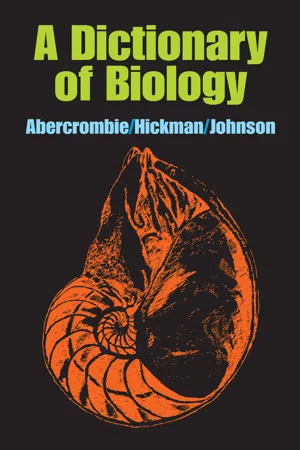
"A Dictionary of Biology" is an up-to-date reference work explains several thousand specialized words that allow for empirical approaches to the biological sciences. It includes more than bare definitions, including information about most of the things named so as to convey their significance in biological discussion. M. Abercrombie, C. J. Hickman, and M. L. Johnson in effect interpret this language as it is actually used, emphasizing customary usage rather than etymology.This comprehensive lexicon includes two thousand entries. Many unfamiliar terms, especially the rarer ones, are defined with the help of other technical terms, perhaps equally unfamiliar. This trick of dictionary-makers could only be avoided by giving a complete account of a large part of biology under each heading. Every biological technical term used in a definition is itself defined elsewhere in the dictionary; though some semi-technical terms, words that can be found in any English dictionary are omitted.The authors use codes throughout the dictionary to help the reader to interpret the use of a word such as whether it is used in relation to plants and animals only, whether the word is an adjective, and when a term is defined elsewhere and adds information to the current definition. The result is an invaluable guide for the layman, the student, and the scholar alike. It presents clear and authoritative explanations of the terms and will remain useful as a quick and concise source of reference.
Information
P
px. Parental generation, consisting of the parents from which a breeding experiment starts; all the males being uniform as regards the allelomorphs under observation, and all the females likewise.
PACEMAKER. Region of vertebrate heart where contraction at each beat is started: the sinus venosus (a contractile chamber of heart); or Its homologue in mammals and birds the sino-auricular node (a small group of muscle and nerve cells in auricle wall). A wave of electro-negativity spreads at each beat from pacemaker first to auricle (s) then to ventricle (s), activiating them to contract in turn. If pacemaker removed, rest of heart beats, but at slower rate. Heart muscle has therefore intrinsic power of rhythmical contraction, normally masked by more rapid pacemaker stimulation.
PAEDOGENESIS. Reproduction In larval or other pre-adult form. See JVeoteny.
PAIRING (OF CHROMOSOMES (SYNAPSIS). Side by side association of homologous chromosomes at meiosls (q.v.). See Fig. 6B, p. 148.
PALAEOBOTANY. Study of fossil plants.
PALAEOGENE. Geological period (q.v.), subdivision of Tertiary, not universally used, equivalent to early Eocene.
PALAEOLITHIC. Phase of human history during which, though tools were manufactured, food was obtained solely by hunting, fishing, or collecting, with no cultivation. Lasted from at least half a million years ago up to beginning of Neolithic stage (q.v.) about 10,000 years ago.
PALAEONTOLOGY. Study of fossils.
PALAEOZOIC. Geological era lasting approximately from 600 till 225 million years ago. See Geological Periods.
PALATE. Roof of vertebrate mouth. In mammals and crocodiles roof of mouth is not homologous with that of other vertebrates; a new (false) palate has developed beneath original palate, by bony shelves projecting inwards from bones of upper jaw. The nasal cavity is thus extended and its internal opening (choana, q.v.) placed right back in the throat. In mammals the bony part of the false palate or hard palate is continued backwards by a fold of mucous membrane and connective tissue, the soft palate.
PALEA (SUPERIOR PALEA, PALE). Glume-like bract of grass spike-let on axis of individual flower which, with lemma, it encloses.
PALISADE. See Mesophyll.
PALPS. Of polychaete annelid worms, tactile appendages on the head; of bivalve molluscs, ciliated flaps of tissue around mouth concerned in production of feeding currents; of Crustacea, distal parts of appendages which carry mandibles, may be locomotor, or may help in feeding; of insects, parts of first and second maxillae, shown to be olfactory in some insects.
PALYNOLOGY. Pollen analysis (q.v.).
PANCREAS. Sweetbread. Gland of gnathostome vertebrate situated in mesentery near duodenum, into which it discharges through pancreatic duct an alkaline mixture of digestive enzymes (trypsino-gen, lipase, amylase, maltase, etc.). Stimulated to secrete this mixture by hormone secretin (q.v.). Also contains groups of cells (islets of Langerhans) of quite different function, secreting into blood a hormone, insulin (q.v.). Components of the pancreas probably occur in cyclostomes, but not united into a definite organ.
PANCREATIN. Extract of pancreas containing digestive enzymes.
PANICLE. Kind of inflorescence (q.v.).
PANTOTHENIC ACID. Vitamin of B group, forming a co-enzyme; required by a variety of organisms, e.g. some yeasts, some bacteria, insects, vertebrates.
PAPAIN. Intracellular proteolytic enzyme (or mixture of enzymes), found in a plant (paw-paw), which splits proteins in neutral solution.
PAPILLA. A projection. Dermal papillae, projections of dermis into epidermis of vertebrates, increasing surface of contact between the two tissues. Tongue papillae, variety of projections on upper surface of mammalian tongue, on which lie taste-buds, and which may be cornified to form a rasping surface, e.g. in cat.
PAPPUS. Ring of fine, sometimes feathery hairs, developed from calyx crowning the fruits of flowering plants of family Compositae, e.g. dandelion; acting as a parachute and aiding in wind dispersal of fruits.
PARABIOTIC TWINS. Artificial ’siamese twins’ produced by surgically joining two animals, so that their blood circulations become continuous.
PARAFFIN SECTIONS. Sections of tissues cut by microtome (q.v.) after embedding in paraffin wax. Usual method of preparing tissues for microscopical study.
PARAMECIUM. Genus of ciliate Protozoa. ’Slipper-animalcule.'
PARAMORPH. Any taxonomic variant within a species; used particularly when, because of lack of data, its status cannot be defined more precisely.
PARAPHYSIS. (Bot.). Sterile filament, numbers of which occur in Mosses and in certain Algae, interspersed amongst the sex organs; and in the hymenium of ascomycete and basidiomycete Fungi.
PARAPODIUM. Paired, segmentally arranged, muscular lateral projection of body of polychaete worms, bearing chaetae and sometimes other structures; locomotor in free-living forms.
PARASEXUAL CYCLE. Novel and flexible breeding system recently demonstrated in certain fungi (including both those with normal sexual reproduction and those with only asexual reproduction) that involves genetic recombination outside the sexual cycle. System comprises the following steps: (i) rare (i in io8 to io7) fusion of two, genetically unlike nuclei in a heterokaryotic mycelium to produce a diploid heterozygous nucleus which (2) multiplies by mitosis during which crossing over occasionally occurs followed, again at rare intervals (1 in io3) by (3) formation of haploid nuclei from the diploids (haploidization) in which whole chromosomes reassort at random producing new genetic combinations. Starting from a culture containing a mixture of genetically different haploid nuclei the result of the parasexual cycle is a much more varied mixture of nuclei consisting of haploids like the originals, haploid recombinants, homozygous and heterozygous diploids. Little is yet known of natural significance of the parasexual cycle but it has already been shown to determine variation in pathogenicity in certain plant pathogens.
PARASITE. Organism living in or on another organism (its host) from which it obtains food. Facultative p., an organism which can live entirely as a saprophyte (q.v.) but can live as a parasite under certain conditions. Obligate p., an organism which can live only parasitically. Parasites may or may not be harmful to the host. Cf. Symbiosis, Saprophyte.
PARASYMPATHETIC SYSTEM. Part of autonomic nervous system (q.v.).
PARATHYROID. Endocrine gland of tetrapod vertebrates, usually paired, lying near or, in some species, within thyroid. Developed from gill pouches. Its hormone (a protein) controls distribution of calcium and phosphate in the body. Administration of hormone transfers calcium from bones to blood; deficiency lowers blood calcium, producing tetany.
PARATONIC. (Of plant movements), induced by external stimuli, e.g. nastic movements, taxes and tropisms (q.v.). Alternatively described as induced or aitiogenic. Cf. Autonomic.
PARAZOA. Grade of organization exemplified only by Porifera (q.v.), which are multicellular animals separately evolved from all others (Metazoa, q.v.).
PARENCHYMA. (Bot.). Tissue consisting of living, thin-walled cells, often almost as broad as long, and permeated by a system of intercellular spaces containing air. Cortex and pith are typically composed of parenchyma. (Zool.). Loose tissue consisting of irregularly-shaped vacuolated cells, forming a large part of body of Platyhelminthes. (2) The specific tissue of an organ, as opposed to the blood-vessels, connective tissue, etc.
PARIETAL, (I) Of coelomic lining (peritoneum or pleura), that covering inside of body-wall, as opposed to visceral part covering organs within coelom. (2) P. bones, pair of membrane-bones which in most vertebrates covers large part of upper surface of brain, behind frontal bones. (3) P. organ, see Pineal apparatus. (4) (Bot.). See Placentation.
PARTHENOCARPY. Formation of fruit without fertilization. In most plants development of a fruit from the ovary can proceed only after fertilization has occurred, but in a number of plants fruit development regularly takes place from unfertilized flowers. Such fruits, e.g. banana, pineapple, are seedless but otherwise normal in appearance. Parthenocarpy can also be induced in unfertilized flowers, e.g. in tomato, by application of certain hormones (q.v.). It has been suggested that fertilization provides a stimulus for production of hormone which, in turn, induces development of fruit tissue, and that where natural parthenocarpy occurs, sufficient hormone to enable fruit development to proceed is produced by the plant independently of stimulus of fertilization.
PARTHENOGENESIS. Development of ovum without fertilization (q.v.) into a new individual. In many animals it may be induced artificially. See Artificial Parthenogenesis. In some plants (dandelion), and animals (aphids, rotifers, where males may be absent), is of normal occurrence. Ova which develop in this way are usually diploid, in which case all offspring are genetically identical with the parent. Frequently in such animals ordinary sexual reproduction, providing genetic recombination, together with employment for males, occurs from time to time (heterogamy, q.v.). See Apomixis.
PASSAGE CELLS. Cells of endodermis, characteristically of older monocotyledonous roots, opposite protoxylem groups of stele, that remain unthickened, with casparian strips (q.v.) only, after thick ening (involving deposition of suberin, cellulose, and lignification) of all other endodermis cells; allowing transfer of material between cortex and vascular cylinder.
PASSERINE. A member of the Passeriformes, a group of birds. A perching bird, with large first toe directed back, other three toes forward. The group includes about half the known species of bird, including most of our common inland ones.
PATELLA. Knee-cap. A bone (sesamoid bone, q.v.) over the front of the knee joint in tendon of (extensor) muscles which straighten the hind-leg, present in most mammals, some birds and reptiles.
PATHOGEN. Parasite which causes disease.
PATHOLOGY. Study of disease or of diseased tissues.
PEAT. Accumulated dead plant material that has remained incompletely decomposed owing, principally, to lack of oxygen, as in moorland and fen where land is more or less completely waterlogged ; often forming a layer many feet deep.
PECTIG COMPOUNDS. Acid polysaccharide carbohydrates present in cell walls of unlignified tissue; comprising pectic acid and pectates, pectose (protopectin), pectin. Form gels under certain conditions. Principal constituents are galacluronic acid, galactose, arabinose, and methyl alcohol.
PECTORAL FIN. See Fin.
PECTORAL GIRDLE. Shoulder girdle (q.v.).
PEDICEL. Stalk of an individual flower of...
Table of contents
- Cover Page
- Title Page
- Copyright Page
- Using the Dictionary
- Authors’ Note
- A
- B
- C
- D
- E
- F
- G
- H
- I
- J
- K
- L
- M
- N
- O
- P
- Q
- R
- S
- T
- U
- V
- W
- X
- Y
- Z
Trusted by 375,005 students
Access to over 1.5 million titles for a fair monthly price.
Study more efficiently using our study tools.
Frequently asked questions
Yes, you can cancel anytime from the Subscription tab in your account settings on the Perlego website. Your subscription will stay active until the end of your current billing period. Learn how to cancel your subscription
No, books cannot be downloaded as external files, such as PDFs, for use outside of Perlego. However, you can download books within the Perlego app for offline reading on mobile or tablet. Learn how to download books offline
Perlego offers two plans: Essential and Complete
- Essential is ideal for learners and professionals who enjoy exploring a wide range of subjects. Access the Essential Library with 800,000+ trusted titles and best-sellers across business, personal growth, and the humanities. Includes unlimited reading time and Standard Read Aloud voice.
- Complete: Perfect for advanced learners and researchers needing full, unrestricted access. Unlock 1.5M+ books across hundreds of subjects, including academic and specialized titles. The Complete Plan also includes advanced features like Premium Read Aloud and Research Assistant.
We are an online textbook subscription service, where you can get access to an entire online library for less than the price of a single book per month. With over 1.5 million books across 990+ topics, we’ve got you covered! Learn about our mission
Look out for the read-aloud symbol on your next book to see if you can listen to it. The read-aloud tool reads text aloud for you, highlighting the text as it is being read. You can pause it, speed it up and slow it down. Learn more about Read Aloud
Yes! You can use the Perlego app on both iOS and Android devices to read anytime, anywhere — even offline. Perfect for commutes or when you’re on the go.
Please note we cannot support devices running on iOS 13 and Android 7 or earlier. Learn more about using the app
Please note we cannot support devices running on iOS 13 and Android 7 or earlier. Learn more about using the app
Yes, you can access A Dictionary of Biology by M. Abercrombie,C.J. Hickman,M.L Johnson in PDF and/or ePUB format, as well as other popular books in Social Sciences & Biology. We have over 1.5 million books available in our catalogue for you to explore.